

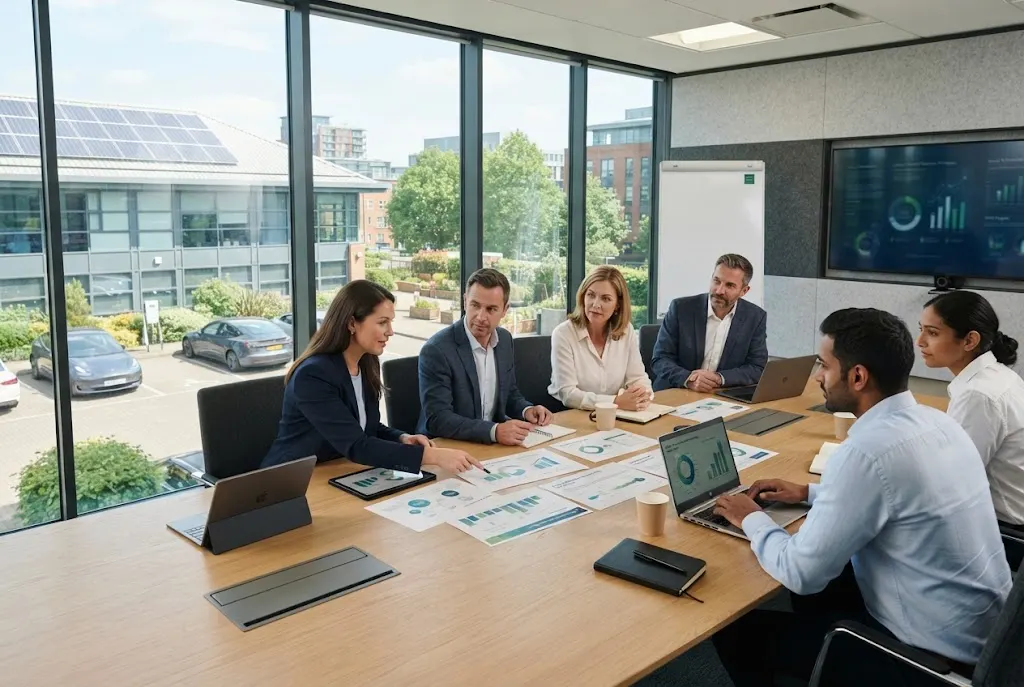
Net zero consultancy helps UK organisations understand their greenhouse gas emissions, identify practical carbon reduction opportunities and develop credible plans for reducing their environmental impact. A net zero consultant can support businesses with emissions measurement, carbon management, reduction strategies, climate planning and the implementation of longer-term environmental goals.
Reaching net zero is not simply a matter of purchasing offsets or announcing a target. Organisations need to understand where emissions come from, determine which reductions are achievable and establish a structured approach for measuring progress. Specialist advice can make that process more systematic and easier to integrate with wider business planning.
What Is Net Zero Consultancy?
Net zero consultancy is professional advisory support that helps organisations develop and implement strategies for reducing greenhouse gas emissions towards a net zero objective.
The exact scope depends on the organisation. A small business may need help establishing an emissions baseline and identifying straightforward energy-saving opportunities, while a large company may require a comprehensive carbon management programme covering buildings, transport, procurement, supply chains and long-term investment decisions.
A net zero consultancy can therefore provide anything from a focused carbon assessment to ongoing strategic and implementation support.
What Does a Net Zero Consultant Do?
A net zero consultant helps an organisation understand its emissions profile and determine how those emissions can be reduced. The work usually combines data analysis, environmental knowledge, strategic planning and practical recommendations.
Depending on the project, a net zero consultant may help with:
- Establishing greenhouse gas emissions baselines.
- Identifying significant emissions sources.
- Developing carbon reduction strategies.
- Assessing energy consumption and efficiency opportunities.
- Supporting renewable energy planning.
- Reviewing transport-related emissions.
- Considering supply-chain and purchased-goods emissions.
- Developing climate and net zero action plans.
- Establishing emissions reduction targets and milestones.
- Monitoring progress against environmental objectives.
Consultants can also help organisations communicate their plans more clearly by distinguishing between completed reductions, planned actions and longer-term ambitions.
Why Businesses Use Net Zero Consultants
Many organisations recognise the importance of reducing emissions but are unsure where to begin. Carbon accounting can involve information from multiple departments, facilities and suppliers, making the initial assessment more complicated than it may appear.
Net zero consultants can provide specialist knowledge and an independent perspective. They can help organisations prioritise the sources of emissions that matter most rather than concentrating only on the easiest changes to implement.
Businesses may seek specialist support when they want to:
- Understand their current carbon footprint.
- Develop a net zero strategy.
- Reduce energy consumption.
- Identify carbon reduction projects.
- Improve environmental performance.
- Understand supply-chain emissions.
- Prepare for climate-related business risks.
- Establish practical environmental targets.
- Track and communicate progress.
External support can be particularly useful when a business does not have dedicated internal carbon or sustainability expertise.
Carbon Consulting and Net Zero Planning
Carbon consulting is closely connected with net zero planning. Before an organisation can develop a meaningful reduction strategy, it needs a reasonable understanding of its greenhouse gas emissions.
Carbon consultants can help identify emissions sources and organise available data. Depending on the organisation, these sources may include purchased electricity, heating, company vehicles, business travel, waste, purchased goods, services and other parts of the value chain.
Once the baseline is established, the organisation can investigate where reductions may be possible. The most effective measures will differ according to the sector, buildings, operations, supply chain and available technology.
Our sustainability consulting firms guide explains how broader sustainability strategies can connect carbon reduction with wider environmental and business objectives.
Understanding Carbon Management
Carbon management is the ongoing process of measuring, reducing and monitoring greenhouse gas emissions. It is an important foundation for organisations working towards net zero.
Effective carbon management generally involves several connected activities:
Measure
The organisation establishes an emissions baseline using relevant and reliable data. This creates a starting point against which future performance can be assessed.
Identify Priorities
Not every emissions source has the same significance. Organisations can examine their data to identify the areas where reduction measures could make the greatest difference.
Reduce
The organisation implements practical measures to reduce emissions. Depending on the business, these could involve energy efficiency, building improvements, renewable energy, transport changes, procurement decisions or operational changes.
Monitor
Progress needs to be reviewed regularly. Monitoring helps organisations determine whether planned measures are producing the expected results and whether additional action is needed.
This cycle makes carbon management an ongoing business process rather than a one-time calculation.
Net Zero Consultancy and Scope 1, 2 and 3 Emissions
Understanding different categories of greenhouse gas emissions is important when developing a net zero strategy.
Scope 1 emissions generally relate to direct emissions from sources that an organisation owns or controls, such as fuel combustion in company-owned equipment.
Scope 2 emissions are associated with purchased energy, particularly electricity, heating or cooling purchased for an organisation’s operations.
The Scope 3 emissions cover other indirect emissions throughout an organisation’s value chain. These can include areas such as purchased goods and services, business travel, employee commuting, waste and other upstream or downstream activities, depending on the organisation.
Scope 3 can be particularly challenging because businesses may have less direct control over these emissions and may depend on suppliers or other external parties for data.
A net zero consultant can help organisations understand which emissions categories are relevant and determine how available information can be incorporated into their carbon management approach.
Carbon Reduction Consultants and Practical Action
Carbon reduction consultants can help organisations move from measurement to implementation. The objective should be to identify practical measures that reduce emissions while considering operational requirements and financial realities.
Potential areas for action can include:
- Improving building energy efficiency.
- Reducing unnecessary energy consumption.
- Switching to lower-carbon energy sources.
- Improving heating and cooling efficiency.
- Reducing business travel where practical.
- Supporting lower-emission transport options.
- Reducing waste and improving resource efficiency.
- Working with suppliers on emissions reduction.
- Considering lower-carbon materials and products.
- Improving environmental data collection.
The appropriate measures depend on the organisation. A manufacturing business may have very different opportunities from an office-based professional services company, so recommendations should be based on actual operations rather than a generic list.
How Net Zero Consultants Develop a Strategy
A net zero strategy should provide a practical route from the organisation’s current position towards its intended emissions reduction goals.
1. Establish the Baseline
The process normally begins by understanding current emissions and identifying important data gaps. This establishes the foundation for future planning.
2. Identify Major Emissions Sources
Consultants can analyse the baseline to determine which activities contribute most significantly to the organisation’s footprint.
3. Develop Reduction Opportunities
The next stage is to identify practical projects and operational changes. Options can then be assessed according to environmental impact, feasibility, cost and timescale.
4. Create a Roadmap
A roadmap can organise actions into short-, medium- and longer-term priorities. Clear ownership and milestones make implementation easier to manage.
5. Track Performance
Regular measurement allows the organisation to see whether emissions are moving in the desired direction. It also helps identify areas where the strategy needs to be adjusted.
Net Zero Consultancy for Small Businesses
Small and medium-sized businesses can also benefit from net zero consultancy, although they may require a simpler approach than a large corporation.
A smaller company might begin by measuring its operational emissions, reviewing energy consumption and identifying straightforward reduction measures. As the organisation develops its environmental programme, it can expand into areas such as supply-chain emissions, sustainable procurement and climate resilience.
The important point is to establish a realistic starting position. A manageable strategy that is implemented consistently can be more useful than an ambitious programme that lacks the resources to move beyond planning.
Net Zero Consultancy for Property and Development
Buildings and development projects can create significant opportunities for carbon reduction. Decisions made during planning and design can influence energy consumption, materials, transport, landscaping and long-term operational performance.
Net zero specialists may therefore work alongside environmental consultants, architects, engineers, planners and other professionals.
Environmental considerations can be equally important. For example, a development may need to consider biodiversity, trees, water management and ecological impacts alongside its carbon objectives. Our guide to environmental consultancy explains how environmental specialists can support development projects through assessment, planning and risk management.
Net Zero Consultant vs Carbon Consultant
The terms net zero consultant and carbon consultant are closely related, but they can describe different areas of focus.
A carbon consultant may concentrate primarily on measuring emissions, carbon accounting and identifying reduction opportunities. A net zero consultant may take a broader strategic view, helping an organisation connect carbon reduction with long-term climate targets, operational planning and implementation.
There is substantial overlap between the roles, and individual consultants may provide both services. When choosing a professional, businesses should therefore focus on the actual scope of expertise rather than relying solely on the job title.
How to Choose a Net Zero Consultancy
Choosing a net zero consultancy should start with a clear understanding of what the organisation needs. Some businesses require an emissions baseline, while others already understand their footprint and need help developing or implementing a reduction roadmap.
Before appointing a consultancy, consider:
- Does the consultancy have relevant sector experience?
- Can it support the emissions measurement process?
- Does it understand Scope 1, Scope 2 and relevant Scope 3 emissions?
- Can it help develop practical reduction measures?
- Does it provide implementation support?
- How does it approach data quality?
- Can it coordinate with sustainability and environmental specialists?
- How will progress be measured and reported?
It is also worth asking for examples of similar projects. A consultancy that understands the operational realities of a particular industry can often provide more useful recommendations.
Net Zero and Environmental Consultancy Working Together
Net zero planning should not always be separated from wider environmental management. Carbon is one important environmental issue, but organisations can also affect biodiversity, water, habitats, land, resources and local environments.
Bringing these perspectives together can help businesses avoid solving one environmental problem while unintentionally creating another. For example, a sustainability project may need to consider biodiversity or land-use implications alongside carbon reduction.
This is why multidisciplinary environmental and sustainability expertise can be valuable for complex projects.
Challenges of Reaching Net Zero
One challenge is the availability and quality of emissions data. Organisations with multiple locations, suppliers or operating systems may find it difficult to gather consistent information.
Another challenge is balancing emissions reductions with operational requirements. Some reduction measures require investment, infrastructure changes or supplier cooperation and therefore cannot be implemented immediately.
Supply-chain emissions can create an additional challenge because businesses may have limited control over suppliers. Collaboration, better data and procurement strategies can help address these issues over time.
Finally, organisations need to avoid treating net zero as a short-term campaign. Meaningful emissions reduction usually requires ongoing measurement, investment, operational change and management attention.
Net Zero Consultancy and Climate Resilience
Reducing emissions and preparing for climate impacts are related but distinct activities. A business can work to reduce its greenhouse gas emissions while also assessing how changing climate conditions could affect buildings, supply chains, infrastructure and operations.
A comprehensive climate strategy may therefore consider both mitigation and resilience. Depending on the organisation, this could involve assessing physical climate risks, reviewing business continuity plans and considering how assets and operations can adapt over time.
Why Long-Term Monitoring Matters
A net zero strategy is only useful if progress can be evaluated. Regular monitoring helps businesses determine whether reduction projects are delivering the expected outcomes.
Monitoring can also reveal changing priorities. Energy prices, technology, business operations, supply chains and environmental expectations can all evolve. An organisation’s net zero roadmap should therefore be capable of being reviewed and updated.
Consultants can support this process by helping organisations establish appropriate indicators, reporting processes and review cycles.
The Future of Net Zero Consulting in the UK
Net zero consulting is becoming increasingly connected with broader business strategy. Climate considerations can influence property investment, procurement, infrastructure, energy decisions, supply-chain management and operational planning.
As organisations develop more sophisticated environmental programmes, the role of consultants is likely to extend beyond calculating emissions. Businesses increasingly need practical support to prioritise investments, manage environmental data, coordinate departments and integrate climate action into everyday decision-making.
This makes multidisciplinary expertise particularly valuable where carbon reduction intersects with sustainability, environmental planning, biodiversity and wider business resilience.
Conclusion
Net zero consultancy can help UK organisations understand their emissions, identify practical carbon reduction opportunities and develop structured strategies for long-term climate action. The process can include carbon measurement, carbon management, energy efficiency, supply-chain considerations, reduction planning and ongoing performance monitoring.
The right consultant should understand the organisation’s sector, operational realities and environmental priorities. Businesses should also look for practical advice that moves beyond target-setting and supports measurable implementation.
Whether an organisation is beginning its carbon journey or refining an established climate strategy, specialist net zero support can provide a clearer framework for turning environmental ambitions into practical action.
