

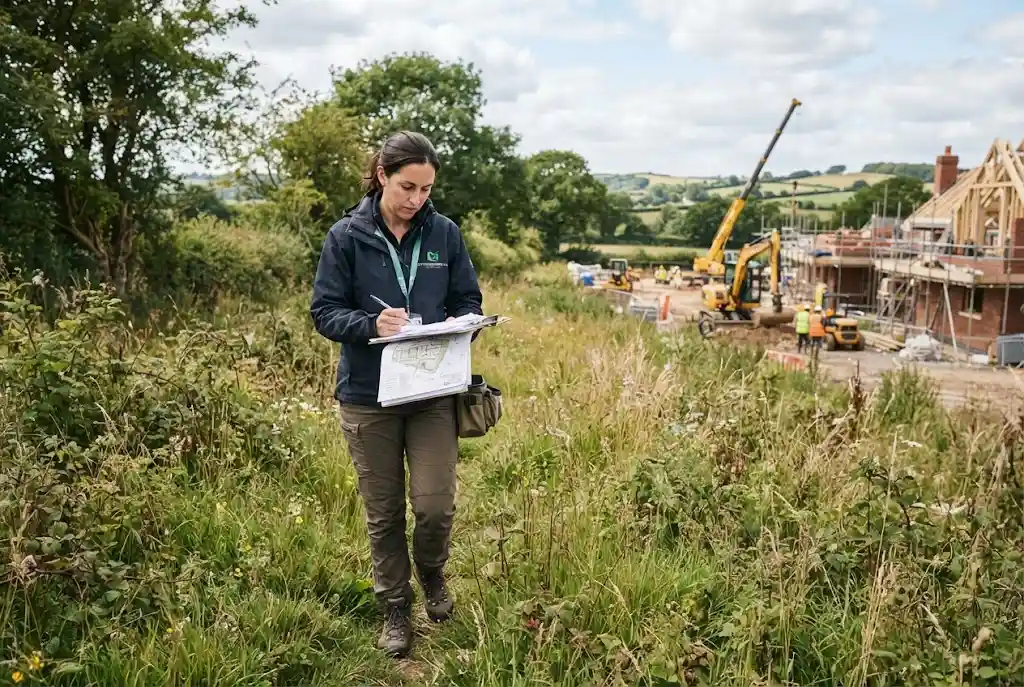
An environmental consultant helps organisations understand environmental risks, meet relevant requirements and make informed decisions about land, development and business activities. In the UK, the role can involve ecology, environmental assessments, pollution, biodiversity, sustainability, planning and environmental management, depending on the consultant’s specialist area.
Environmental consultants work across a wide range of projects. They may advise a property developer before planning a new scheme, assess environmental conditions on a construction site, support infrastructure projects or help organisations improve their environmental performance. Because the profession covers several disciplines, there is no single route or job description that applies to every environmental consultant.
What Does an Environmental Consultant Do?
An environmental consultant provides specialist advice about the relationship between human activity and the natural environment. Their work typically involves gathering information, assessing environmental risks, interpreting regulations and technical guidance, and recommending practical measures to manage potential impacts.
The responsibilities of an environmental consultant can vary considerably. One professional may specialise in ecology and biodiversity, while another may focus on contaminated land, environmental impact assessments, water, sustainability or environmental management systems.
Typical responsibilities can include:
- Conducting or coordinating environmental surveys and assessments.
- Reviewing proposed developments for environmental constraints.
- Preparing technical reports and supporting documentation.
- Advising clients on environmental risks and mitigation.
- Supporting planning and development projects.
- Monitoring environmental conditions and compliance.
- Working with planners, engineers, ecologists and other specialists.
- Communicating technical findings to clients and project teams.
The role can combine office-based analysis with fieldwork. A consultant might spend part of a week reviewing documents and preparing reports, then visit a site to inspect environmental conditions or collect information.
Where Do Environmental Consultants Work?
Environmental consultants can work for specialist environmental consultancy firms, multidisciplinary professional services companies, engineering organisations, construction businesses, local authorities and other employers with environmental responsibilities.
Environmental consultancy firms may provide several technical disciplines under one organisation. This can be useful for large projects because environmental specialists can collaborate with planning, engineering and other professional teams.
Some consultants also develop expertise in a specific environmental niche. For example, a professional may concentrate on ecological surveys, contaminated land, arboriculture, carbon management or environmental permitting.
For organisations looking to understand the wider consultancy sector, our guide to environmental consultancy explains the services environmental professionals can provide and why early environmental advice can be valuable for UK projects.
Key Areas of Environmental Consulting
Environmental consulting is a broad field. Understanding the main specialisms can help businesses and aspiring professionals identify the type of expertise they need.
Ecology and Biodiversity
Ecological consultants assess habitats, species and ecological features that may be affected by development or land management. Their work can involve surveys, ecological reports, mitigation recommendations and biodiversity planning.
Biodiversity has become an increasingly important consideration in development, particularly where projects need to demonstrate how environmental impacts will be avoided, mitigated or compensated.
Environmental Impact Assessment
Some environmental consultants contribute to Environmental Impact Assessments, or EIAs. These assessments examine potential environmental effects associated with certain development proposals.
Depending on the project, an assessment can consider topics such as biodiversity, landscape, water, air quality, soil, climate and human health. Consultants may contribute specialist assessments and help coordinate information across different disciplines.
Our article on environmental impact assessment provides further information about how this process can support informed planning and environmental decision-making.
Contaminated Land
Land that has previously been used for industrial, commercial or waste-related activities may require environmental investigation before redevelopment. Consultants specialising in contaminated land can help assess potential risks and determine whether further investigation or remediation is appropriate.
This area can be particularly important for regeneration projects where previously developed land is being brought back into productive use.
Water and Flood Risk
Environmental consultants may also contribute to projects involving water resources, drainage and flood risk. Development can alter surface water movement and affect nearby watercourses, so environmental considerations may need to be incorporated into site design.
Consultants can work with engineers and other professionals to assess environmental risks and develop suitable mitigation or management approaches.
Carbon and Climate
Climate-related consulting is another growing area within the wider environmental profession. Organisations may seek specialist support to understand greenhouse gas emissions, identify reduction opportunities and develop longer-term environmental strategies.
This work overlaps with the specialist field of net zero consultancy, which focuses more specifically on carbon reduction, emissions management and progress towards net zero goals.
Environmental Consultant vs Environmental Advisor
The terms environmental consultant and environmental advisor can sometimes describe similar work, but they are not always used in exactly the same way.
An environmental consultant often works externally with multiple clients and projects. Their role may involve providing independent specialist advice, producing technical reports and supporting specific development or business requirements.
An environmental advisor, by contrast, may work directly within an organisation and provide ongoing environmental guidance as part of an internal team. For example, a construction company may employ an environmental advisor to help project teams manage environmental responsibilities across multiple sites.
There is considerable overlap between the two roles. Job titles can also vary between employers, so the actual responsibilities are usually more important than the title itself.
Skills Needed to Become an Environmental Consultant
Environmental consulting combines technical knowledge with communication, organisation and problem-solving skills. Consultants need to understand environmental information while also explaining their findings clearly to people who may not have a technical background.
Useful skills include:
- Environmental science and technical knowledge.
- Research and analytical ability.
- Report writing.
- Data interpretation.
- Project management.
- Problem-solving.
- Clear written and verbal communication.
- Attention to detail.
- Understanding of relevant planning and environmental requirements.
- Ability to work effectively with multidisciplinary teams.
Field-based roles may also require practical survey skills and a willingness to work outdoors in different weather conditions. Office-based positions can place greater emphasis on technical reporting, data analysis, project coordination and client communication.
How to Become an Environmental Consultant in the UK
Many environmental professionals begin with a relevant university degree. Subjects can include environmental science, ecology, geography, geology, environmental management and related disciplines.
However, there is no single academic background for every environmental consulting career. The appropriate qualification depends heavily on the specialism a person wants to pursue.
After university, graduates may enter an entry-level or graduate environmental consultant position. Early career work can provide exposure to site assessments, data collection, report preparation and client projects.
Professional development can then involve additional technical training, specialist qualifications and professional membership where appropriate. Experience is particularly valuable because environmental consultancy often requires professionals to apply theoretical knowledge to complex real-world situations.
What Is a Graduate Environmental Consultant?
A graduate environmental consultant is typically an early-career professional who supports more experienced consultants while developing practical and technical expertise.
Graduate responsibilities can include assisting with field surveys, collecting data, researching environmental requirements, analysing information and contributing to technical reports. The exact balance between fieldwork and office work depends on the employer and specialism.
Graduate roles can provide an important foundation because environmental consulting involves practical judgement as well as academic knowledge. Working alongside experienced professionals can help graduates understand how environmental findings influence planning, design and project decisions.
Environmental Consultant Jobs in the UK
Environmental consultant jobs are available across a range of specialisms and experience levels. Entry-level vacancies may be advertised as graduate, assistant or junior environmental positions, while experienced professionals can move into consultant, senior consultant, principal consultant or management roles.
When searching for environmental consultancy jobs, it is worth looking beyond the exact phrase “environmental consultant”. Employers may use titles such as environmental advisor, environmental scientist, ecological consultant, environmental manager or sustainability consultant depending on the role.
Job descriptions should therefore be assessed carefully. Two vacancies with similar titles can have very different responsibilities, travel requirements, technical expectations and opportunities for progression.
Environmental Consultant Salary and Pay
Environmental consultant salary levels in the UK vary according to experience, specialism, location, employer and responsibility. Graduate and entry-level positions generally have different pay expectations from senior consultancy or management roles.
Specialist technical knowledge and professional experience can influence earning potential as a consultant progresses. Location can also affect salaries, particularly when comparing major cities with other parts of the UK.
Anyone researching environmental consultant pay should therefore compare current vacancies and employer information rather than relying on a single salary figure. Job advertisements can provide a useful indication of what particular employers are offering for specific levels of experience.
Environmental Consultant Wage: What Influences Earnings?
The environmental consultant wage offered by an employer can depend on several factors. Experience is one of the most obvious, but it is not the only consideration.
Specialist expertise can influence remuneration because certain technical areas require additional knowledge, qualifications or experience. Senior professionals may also take responsibility for client relationships, project budgets, technical quality and junior staff.
Geographical location is another consideration. Roles in London and other major commercial centres may have different salary structures from positions elsewhere in the UK.
When comparing opportunities, candidates should consider the complete package rather than salary alone. Benefits, professional development, training, flexible working, travel expectations and progression opportunities can all affect the overall value of a role.
Environmental Consultancy Jobs and Career Progression
Environmental consultancy can offer several potential career paths. A graduate may begin by supporting surveys and technical projects, then progress into a consultant role with greater responsibility.
With experience, professionals can specialise further or move towards project management and leadership. Some may develop into technical specialists, while others focus on business development, client management or environmental strategy.
Career progression is not necessarily linear. Experience gained in consultancy can also be relevant to environmental management, sustainability, planning, construction, infrastructure and other sectors.
When Should a Business Hire an Environmental Consultant?
Businesses and developers should consider environmental advice when environmental constraints could affect a project, planning application or operational activity.
Professional input can be particularly useful when:
- A development may affect habitats, species or biodiversity.
- The site has a history of potentially contaminating activities.
- An environmental assessment may be required.
- Flooding, drainage or water resources could affect the project.
- Trees or other environmental features may constrain development.
- The organisation needs help managing environmental risks.
- A project involves complex planning or regulatory considerations.
- The business wants to reduce environmental impacts or improve sustainability.
Early advice can be especially valuable because environmental constraints may influence site layouts, construction methods, project schedules and planning strategies.
How to Choose the Right Environmental Consultant
Choosing an environmental consultant should begin with the project’s specific requirements. Rather than selecting a provider based only on location or price, identify the environmental issues that need to be addressed and look for relevant experience.
Ask prospective consultants about their experience with similar projects, technical specialisms, professional qualifications and approach to reporting. It is also useful to establish whether they can coordinate with other specialists involved in the project.
For a complex development, an effective consultant should be able to explain technical findings in practical terms and show how recommendations could affect the wider project.
The Growing Role of Environmental Consultants
Environmental consultants are increasingly involved in decisions that go beyond basic environmental compliance. Biodiversity, climate resilience, carbon reduction and sustainable land use are becoming more closely connected with planning and business strategy.
This creates opportunities for professionals who can combine technical environmental knowledge with commercial awareness and practical problem-solving.
At the same time, environmental consulting remains highly specialised. Strong consultants understand the limits of their expertise and bring in appropriate specialists when a project requires knowledge outside their core discipline.
Conclusion
An environmental consultant provides specialist advice that can help organisations understand environmental risks, meet project requirements and make better decisions about development and land use. The profession covers many disciplines, including ecology, biodiversity, environmental assessment, contaminated land, water, carbon and environmental management.
For people considering the profession, graduate positions can provide a route into the sector, while experienced consultants can develop specialist or management careers. For businesses and developers, selecting the right consultant means matching technical expertise to the specific environmental challenges of the project.
As environmental considerations continue to influence UK planning, development and business strategy, skilled environmental professionals will remain an important part of responsible project decision-making.
