

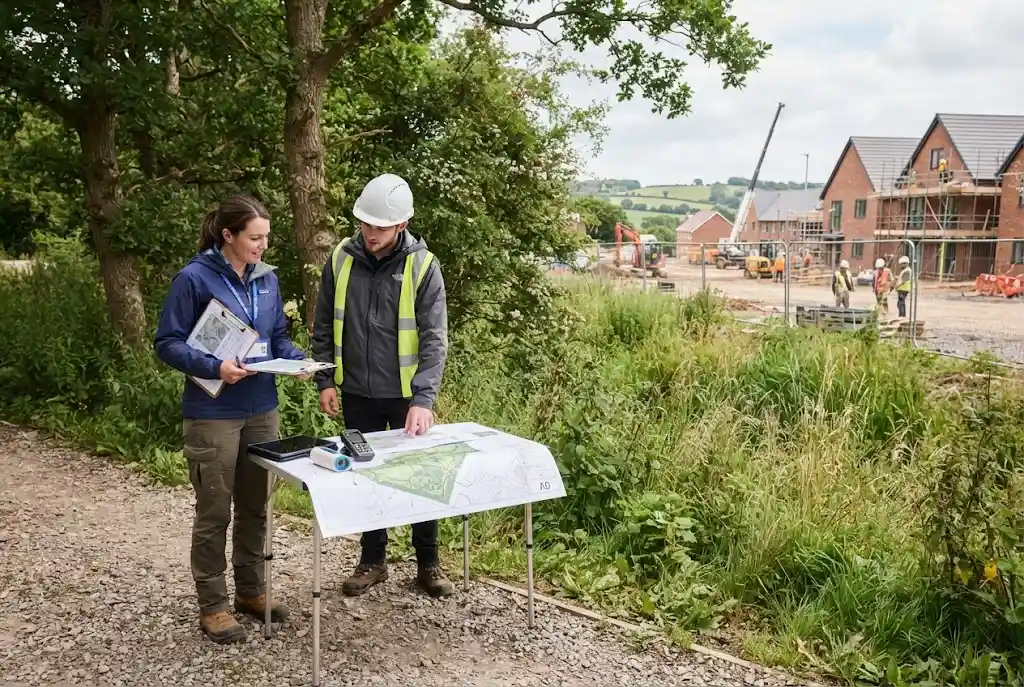
Environmental consultancy helps businesses, developers, landowners and organisations understand environmental risks, meet planning requirements and make more responsible decisions about land and development. From environmental impact assessments and ecological considerations to biodiversity, trees, drainage and sustainability planning, professional advice can help projects progress while reducing unnecessary harm to the natural environment.
In the UK, environmental issues are increasingly important during planning and development. A project may need to consider protected habitats, biodiversity, flood risk, contamination, trees, water, pollution or other environmental constraints before work can begin. Bringing specialist advice into the process early can make it easier to identify these issues and build practical solutions into the project.
What Is Environmental Consultancy?
Environmental consultancy is the professional process of assessing environmental conditions, identifying potential risks and providing practical recommendations for projects, organisations and landowners. An environmental consultant may work across several disciplines depending on the nature, size and location of a project.
The work can range from a focused site assessment to broader environmental planning and project support. For example, a development proposal may require an assessment of ecological conditions, drainage, biodiversity, trees or potential contamination before planning decisions can be made.
The exact scope of an environmental consultancy project therefore depends on the site and the proposed activity. A residential development, infrastructure scheme, commercial site and land restoration project can all have very different environmental requirements.
What Do Environmental Consultancy Services Include?
Environmental consultancy services can cover a wide range of technical and planning-related activities. The objective is not simply to identify problems but to help clients understand them and determine suitable ways to manage environmental impacts.
Environmental Impact Assessments
Environmental Impact Assessments, commonly known as EIAs, examine the potential environmental effects of certain proposed developments before important decisions are made. Depending on the project, an assessment may consider biodiversity, habitats, water, air quality, soil, landscape, noise and other environmental factors.
Environmental consultants can help coordinate assessments, interpret findings and develop mitigation measures where potential impacts are identified. This can be particularly valuable for larger or environmentally sensitive projects.
For a deeper look at this subject, see our guide on environmental impact assessments, which explains how assessments can help protect natural habitats during development.
Ecology and Biodiversity
Development can affect habitats and species in ways that are not always obvious from an initial site inspection. Environmental professionals can help identify ecological constraints and determine whether further surveys or specialist assessments may be appropriate.
Depending on the site, this can involve consideration of woodland, wetlands, grassland, hedgerows, watercourses, nesting habitats and other ecological features.
Biodiversity is also becoming an increasingly important part of development planning. In England, biodiversity net gain requirements mean many developments subject to the relevant planning rules need to demonstrate a measurable improvement in biodiversity. Professional environmental advice can help developers understand what information and planning considerations may be relevant to their proposals.
Tree and Green Infrastructure Advice
Trees are an important part of the environmental character of many development sites. Mature trees can provide habitat, shade, landscape value and wider ecosystem benefits, while construction activity can create risks through excavation, soil compaction, root disturbance and changes to drainage.
Environmental consultants may therefore work alongside arboricultural professionals when a project contains significant trees or woodland. This combined approach can help ensure environmental and tree-related considerations are incorporated into the development process from an early stage.
Our article on environmental consulting services also explores how environmental planning can work alongside arboricultural expertise during land development.
Flood Risk and Water Management
Changes to land use can influence surface water runoff, drainage and groundwater conditions. Increasing areas of hard surfacing, for example, can alter how rainfall moves across a site.
Environmental consultants may contribute to assessments covering drainage, water management and flood-related risks. Depending on the project, recommendations can include sustainable drainage approaches, permeable surfaces, rain gardens, green infrastructure and other measures designed to manage water more effectively.
Considering these issues before construction begins can help reduce the likelihood of expensive design changes later in the project.
Contaminated Land and Ground Conditions
Some sites have a history of industrial, commercial or other land uses that may create environmental concerns. Former industrial land, waste sites, mining areas and other locations can require investigation before redevelopment.
Environmental specialists can help identify potential contamination risks, arrange appropriate investigations and advise on remediation where necessary. Ground conditions can also be relevant to planning decisions because the proposed use of land needs to be appropriate for the site’s environmental characteristics.
Why Environmental Consultancy Matters for UK Development
Environmental considerations can influence the feasibility, design and timing of a development project. Identifying constraints early gives developers and project teams more opportunity to respond before plans become difficult or expensive to change.
UK Government guidance advises developers to seek environmental advice early in the planning process. Early assessment can help identify environmental risks, improve the quality of supporting information and highlight opportunities for environmental enhancement.
For example, an environmental review might reveal the need for additional ecological surveys, flood risk information, habitat protection measures or changes to a proposed site layout. Addressing these matters during the design stage can be more efficient than discovering them after plans have already progressed.
How an Environment Consultant Can Support a Project
An environment consultant can act as a specialist adviser throughout different stages of a project. Their role may begin with an initial site review and continue through surveys, assessments, planning submissions, mitigation design and environmental monitoring.
A typical consultancy process may involve:
- Reviewing the proposed development and site conditions.
- Identifying potential environmental constraints.
- Determining which surveys or assessments may be required.
- Collecting and interpreting environmental information.
- Advising on design changes and mitigation measures.
- Supporting planning and regulatory documentation.
- Helping project teams implement environmental management measures.
- Reviewing environmental performance where ongoing monitoring is required.
The exact process varies from project to project. A small land development may need a relatively focused assessment, while a major infrastructure project can involve multiple technical disciplines and extensive environmental documentation.
Choosing Between Environmental Consultancy Firms
There are many environmental consultancy firms operating across the UK, from specialist practices to multidisciplinary organisations. The right choice depends on the type of project and the environmental expertise required.
Before appointing a consultancy, it is useful to establish what services the firm provides and whether its experience matches the site’s requirements. A consultant experienced in ecological surveys may not provide the same depth of expertise in contaminated land, carbon management or major infrastructure assessment.
Consider asking potential environmental consultants about:
- Their experience with projects similar to yours.
- The environmental disciplines they cover.
- The qualifications and professional experience of the project team.
- The surveys and assessments they can coordinate.
- Their approach to planning and regulatory requirements.
- How they communicate findings and recommendations.
- Whether they can support the project beyond the initial assessment.
For complex developments, it can also be helpful to establish how the environmental team will coordinate with planners, architects, engineers, ecologists, arborists and other specialists.
Environmental Consultancy London and Other UK Locations
Demand for environmental consultancy London services can be particularly relevant to urban development, regeneration and infrastructure projects. Dense built environments can create a combination of environmental considerations involving trees, biodiversity, drainage, air quality, green infrastructure and climate resilience.
However, environmental consulting is not limited to London. Environmental consultants UK-wide support projects in cities, towns, rural areas and coastal locations, with the appropriate scope of work depending on local environmental conditions and planning requirements.
If you are searching for environmental consultants near me, proximity can be useful, but it should not be the only factor. Technical expertise, relevant project experience and the ability to address the specific environmental issues affecting your site are usually more important than simply choosing the nearest provider.
Environmental Consultancy and Sustainability
Environmental consultancy and sustainability consulting often overlap, but they are not identical. Environmental consultancy commonly focuses on environmental conditions, risks, impacts, planning requirements and mitigation. Sustainability work can take a broader organisational or strategic view, including resource use, carbon reduction and long-term environmental performance.
For businesses and developers, these areas can complement each other. A project may first need environmental assessments and planning advice, followed by a broader sustainability strategy that addresses resource efficiency, biodiversity, climate resilience and carbon reduction.
This connection is particularly important as organisations increasingly consider how environmental decisions made today can affect long-term operational resilience.
Environmental Consultants and Biodiversity Protection
Biodiversity should be considered as part of the wider environmental picture rather than treated as an isolated planning issue. Habitats, trees, waterways and green spaces can interact to form connected ecological systems.
Good environmental planning therefore looks at how development may affect the wider site and surrounding environment. Measures such as habitat retention, native planting, green corridors and appropriate landscape design can contribute to better ecological outcomes when they are suitable for the site.
Our guide to urban biodiversity conservation explores why protecting biodiversity is particularly important as towns and cities continue to develop.
When Should You Hire an Environmental Consultant?
It is generally sensible to consider environmental advice before a project reaches an advanced design or planning stage. Early involvement gives consultants more opportunity to identify constraints and recommend solutions while changes are still practical.
You may benefit from specialist advice when:
- You are planning a new development.
- A site contains mature trees, woodland or potential wildlife habitats.
- The proposed project could affect water, drainage or flood risk.
- The land has a potentially contaminated or industrial history.
- An environmental assessment may be required.
- You need ecological or biodiversity information for planning.
- You are redeveloping previously used land.
- You want to improve the environmental performance of a development.
Not every project will require the same level of consultancy. A preliminary review can help establish which environmental issues are genuinely relevant and where specialist input is needed.
What Makes Effective Environmental Consulting?
Good environmental consulting should be practical as well as technically sound. A report that identifies environmental risks is useful, but the real value comes from helping the client understand what those findings mean for the project.
Effective consultants should communicate clearly, explain significant constraints, distinguish major risks from minor considerations and provide realistic recommendations. They should also understand how environmental requirements interact with planning, construction, design and project timelines.
Environmental work is strongest when it becomes part of the project strategy rather than an afterthought added shortly before a planning submission.
The Future of Environmental Consultancy in the UK
Environmental consultancy is likely to remain an important part of UK development and land management as environmental expectations become more integrated into planning and business decisions.
Climate resilience, biodiversity protection, green infrastructure, sustainable drainage and responsible land use are all influencing the way projects are designed. At the same time, digital mapping, remote sensing, monitoring technologies and improved environmental data are giving consultants more tools to understand sites and assess potential impacts.
The role of environmental professionals is therefore expanding beyond simple compliance. Increasingly, the focus is on helping projects make informed decisions that balance development needs with environmental protection and long-term resilience.
Conclusion
Environmental consultancy provides valuable specialist support for UK businesses, developers, landowners and organisations dealing with environmental risks and planning requirements. From environmental impact assessments and biodiversity to trees, drainage, contaminated land and sustainability, the right advice can help projects identify problems early and develop practical solutions.
Choosing an experienced environmental consultant should be based on the specific needs of the project rather than location alone. When environmental expertise is brought into the process early, it can support better planning, stronger environmental outcomes and more resilient development.
