

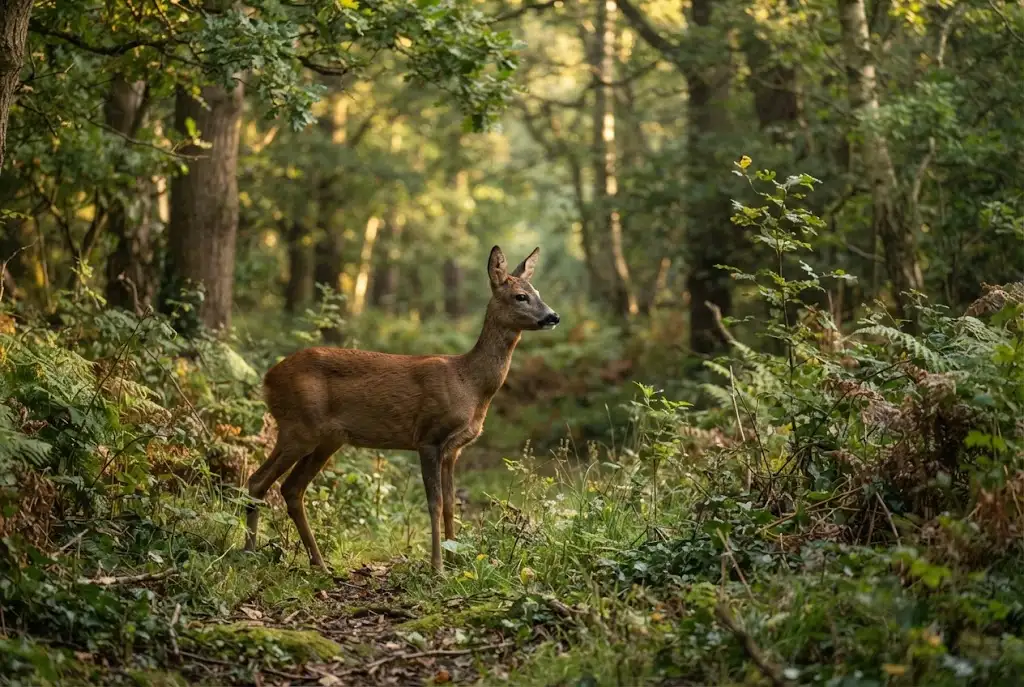
Deer wild populations are an important part of Britain’s countryside, with several species living across forests, farmland, parks, heathland and other habitats. From the familiar roe deer and red deer to smaller muntjac and introduced fallow deer, Britain’s deer vary considerably in size, appearance, behaviour and habitat preferences.
Learning about deer wild species can make countryside walks much more rewarding. It can also help people understand the role deer play in ecosystems and why responsible deer management is an important part of modern conservation. This guide looks at the main species found in Britain, how to recognise them and the differences between native and introduced deer.
What Wild Deer Species Live in Britain?
Britain is home to six species of wild deer that are commonly recognised: red deer, roe deer, fallow deer, sika deer, muntjac and Chinese water deer. They do not all have the same history in Britain.
Red deer and roe deer are Britain’s two native deer species. Fallow deer were introduced many centuries ago, while sika deer, muntjac and Chinese water deer are also introduced species that have established wild populations.
The British Deer Society explains that these six species now occur in different parts of Great Britain and occupy a wide variety of habitats. Their distribution and population levels vary significantly between species. ([bds.org.uk](https://www.bds.org.uk/information-advice/about-deer/deer-species/?utm_source=chatgpt.com))
Red Deer
Red deer are Britain’s largest native land mammal and are strongly associated with large forests, open hills, moorland and upland landscapes. Adult males, known as stags, can become particularly impressive during the autumn rut.
The species has a reddish-brown summer coat that becomes darker during winter. Mature males develop large antlers, which are shed and regrown annually.
Red deer are especially associated with the Scottish Highlands, although populations also occur elsewhere in Britain. Their size makes them relatively easy to distinguish from smaller species when seen at a reasonable distance.
The Red Deer Rut
The autumn rut is one of the most spectacular wildlife events involving British deer. Male red deer compete for access to females, with stags using roaring calls, displays and sometimes physical contests.
The British Deer Society describes the rut as a period of intense activity during autumn, when mature stags gather harems of hinds and compete with rival males. ([bds.org.uk](https://www.bds.org.uk/information-advice/about-deer/deer-species/red-deer/?utm_source=chatgpt.com))
Anyone visiting areas where red deer rut should maintain a safe distance. Large stags can be unpredictable during this period, and approaching animals for photographs can cause unnecessary stress or create dangerous situations.
Roe Deer
Roe deer are Britain’s other native deer species. They are considerably smaller than red deer and are commonly found in woodland, farmland and mixed countryside.
Roe deer have a relatively compact body and can be recognised by their small size, short tail and distinctive white rump. Adult males, called bucks, grow short antlers with typically three points on each side once fully developed.
Unlike red deer, roe deer are often encountered individually or in small groups rather than in very large herds. They can be surprisingly difficult to spot because their colouring blends effectively into woodland vegetation.
The British Deer Society identifies roe deer as a native species and notes their widespread distribution across Britain. ([bds.org.uk](https://www.bds.org.uk/information-advice/about-deer/deer-species/roe-deer/?utm_source=chatgpt.com))
Fallow Deer
Fallow deer are among Britain’s most widespread introduced deer. They have been present in Britain for centuries and are now established in many parts of England and Wales, as well as some areas of Scotland.
Fallow deer are particularly variable in colour. Individuals can be brown with pale spots, darker brown, very pale or almost black. Their distinctive white rump and relatively long tail can help with identification.
Male fallow deer, known as bucks, develop broad, palmate antlers. This is one of the easiest ways to distinguish mature fallow bucks from the males of several other British species.
The species can occur in woodland, farmland and large parkland landscapes. Their adaptability has contributed to their widespread distribution.
Sika Deer
Sika deer originate from East Asia but were introduced to Britain during the 19th century. They have subsequently established wild populations, particularly in Scotland and parts of England.
Sika are medium-sized deer with a generally dark appearance, although their coats can vary. They can also hybridise with red deer, which can complicate identification and create conservation concerns.
The British Deer Society notes that sika and red deer can interbreed, producing fertile offspring. This genetic interaction is an important consideration when managing populations and conserving the characteristics of Britain’s native red deer. ([bds.org.uk](https://www.bds.org.uk/information-advice/about-deer/deer-species/sika-deer/?utm_source=chatgpt.com))
Muntjac Deer
Muntjac deer are Britain’s smallest established deer species. They are compact, short-legged animals with a distinctive appearance and are particularly associated with woodland and dense vegetation.
The muntjac is sometimes called the barking deer because of its characteristic vocalisation. Unlike larger deer, males have short, simple antlers and prominent tusk-like upper canine teeth.
Muntjac can breed throughout much of the year, which is unusual compared with the strongly seasonal breeding patterns of larger British deer. The British Deer Society identifies the muntjac as an introduced species that has become established in many parts of England and Wales. ([bds.org.uk](https://www.bds.org.uk/information-advice/about-deer/deer-species/muntjac-deer/?utm_source=chatgpt.com))
What Is a Baby Muntjac Deer Like?
A baby muntjac deer is considerably smaller than the young of Britain’s larger deer species. Like other deer fawns, it is born with a spotted coat that provides camouflage during its early life.
Muntjac mothers typically leave young animals concealed while they feed nearby. This is one reason members of the public should never pick up a seemingly abandoned fawn. A young deer lying quietly does not necessarily mean it has been abandoned.
If you encounter a young deer in vegetation, the safest response is usually to leave it alone and move away quietly.
Chinese Water Deer
The Chinese water deer is another small introduced species. It originates from China and Korea and has become particularly established in parts of eastern England.
Chinese water deer are unusual among British deer because adult males do not grow antlers. Instead, bucks have prominent tusk-like upper canine teeth that project downwards from the mouth.
The species is also strongly associated with wet habitats, including river valleys, wetlands and reedbeds. The British Deer Society notes that the species has become particularly associated with eastern England. ([bds.org.uk](https://www.bds.org.uk/information-advice/about-deer/deer-species/chinese-water-deer/?utm_source=chatgpt.com))
Kinds of Deer: How Do You Tell Them Apart?
When learning the different kinds of deer in Britain, size is a useful starting point, but it should not be your only clue.
- Red deer: Britain’s largest native deer, often associated with uplands and large forests.
- Roe deer: smaller native deer with a distinctive white rump and compact build.
- Fallow deer: variable coat colours and broad palmate antlers in mature males.
- Sika deer: medium-sized, generally dark deer that can resemble red deer.
- Muntjac: Britain’s smallest established deer, compact and short-legged.
- Chinese water deer: small deer whose males lack antlers and have visible canine tusks.
Habitat can also help. A large deer on open Scottish uplands may be a red deer, while a small deer moving through dense woodland in southern England could be a muntjac or roe deer.
Small Deer-Like Animals in Britain
People sometimes search for a small deer like animal after seeing a compact mammal moving through woodland. In Britain, muntjac and Chinese water deer are two particularly important possibilities.
Muntjac tend to have a distinctive compact appearance, short antlers in males and a relatively rounded body. Chinese water deer have longer-looking ears and a different head profile, while adult males are notable for their tusks rather than antlers.
Other mammals can also be mistaken for young deer at a distance. This is why size alone should not be used to identify an animal. Look at its body shape, ears, tail, movement, habitat and, where visible, antlers or facial features.
Animals That Look Like Deer
Several animals can be mistaken for deer when seen briefly. Sheep, goats and even some woodland mammals can appear similar at a distance, particularly in poor light.
Young deer are especially difficult to identify because their proportions differ from adults and many fawns have spotted coats. A cautious observer should therefore avoid approaching an unfamiliar animal simply to obtain a closer look.
When possible, binoculars are a much better identification tool than getting closer. They allow you to examine features while maintaining a safe distance.
Mount Jack Deer or Muntjac Deer?
The phrase mount jack deer is sometimes used when people are searching for muntjac deer. The correct common name in Britain is muntjac deer.
Muntjac are small, forest-associated deer that have expanded their range considerably. Their barking calls can sometimes reveal their presence before the animal itself is seen.
The species’ small size and unusual appearance make it one of the more memorable deer to encounter in Britain’s countryside.
Where Do Wild Deer Live in Britain?
British deer occupy a wide variety of habitats. Woodland is particularly important for several species because it provides cover, food and shelter. However, deer also use farmland, heathland, moorland, grassland, wetlands and parkland.
Red deer are strongly associated with uplands and extensive landscapes, while roe deer can thrive in smaller patches of woodland surrounded by farmland. Fallow deer are adaptable and occur in many different countryside environments.
Muntjac favour dense vegetation and woodland, whereas Chinese water deer are closely associated with wet landscapes in their established range.
This variety demonstrates why deer conservation cannot focus on one habitat alone. Different species require different combinations of food, cover and space.
What Do Wild Deer Eat?
Deer are herbivores and feed on a broad range of vegetation. Their diets vary according to species, habitat and season.
Depending on availability, deer may browse leaves, shoots, buds, shrubs, grasses and other vegetation. In woodland, they can feed on young tree growth and ground vegetation, while agricultural landscapes can provide additional food sources.
Their feeding behaviour is one reason deer populations can have significant effects on vegetation. Where deer numbers are high, repeated browsing can prevent young trees and shrubs from regenerating naturally.
Wild Deer and Woodland Conservation
Deer are a natural part of Britain’s ecosystems, but population density matters. When too many deer feed in a particular area, browsing pressure can alter vegetation structure and affect woodland regeneration.
The Forestry Commission explains that excessive deer browsing can damage young trees and reduce the ability of woodlands to regenerate naturally. Deer management can therefore be necessary in some landscapes to protect woodland restoration and biodiversity. ([gov.uk](https://www.gov.uk/guidance/deer-management?utm_source=chatgpt.com))
This does not mean that deer themselves are inherently harmful. The conservation challenge is about maintaining a sustainable balance between deer populations, habitat conditions and other wildlife.
Deer Management and Conservation
Responsible deer management is a complex aspect of countryside conservation. Managers may need to consider species, population density, habitat condition, woodland regeneration, agricultural impacts and animal welfare.
The British Deer Society emphasises that effective management requires knowledge of deer ecology, population dynamics and local habitat conditions. ([bds.org.uk](https://www.bds.org.uk/information-advice/deer-management/?utm_source=chatgpt.com))
Monitoring is therefore important. Land managers can assess signs such as browsing damage, tracks, deer activity and changes in vegetation before deciding what management approach is appropriate.
Are Wild Deer Dangerous?
Wild deer generally avoid people, but they are still large wild animals and should be treated with caution. The risk can increase during breeding periods, particularly when mature males are displaying territorial or competitive behaviour.
Drivers should also be aware of deer on rural roads. Deer can cross roads suddenly, particularly around dawn and dusk and during seasonal movements. If a deer appears near the road, reducing speed can give both the driver and animal more time to react.
Never attempt to approach, feed or touch a wild deer. If an animal appears injured, contact an appropriate wildlife or animal welfare organisation rather than trying to handle it yourself.
How to Watch Deer Responsibly
Observing deer can be a memorable wildlife experience when it is done carefully. Early morning and evening are often productive periods, but visitors should always respect local access restrictions and sensitive habitats.
- Watch from a safe distance.
- Use binoculars rather than approaching animals.
- Never chase deer for photographs.
- Avoid disturbing animals during the breeding season.
- Keep dogs under close control where required.
- Do not feed wild deer.
- Stay on permitted paths and follow reserve guidance.
Responsible observation is particularly important in woodland, where repeated disturbance can affect animals and other wildlife using the same habitat.
Wild Deer and Britain’s Wider Wildlife
Deer form part of a much wider British wildlife community. Woodland habitats used by deer may also support birds, insects, mammals and plants, making habitat management an interconnected conservation task.
If you are interested in identifying other British wildlife by sound, our guide to British bird sounds covers common calls and songs from gardens, woodland and countryside.
Nocturnal wildlife provides another fascinating area to explore. Our guide to British owl sounds explains how tawny owls, barn owls and other species can be identified through their calls.
Bird migration also demonstrates how different species depend on connected habitats. Our guide to geese migration explores the seasonal movements of geese between Britain and northern breeding grounds.
Final Thoughts on Deer Wild in Britain
Deer wild populations are an important and highly visible part of Britain’s natural environment. The country’s six established wild deer species range from the enormous red deer to the tiny muntjac, with each occupying different habitats and displaying distinctive characteristics.
Learning to distinguish these species is useful for anyone interested in conservation, woodland management or wildlife watching. Size, coat colour, antlers, body shape, habitat and behaviour can all help with identification.
At the same time, deer conservation requires more than simply protecting individual animals. Healthy populations depend on suitable habitats, while healthy woodlands may require careful management where browsing pressure becomes excessive.
Understanding this balance is central to responsible countryside conservation. By observing deer from a respectful distance and learning how they interact with their habitats, we can appreciate their place within Britain’s wider ecosystems without disturbing the wildlife we are trying to protect.
