

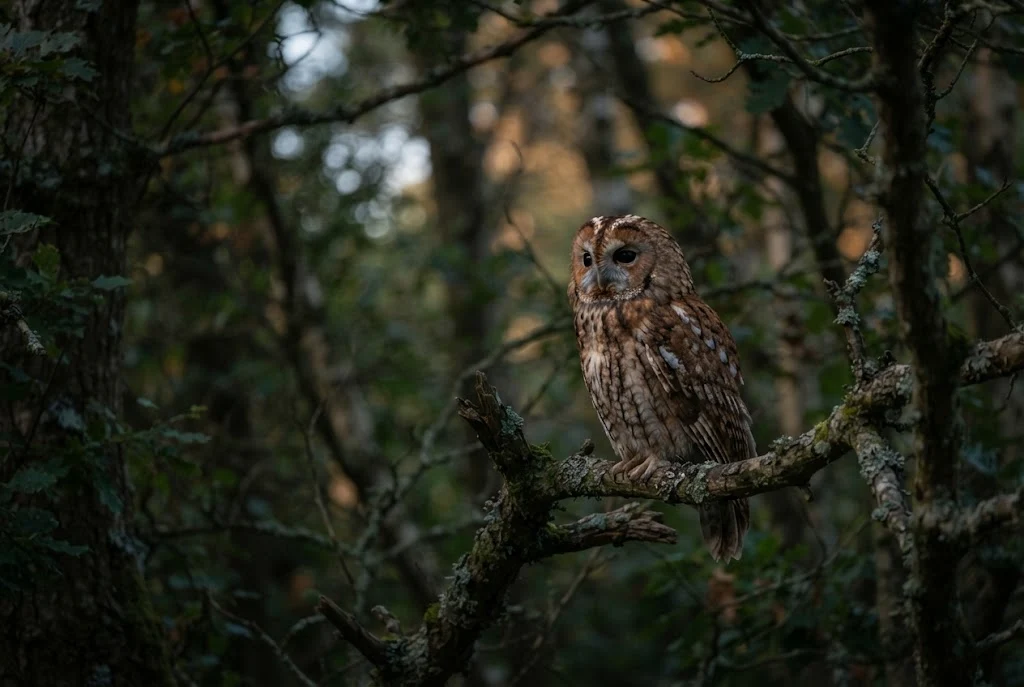
British owl sounds can reveal the presence of an owl long before you ever see one. These mostly nocturnal birds are often hidden among trees, hedgerows, barns and dense vegetation, making their calls one of the best ways to identify them. From the familiar hooting of a tawny owl to the eerie screech of a barn owl, each species has its own combination of calls, habitat and behaviour.
Learning to recognise British owls sounds is particularly useful for anyone exploring woodland, farmland or countryside after dark. Instead of relying on the appearance of a bird that may only be visible for a few seconds, you can combine its call with the location, time of day and flight behaviour to make a more confident identification.
Why British Owl Sounds Are Useful for Identification
Owls are often easier to hear than see. Their nocturnal habits, camouflage and preference for mature trees, grassland and secluded habitats can make visual identification difficult. A distinctive call can therefore provide the first clue that an owl is nearby.
However, identifying an owl from sound alone is not always straightforward. Individual birds can make several different vocalisations, while males, females and young birds may sound different. Context is therefore important.
The best approach is to listen for the character of the call and then consider the habitat. A classic repeated hoot from mature woodland suggests a very different species from a harsh screech heard over open farmland.
British Owl Sounds: The Tawny Owl
The tawny owl is probably the species most closely associated with traditional uk owl sounds. Its familiar hooting has become one of the defining sounds of Britain’s nighttime woodlands.
There is an important detail behind the famous “twit-twoo” description, however. It is actually a combination of calls from two birds. The female produces a sharper contact call, often described as a “ke-wick” sound, while the male responds with a longer, wavering hoot.
This means that what sounds like one continuous owl call may actually be a conversation between a male and female.
The RSPB describes the tawny owl as a widespread breeding species in England, Wales and Scotland. It is particularly associated with broadleaved woodland, although mature parks and large gardens can also provide suitable habitat.
What Does a Tawny Owl Sound Like?
The male’s familiar hoot is deep and sustained, while the female’s response is sharper and more abrupt. Listen carefully and you may notice that the two calls have noticeably different tones.
Tawny owls are particularly vocal during autumn, when young birds disperse and adults establish or defend territories. Woodland Trust guidance also notes that autumn evenings can be a particularly good time to listen for them.
Barn Owl Sounds: The Screeching Call
Barn owl sounds are very different from the stereotypical owl hoot. Rather than producing a deep “hoo” like a tawny owl, barn owls are known for a distinctive, shrill screech.
This explains why the barn owl has sometimes been called the “screech owl”. Its vocalisations can sound surprisingly harsh, especially when heard unexpectedly in the darkness.
The barn owl’s appearance is equally distinctive. It has a heart-shaped facial disc, dark eyes, pale underparts and buff-and-grey markings on its back and wings. It commonly hunts over rough grassland and farmland, often flying low while searching for small mammals.
What Noise Do Barn Owls Make?
If you are wondering what noise do barn owls make, listen for a long, high-pitched screech rather than a conventional hoot. The sound can be difficult to describe precisely because the bird may produce different vocalisations in different situations.
Barn owls may be particularly noticeable around the breeding season, while their hunting activity can make them easier to spot around dawn and dusk. Woodland Trust identifies the shrill screech as one of the key sounds associated with the species.
The barn owl’s silent flight makes the contrast even more striking. You may hear a sudden screech or glimpse a pale bird moving quietly across a field before it disappears into the darkness.
Barn Owl Noise vs Tawny Owl Calls
One of the most useful comparisons for beginners is barn owl tawny owl identification. Both species can occur in rural areas, but their sounds are very different.
- Tawny owl: associated with deep hoots, sharper contact calls and the familiar male-and-female “twit-twoo” combination.
- Barn owl: known for a distinctive shrill screech rather than the classic hooting sound.
- Tawny owl habitat: commonly broadleaved woodland, mature parks and gardens with established trees.
- Barn owl habitat: open farmland, rough grassland, field margins and suitable buildings or nest sites.
If you hear a traditional hooting owl deep within mature woodland, a tawny owl is a strong possibility. If a sharp screech comes from an open field at dusk, a barn owl may be nearby.
British Owls Sounds You May Hear in the Countryside
Britain has several owl species, and their vocalisations vary considerably. Learning the most common calls gives wildlife watchers a useful foundation before moving on to rarer species.
Little Owl
The little owl is smaller than both the tawny owl and barn owl and is often associated with tree-rich farmland and pasture. Unlike some British owls, it can be active during daylight hours.
Its calls include short repetitive sounds that can be described as “woop” or sharper “kiew kiew” notes. Woodland Trust notes that both males and females may also use softer contact calls.
When identifying a little owl, therefore, sound should be combined with habitat and behaviour. Seeing a small owl perched on a tree branch or rock in open farmland during daylight can provide an important additional clue.
Long-Eared Owl
The long-eared owl is one of Britain’s more secretive owls. It is mainly nocturnal and can be difficult to find, even in areas where it occurs.
The male produces a relatively soft hooting sound, while the female’s call is higher pitched. During display flights, long-eared owls can also produce a soft wing-clapping sound.
The species favours dense vegetation, thickets and wooded areas, including some coniferous woodland and scrub habitats. Because it is difficult to encounter visually, learning its vocalisations can be particularly useful.
Short-Eared Owl
Short-eared owls are unusual among British owls because they can often be seen hunting during daylight, particularly around dawn and dusk. They are associated with open habitats such as rough grassland, moorland, marshes and coastal areas.
The male can produce a sequence of rapid hoots during display flights, while both sexes have other vocalisations that can include harsher sounds. Woodland Trust notes that the species may be more noticeable around winter hunting grounds.
This means a daytime sighting over open countryside can be just as valuable for identification as a night-time call.
Barn Owl Flying: What to Look For
Although this article focuses on sound, observing barn owl flying behaviour can help confirm an identification after hearing a call.
Barn owls often fly low over rough grassland while searching for small mammals. Their flight can appear almost effortless because the feathers are specially adapted to reduce the sound produced by movement through the air.
Their pale underside can also stand out against a darker background, particularly during twilight. However, distance and lighting can significantly change how the bird appears, so flight behaviour should be considered alongside habitat and sound rather than used alone.
Long-Eared Owl Flying and Display Behaviour
Long eared owl flying can be difficult to observe because these birds are strongly nocturnal and secretive. When seen, their long wings and distinctive appearance can help separate them from more familiar British owls.
During display, wing-clapping may provide an additional auditory clue. This is particularly interesting for wildlife watchers because the sound is generated by the bird’s behaviour rather than being a conventional vocal call.
Because long-eared owls are difficult to locate, observers should avoid approaching suspected roosting or breeding sites. Listening from a suitable distance is a much less disruptive way to study them.
How to Identify UK Owl Sounds
When learning British owl sounds, it helps to develop a consistent listening method. Instead of trying to memorise every sound at once, focus on a few characteristics.
Listen to the Tone
Ask whether the sound is deep, soft, shrill, harsh or high-pitched. A deep hoot points you towards a very different group of possibilities than a piercing screech.
Listen to the Rhythm
Some owl calls consist of individual notes separated by pauses, while others are longer sounds or repeated sequences. Pay attention to whether the same phrase is repeated at regular intervals.
Consider the Habitat
A sound heard in mature woodland is worth interpreting differently from one heard over open farmland. Habitat can dramatically narrow the list of possible species.
Consider the Time
Most UK owls are nocturnal, but some species are more likely to be encountered during daylight, especially when hunting. Seasonal behaviour also affects how frequently certain calls are heard.
Listen More Than Once
One unfamiliar sound can be misleading. If possible, listen for several calls and compare their rhythm, pitch and direction. This can help distinguish a repeated call from an isolated contact note.
Why Owls Are Often Heard Before They Are Seen
Several adaptations make owls remarkably difficult to observe. Their feathers provide excellent camouflage, while their mostly nocturnal lifestyles keep them out of sight during the day.
Many owls also have specialised feathers that help reduce the sound of flight. This is particularly valuable for predators that depend on hearing as well as sight when locating prey.
The result is a bird that can pass through woodland or across farmland with very little warning. In many cases, the call is the first indication that an owl is nearby.
British Owl Sounds and Conservation
Learning owl calls can also encourage greater interest in habitat conservation. Different species depend on different landscapes, so an owl’s presence can tell us something about the environment around it.
Tawny owls rely heavily on mature woodland and trees suitable for roosting and nesting. Barn owls depend on prey-rich rough grassland and suitable nesting or roosting locations. RSPB conservation guidance highlights the importance of rough grassland for barn owl hunting and notes that loss of suitable hunting habitat can reduce food availability.
Conservation status can also change over time. The RSPB currently lists the tawny owl as Amber-listed and reports a decline of more than 40% between 1995 and 2023. The organisation notes that the exact reasons for the decline are not fully understood, although habitat loss and reduced prey availability may contribute.
Barn owls, by contrast, are currently listed by the RSPB on the Green List, although the species has faced historical pressures and continues to depend on suitable farmland habitats.
Responsible Owl Watching in Britain
Owl watching should always be approached with care. A bird that appears calm may still be responding to human presence, particularly around a nest or roost.
Use binoculars rather than approaching closely, avoid deliberately flushing birds from their roosts and never interfere with nests or eggs. If you discover a nesting site, give the birds plenty of space and avoid repeatedly returning to obtain photographs.
This is particularly important because many owls are active at night, when people can accidentally disturb them without realising it. Quiet observation from a suitable distance is usually the best approach.
Using Owl Calls Alongside Other Bird Sounds
Once you become comfortable recognising owl calls, you can expand your listening skills to other British wildlife. The same principles apply: identify the tone, rhythm, habitat and time of day before making a conclusion.
For a broader introduction to identifying wildlife by sound, you can explore British bird sounds and compare common daytime bird calls with the nocturnal vocalisations covered here.
You can also combine sound-based identification with knowledge of England birds of prey. Raptors and owls occupy different ecological niches, but both demonstrate how valuable careful observation can be when studying Britain’s wildlife.
Seasonal bird movement provides another useful area for exploration. Learning about geese migration can help put local bird sightings into the wider context of movements across Britain and Europe.
Final Thoughts on British Owl Sounds
British owl sounds offer one of the best ways to discover Britain’s nocturnal birdlife. The deep and familiar calls of tawny owls, the sharp screech of a barn owl and the less familiar vocalisations of little, long-eared and short-eared owls all provide valuable clues for identification.
The key is not to rely on a single sound in isolation. Combine the call with habitat, time of day, flight behaviour and, when possible, visual features. With regular listening, the nighttime countryside becomes much easier to interpret.
Most importantly, owl watching should go hand in hand with responsible wildlife observation. Giving birds space and protecting the habitats they depend on ensures that future generations can continue to hear these distinctive sounds across Britain’s countryside.

1 Comment
Pingback: British Bird Sounds: Identify Common UK Birds by Sound