

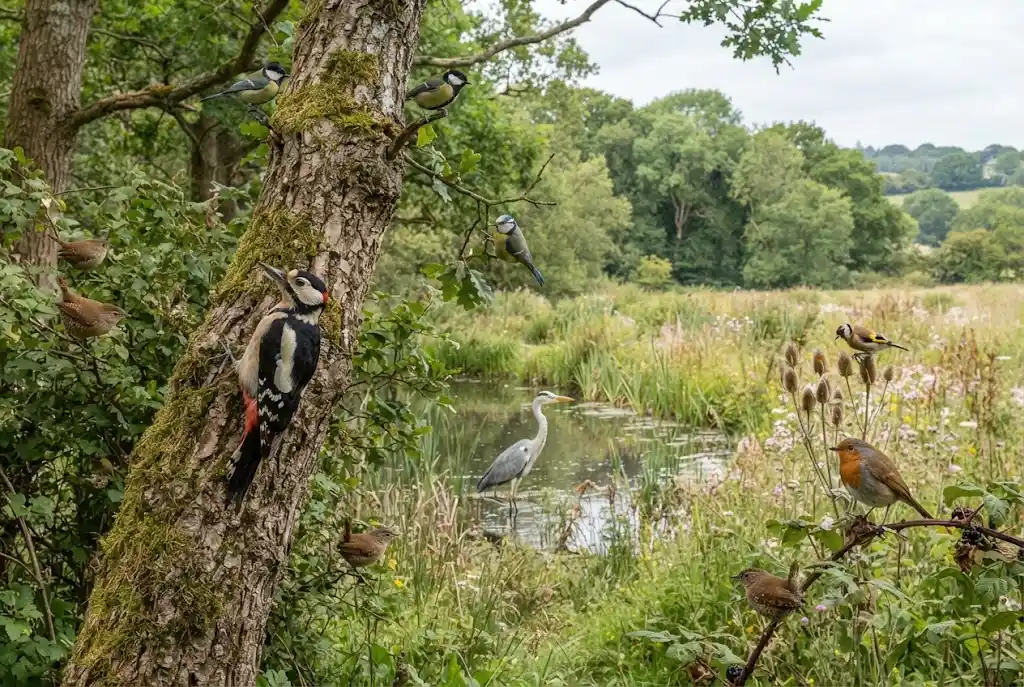
There are countless interesting facts about birds that reveal just how diverse and adaptable these animals are. Birds live in almost every part of the world, from gardens and woodland to wetlands, mountains, deserts and open oceans. Their bodies, behaviours and senses have evolved to help them survive in environments that can be dramatically different from one another.
Some birds can travel thousands of kilometres during migration, while others spend almost their entire lives at sea. Some use remarkable calls to communicate, others rely heavily on vision, and many have developed specialised bills, feet and feathers suited to the way they live. Understanding these features can make everyday birdwatching much more rewarding, whether you are observing UK woodpeckers identification in woodland or looking for birds around wetlands.
Interesting Facts About Birds and Their Evolution
Birds belong to a diverse group of vertebrate animals and are the only living animals with feathers. Modern birds are part of the dinosaur lineage, making their evolutionary history particularly fascinating.
Although birds share several characteristics, they vary enormously in size, shape, behaviour and lifestyle. A tiny garden bird and a huge soaring bird may look completely different, yet both have adaptations that allow them to survive successfully in their respective environments.
1. Birds Have Feathers
Feathers are one of the defining characteristics of birds. They are used for much more than flight. Feathers can provide insulation, assist with communication and displays, protect the body and help birds regulate their temperature.
The structure and arrangement of feathers can also differ between species. A bird that spends most of its time swimming has different feather adaptations from a bird that spends its life soaring over open land.
2. Birds Are Living Dinosaurs
Modern birds evolved from theropod dinosaurs. This means that when you watch a bird in a garden or woodland, you are observing a living branch of a very ancient evolutionary lineage.
This connection is one of the most fascinating aspects of bird biology and helps explain why birds share certain anatomical characteristics with their extinct relatives.
3. Birds Have Lightweight Skeletons
Many flying birds have skeletal adaptations that help reduce overall body weight. Some bones are hollow or partly hollow and contain internal structures that provide strength without requiring the same amount of material as a solid bone.
However, the idea that every bird has a completely hollow skeleton is misleading. Bird skeletons are specialised in different ways depending on the species and its lifestyle.
Interesting Information About Birds and Flight
Flight is one of the features most strongly associated with birds, although not every bird can fly. The mechanics of flight involve wings, feathers, muscles, body shape and careful control of movement.
4. Not Every Bird Can Fly
Some birds have evolved to live successfully without powered flight. Ostriches, penguins, emus, cassowaries and kiwis are examples of birds with very different lifestyles from typical flying species.
Penguins, for example, have wings adapted for swimming rather than aerial flight. Their streamlined bodies and specialised feathers allow them to move efficiently through water.
5. Birds Use Different Flight Techniques
Birds do not all fly in the same way. Some species flap continuously, while others use gliding or soaring techniques to travel with less energy.
Large soaring birds can exploit rising air currents, allowing them to remain airborne while using relatively little energy. Smaller birds may use rapid wingbeats and different flight patterns suited to their size and habitat.
6. Wings Come in Different Shapes
Wing shape is closely connected to lifestyle. Birds that fly quickly through dense woodland need different wing characteristics from birds that spend long periods soaring above open landscapes.
Shorter, rounded wings can provide manoeuvrability, while longer wings can be useful for efficient gliding and soaring. Examining wing shape can therefore provide clues about how a bird lives.
Unique Facts About Birds and Their Senses
Birds have sophisticated senses that help them find food, avoid predators, navigate landscapes and communicate with one another.
7. Many Birds Have Excellent Vision
Vision is extremely important to birds. Predatory species may rely on detailed visual information to locate prey, while other birds use their eyesight to identify food, navigate their surroundings and detect threats.
Some birds can perceive colours beyond the range visible to humans because they can detect ultraviolet wavelengths. This can influence how they see plumage, food and other features of their environment.
8. Birds Can Communicate Through Sound
Bird calls and songs can serve different purposes. Birds may use vocalisations to attract mates, defend territories, maintain contact with other members of their species or warn about danger.
Woodpeckers provide a useful example of communication that does not always involve a conventional song. Their drumming can carry through woodland and is an important part of their behaviour.
Learning bird sounds can be particularly useful because birds are often heard before they are seen. This is one reason sound is an important part of marsh birds UK identification as well as woodland birdwatching.
9. Some Birds Can Imitate Sounds
Some bird species are remarkable vocal mimics. They can reproduce sounds from other birds and, in some cases, imitate sounds associated with their wider environment.
This ability demonstrates how flexible bird communication can be. It also means that identification based solely on a single call is not always reliable when dealing with species known for mimicry.
Interesting Facts About Birds and Migration
Bird migration is one of the most impressive natural behaviours observed across the world. Migrating birds move between different areas according to seasonal changes in food availability, breeding conditions and environmental factors.
10. Birds Can Travel Huge Distances
Some migratory birds travel thousands of kilometres between breeding and wintering grounds. These journeys can involve crossing seas, deserts and mountain ranges.
Migration requires significant energy and exposes birds to changing weather and other risks. Successful migrants therefore rely on a combination of biological adaptations and environmental cues.
11. Migration Is Not the Same for Every Bird
Some birds migrate long distances, while others move only relatively short distances. Some populations may remain in the same general region throughout the year, depending on climate and food availability.
This variation means there is no single migration strategy that applies to all birds. Each species has evolved behaviour suited to its particular ecological circumstances.
Interesting Facts About Birds and Feeding
Bird bills provide excellent clues about diet. Different shapes allow birds to collect, break, probe, filter or tear different types of food.
12. Bird Bills Are Highly Specialised
A finch’s strong, compact bill is suited to handling seeds, while a heron’s long pointed bill is useful for catching prey in shallow water. Woodpeckers have strong bills adapted to working on trees and accessing food beneath bark or within wood.
Bill shape is therefore one of the most useful features to consider when identifying unfamiliar birds.
13. Feet Can Reveal a Bird’s Lifestyle
Bird feet are also highly specialised. Raptors have powerful talons for capturing prey, while waterbirds may have webbed feet that help them swim.
Woodpeckers have feet adapted for gripping tree trunks. Their arrangement allows them to cling to vertical surfaces while moving around bark in search of food.
14. Birds Have Different Feeding Strategies
Some birds hunt insects in flight, some probe soil for worms, some crack seeds and others search underwater. This diversity means that birds occupy many different ecological niches.
Wetlands are particularly productive because they can provide several feeding environments within a relatively small area. Shallow water, mud, reedbeds and surrounding vegetation may all attract different species.
Interesting Facts About Birds and Their Nests
Bird nests vary enormously in construction. Depending on the species, nests may be built in trees, shrubs, cavities, cliffs, reedbeds, buildings or directly on the ground.
15. Nests Come in Many Shapes
Some birds construct elaborate cup-shaped nests, while others use cavities or simple depressions in the ground. Materials can include twigs, grass, moss, feathers, mud and other natural materials.
The nest design usually reflects the species’ environment and breeding strategy. A nest hidden within dense vegetation may offer protection from predators, while a cavity can provide shelter from weather and other threats.
16. Both Parents May Help Raise Young
Parental behaviour differs widely between bird species. In some species, both adults contribute to incubation and feeding, while in others one parent performs most of the work.
The amount of parental care is closely connected to the species’ reproductive strategy and environment.
Unique Facts About Birds and Survival
17. Birds Can Regulate Their Body Temperature
Birds are endothermic animals, meaning they generate internal heat and maintain a relatively stable body temperature. Feathers play an important role in insulation and help reduce heat loss.
18. Birds Replace Old Feathers
Feathers eventually become worn and need to be replaced. Birds undergo moulting, during which old feathers are shed and new ones grow.
The timing and extent of moult varies between species. During some moulting periods, changes in plumage can make identification more challenging.
19. Birds Adapt to Their Habitats
Birds occupy environments ranging from Arctic regions to tropical forests and British urban areas. Their bodies and behaviours reflect the challenges presented by each habitat.
For example, wetland species may have long legs for walking through shallow water, while woodland birds may have adaptations that allow them to move efficiently among branches and tree trunks.
Interesting Facts About Birds in the UK
Britain has a diverse bird population because the country contains many different habitats. Coastal environments, wetlands, farmland, woodland, heathland and urban areas all support different bird communities.
Species that people encounter can also change according to season. Some birds breed in Britain before migrating elsewhere, while other species arrive from northern regions during winter.
Urban gardens can also make a meaningful contribution to bird habitat. Trees, shrubs, natural vegetation and suitable water sources can provide food and shelter for a variety of species.
What Can Birdwatchers Learn From Behaviour?
Behaviour is one of the most useful tools for identification. Instead of focusing only on colour, watch what the bird actually does.
- Does it feed on the ground or in trees?
- Does it remain still or move constantly?
- Does it climb tree trunks?
- Does it probe mud or shallow water?
- Does it soar, glide or flap continuously?
- Does it travel alone or in a group?
- Does it have a distinctive call or song?
Combining behaviour with appearance and habitat can make identification much more reliable.
Quiz About Animals: Test Your Wildlife Knowledge
A simple quiz about animals can be a useful way to turn wildlife learning into an engaging activity for children and adults. Questions can cover habitats, feeding behaviour, adaptations and species identification.
For example, you might ask which bird has a distinctive habit of climbing tree trunks, which bird is associated with long-distance migration, or which type of bird has specialised webbed feet for swimming.
Wildlife quizzes are particularly useful because they encourage people to remember characteristics rather than simply memorising species names. The more connections you make between appearance, habitat and behaviour, the easier identification becomes in the field.
Animals Five Letters Long: A Quick Wildlife Challenge
If you are creating a word-based wildlife activity, there are plenty of animals five letters long that can be used as clues. “Eagle”, “otter” and “horse” are simple examples, although a good wildlife quiz can go much further by asking participants to identify animals from habitats, sounds or behaviours.
Combining word games with real ecological information can make wildlife education more memorable. It also encourages people to explore species beyond the birds they already recognise.
Why Learning Bird Facts Matters
Learning interesting facts about birds is not simply about memorising unusual pieces of information. Bird behaviour can reveal how ecosystems function and how animals respond to their environment.
A woodpecker’s relationship with mature trees, a heron’s dependence on shallow water or a migratory bird’s seasonal movement all demonstrate connections between animals and habitat. These relationships are important when considering conservation and responsible land management.
Birdwatching also encourages people to spend time outdoors and notice changes in the natural environment. A species that appears regularly in one season but disappears during another can provide a simple introduction to migration, breeding and seasonal ecology.
Final Thoughts on Interesting Facts About Birds
There are far more interesting facts about birds than can be covered in one guide. Birds have specialised feathers, bills, feet, senses and behaviours that allow them to occupy an extraordinary range of habitats.
From migration and flight to communication, feeding and nesting, each adaptation tells us something about how a species survives. The next time you see a bird, take a moment to observe more than its colour. Look at its bill, feet, movement, habitat and behaviour, and you may discover a much more detailed story.
For anyone who wants to continue exploring British birdlife, the RSPB birds and wildlife resources provide further information about species, habitats and conservation.
