

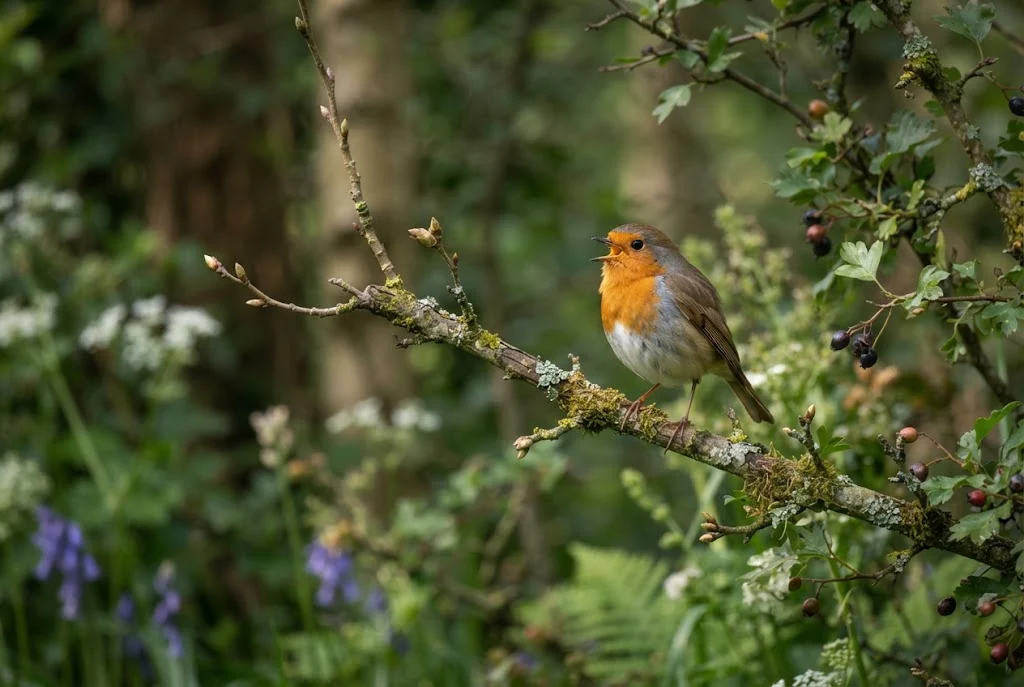
British bird sounds can reveal far more about the wildlife around you than you might expect. A familiar robin singing from a garden hedge, a blackbird calling from a rooftop or a woodpecker drumming somewhere in the trees can often be identified before the bird is visible. Learning these sounds is therefore one of the simplest ways to improve your birdwatching skills.
Birdsong identification does not require you to memorise every call at once. By paying attention to pitch, rhythm, repetition, volume, habitat and time of year, you can gradually build a useful mental library of common UK bird sounds. This guide explores some of the most recognisable bird sounds UK birdwatchers are likely to encounter and explains how to approach identification by ear.
Why British Bird Sounds Matter for Identification
Birds are often easier to hear than see. Dense foliage, hedges, tall trees and woodland can hide even familiar species, while some birds move quickly between branches. Their songs and calls can travel considerable distances, providing clues about what is nearby.
Sound can also tell you something about behaviour. A bird singing repeatedly from a prominent perch may be defending a territory or attracting a mate. A shorter contact call may help members of a flock remain together, while an alarm call can indicate the presence of a predator or other disturbance.
The RSPB recommends considering context when learning bird sounds, including what the sound is like, when it occurs and where the bird is likely to be found.
British Bird Sounds: Start With the Most Familiar Species
If you are new to identifying British bird sounds, it is easier to learn a small number of distinctive species before attempting to identify everything you hear. Common garden and woodland birds provide an excellent starting point because they are widespread and often vocal.
Robin
The robin has a clear, high-pitched and melodic song. Its phrases can vary considerably, with short passages separated by pauses. Robins can sing throughout much of the year and are particularly noticeable in gardens, parks and other places where people regularly encounter them.
One useful clue is the quality of the song rather than a single repeated phrase. The sound is generally bright and tuneful, making it quite different from the deeper song of a blackbird.
The RSPB describes the robin’s song as a melodic, high-pitched whistle and notes that the species can be heard across gardens, parks and cities throughout the UK.
Blackbird
The blackbird produces one of the most recognisable songs in the British countryside. Its voice is generally deeper and more relaxed than a robin’s, with rich fluting phrases and pauses between sections.
Blackbirds are especially noticeable during the breeding season, when males often sing from elevated positions such as trees, rooftops and other prominent perches. Their song can also contribute to the early morning chorus in towns and villages.
When comparing a robin and blackbird, listen for the overall character. The robin tends to sound sharper and more intricate, while the blackbird’s song is more mellow and fluting.
Wren
The wren may be tiny, but its song is surprisingly powerful. It produces a rapid, energetic burst of notes that can sound much louder than you would expect from such a small bird.
Wrens often remain hidden in dense vegetation, hedges and undergrowth. This makes them an excellent example of why sound-based identification is so useful. You may hear the bird clearly while struggling to locate it visually.
The RSPB describes the wren’s song as fast-paced and loud, with a remarkable number of notes packed into a short performance.
Great Tit
The great tit has a distinctive two-syllable song that can be heard in gardens, parks and woodland. It is a particularly useful bird to learn because it has several different calls, meaning that not every sound produced by a great tit will resemble its best-known song.
When learning common UK bird sounds, this is an important lesson: individual species do not necessarily have just one sound. Birds use different vocalisations for different situations.
Blue Tit
Blue tits produce a range of short, high-pitched sounds and trilling phrases. They are common garden birds and can often be heard around feeders, hedges and trees.
Their sounds can be useful for distinguishing a busy group of small birds, particularly when several species are calling at the same time. Listening repeatedly in familiar locations makes these subtle differences easier to recognise.
Common UK Bird Sounds in the Garden
Gardens can function as excellent outdoor classrooms for learning common UK bird sounds. You do not need a remote nature reserve to begin. A garden, park or quiet street with mature trees may provide dozens of opportunities to practise.
Start by choosing one species at a time. Spend several days listening for that bird and paying attention to where it usually calls from. Once its sound becomes familiar, move on to another species.
The RSPB recommends concentrating on individual sounds rather than attempting to memorise a large collection immediately. Its bird-song guide suggests learning one birdsong at a time as a practical way to build identification skills.
Woodpigeon
The woodpigeon’s song consists of a series of mellow cooing notes. It is often heard from high in trees, making the bird easier to hear than see in some situations.
The rhythm is particularly useful. Rather than listening only for pitch, pay attention to the number and spacing of the notes. Once familiar, the woodpigeon’s repetitive cooing becomes difficult to confuse with many smaller garden birds.
Goldfinch
Goldfinches produce bright, lively calls that can sound fast and twittering. Their vocalisations are often heard when birds are moving around in groups or travelling between feeding areas.
Their appearance is distinctive, but learning the sound gives birdwatchers another way to detect them when foliage or distance makes visual identification difficult.
Chaffinch
The chaffinch has a structured song that descends through a series of notes before finishing with a characteristic flourish. It is a common and widespread British bird, so its song is well worth learning.
Unlike a simple repeated call, the chaffinch’s song has a recognisable beginning, progression and ending. Listening for that overall pattern can make identification easier.
British Bird Noises Beyond Songs
Not every bird sound is technically a song. The phrase British bird noises can refer to calls, alarm sounds, contact calls, drumming and other vocal or behavioural sounds.
This distinction matters because some of the most recognisable sounds in British birdwatching are not conventional songs at all.
A woodpecker drumming against a tree, for example, creates a highly distinctive sound through physical behaviour rather than a conventional vocal performance. Learning these sounds broadens your ability to identify birds by ear.
Great Spotted Woodpecker Sound
The great spotted woodpecker sound is particularly useful for woodland identification. Instead of relying solely on a vocal call, listen for rapid drumming against a tree trunk or branch.
Great spotted woodpeckers use drumming as part of their territorial and breeding behaviour. Their sharp calls can provide another clue, particularly when the bird flies between trees or visits a garden feeder.
Woodland Trust describes the great spotted woodpecker’s drumming as a rapid, echoing sound and notes that its sharp call is often heard in flight.
The RSPB similarly identifies its rapid drumming and sharp call as useful identification clues. Great spotted woodpeckers are now widespread across much of Britain and are frequently found in larger woods, parks and gardens.
How Great Spotted Woodpecker Drumming Differs
The sound can travel surprisingly far through woodland. In early spring, listening for rapid bursts of drumming can be one of the easiest ways to establish that a great spotted woodpecker is nearby.
Once you hear it, look carefully at nearby trunks and branches rather than searching randomly through the entire canopy. The bird may be clinging to the opposite side of a trunk or moving quickly between trees.
Woodland Birds and Their Sounds
Woodlands provide a particularly rich soundscape. Different species occupy different layers of the habitat, so calls may come from the canopy, mid-level branches, shrubs or forest floor.
Chiffchaffs, for example, have a highly memorable repetitive song that resembles the sound of their name. Great tits, blackbirds and robins may also contribute to the woodland chorus.
Woodpeckers add another dimension because their sounds can include drumming and sharp calls rather than conventional melodic songs. The RSPB’s woodland sound guide highlights how listening can help distinguish species that may be difficult to see among leaves and branches.
How to Identify Bird Sounds in the UK
Good bird sounds UK identification comes from combining several clues rather than relying on one sound description.
Listen for Rhythm
Rhythm can be one of the strongest identification clues. Ask whether the sound is a series of repeated notes, a rapidly changing sequence, a long phrase or a short call.
Notice Pitch
Is the sound high, low, sharp, mellow, metallic or raspy? Pitch can immediately narrow down the possible species, especially when combined with rhythm.
Record the Location
Habitat provides valuable context. A bird singing from dense woodland may be different from one calling from a garden hedge or open farmland.
Consider the Season
Birds do not vocalise at the same intensity throughout the year. Many songs are particularly prominent during breeding periods, while contact and alarm calls can be heard more broadly.
Listen to the Ending
Beginners often concentrate on the first few notes of a song. The ending can sometimes be equally important. Some species have a distinctive final flourish, trill or change in pitch.
Tweeting of Birds: What Does It Tell You?
The phrase tweeting of birds is often used broadly to describe small, high-pitched bird sounds. However, birds use vocalisations for many different reasons, so it is better to think about the context in which the sound occurs.
A flock of small birds making short calls while moving through bushes may be maintaining contact with one another. A single bird repeatedly singing from a prominent branch is more likely to be producing a territorial or mate-attraction song.
Listening for these behavioural clues can make identification more accurate and help you understand what the birds are actually doing.
Using Apps and Recordings to Learn British Bird Sounds
Audio guides and bird-identification resources can be useful learning aids, particularly when you are beginning. The RSPB provides a bird song identifier covering a selection of common UK species and explains their sounds alongside information about where and when they are heard.
Recordings should be used as references rather than treated as perfect representations of every individual bird. Real-world calls can vary according to the individual, distance, background noise and circumstances.
A practical approach is to listen to a recording first, then try to locate the same species outdoors. Repeating this process helps connect an artificial audio example with the sound as it actually occurs in the landscape.
British Bird Sounds and Conservation
Learning bird sounds can contribute to a deeper understanding of habitats and seasonal change. A woodland that sounds different from one month to the next may be reflecting changes in breeding activity, migration or the presence of different species.
Sound can also help observers detect birds that are difficult to see. This is especially important in dense woodland, reedbeds and thick hedgerows where visual surveys can miss species hidden by vegetation.
The great spotted woodpecker provides a useful example of the connection between habitat and sound. The species depends on trees and woodland habitats, and protecting mature trees and suitable woodland helps maintain the environments in which it feeds and breeds. Woodland Trust notes the importance of mature trees and woodland protection for the species’ future.
From British Bird Sounds to Other Wildlife Calls
Once you become comfortable with common daytime bird sounds, you can expand your listening skills into other parts of Britain’s wildlife. Our guide to British owl sounds explores the very different vocalisations of nocturnal species such as tawny and barn owls.
You can also compare sound-based identification with visual wildlife observation. Our guide to England birds of prey explains how raptors can be identified using silhouette, flight pattern, habitat and behaviour.
Bird movement provides another useful area for exploration. Understanding geese migration can help put individual sightings into the wider context of seasonal bird movements across Britain.
Tips for Becoming Better at Bird Sound Identification
- Learn one sound at a time: Mastering a few common species is more effective than trying to memorise dozens simultaneously.
- Use familiar locations: Regular walks make it easier to notice changes in the local soundscape.
- Look after listening: Once you have an idea of the species, try to find the bird and confirm the identification visually.
- Pay attention to habitat: Location can narrow down the possibilities considerably.
- Listen in different seasons: The same area may have a very different collection of sounds throughout the year.
- Do not ignore non-song sounds: Drumming, alarm calls and contact calls can be excellent identification clues.
Final Thoughts on British Bird Sounds
British bird sounds turn an ordinary walk through a garden, park or woodland into a much richer wildlife experience. From the melodic robin and fluting blackbird to the explosive song of the wren and the unmistakable drumming of the great spotted woodpecker, Britain’s birds produce an extraordinary range of sounds.
The most effective way to learn is gradually. Focus on one or two species, listen carefully to their rhythm and pitch, and then use habitat, season and behaviour to confirm what you hear. Over time, familiar calls become almost as recognisable as familiar faces.
Most importantly, listening encourages closer attention to the natural environment. Even when birds remain hidden, their voices can reveal which species share a habitat, how wildlife changes with the seasons and why healthy woodland, gardens and countryside remain so important for Britain’s birds.

2 Comments
Pingback: Geese Migration: Where UK Geese Go and Why They Migrate
Pingback: Deer Wild in Britain: Species, Habitats and Key Facts