

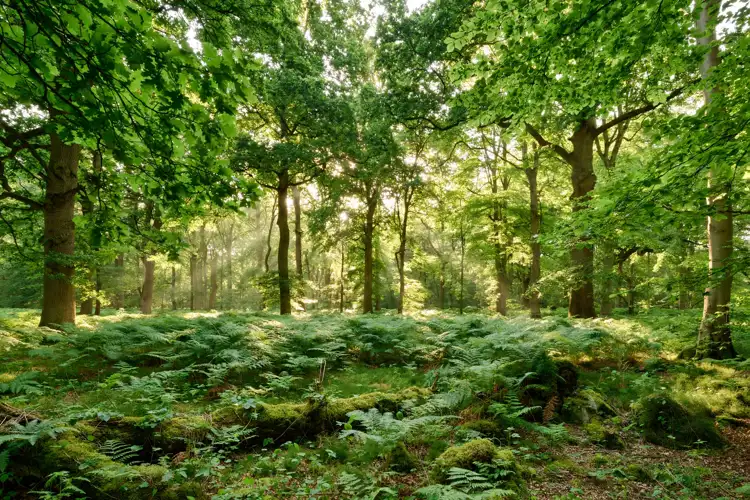
Trees are often described as the lungs of the planet, but their quieter talent matters just as much: trees and carbon storage go hand in hand. As a tree grows, it draws carbon dioxide from the air and locks the carbon away in its trunk, branches, roots and leaves, while the soil beneath a woodland holds even more in roots, fungi and decaying leaf litter. A wood is therefore not just a collection of trees but a long-term carbon store, one that keeps working for as long as the trees stand and the soil stays undisturbed. Understanding how that storage works, and what threatens it, is the first step towards managing UK woodlands in a way that genuinely helps the climate.
How Trees and Carbon Storage Work
Through photosynthesis, a tree takes in carbon dioxide and water and converts them into sugars that fuel its growth, releasing oxygen as a by-product. The carbon from that process ends up in the wood itself: roughly speaking, a substantial share of a tree’s dry weight is carbon, and it stays there for the life of the tree and beyond if the timber is later used in buildings or furniture. Young, fast-growing trees absorb carbon quickly as they put on wood; older trees grow more slowly but hold far larger stocks, which is why a mature woodland represents decades or centuries of accumulated storage that cannot be replaced quickly.
The storage does not stop at the trunk. Roots carry carbon deep into the soil, fallen leaves feed the soil ecosystem, and undisturbed woodland soils can hold large quantities of carbon for very long periods. This is one reason our guide to why tree conservation is essential stresses that protecting existing woods matters at least as much as planting new ones: felling a mature tree and disturbing its soil can release in a short time what took generations to build up.
Why Existing Woodland Stores Matter Most
New planting is essential and welcome, and our complete tree planting guide for the UK explains how to do it well. But a sapling planted today will take decades to hold what a mature oak already holds. Protecting the woods we already have, letting them age, regenerate naturally and keep their soils intact, is the fastest form of carbon storage available because the store already exists. The same logic sits behind our article on why sustainable tree management matters for modern cities: management that keeps trees healthy and standing, rather than removing them at the first sign of inconvenience, preserves both the canopy and the carbon beneath it.
What Helps Woodlands Store More Carbon
Several straightforward principles help. Plant the right tree in the right place, choosing species suited to the soil and space so they survive to maturity; the benefits described in our guide to the benefits of planting trees in the UK only arrive if the tree lives long enough to deliver them. Mix species and ages, because a varied woodland resists pests, disease and storm damage better than a single-species stand, and resilience is what keeps carbon locked away through decades of changing weather. Protect soils by avoiding unnecessary compaction, drainage and deep cultivation, especially around established trees. And let some deadwood lie: fallen trunks and branches continue to hold carbon while feeding the fungi and insects that keep woodland soils healthy.
Urban Trees Count Too
Carbon storage is not only a rural story. Street trees, park trees and garden trees all absorb carbon as they grow, and they do it where most people live, alongside the shade, cooling and air-quality gains explored in our article on how urban forestry improves air quality and public health. An individual street tree stores modest amounts compared with a woodland giant, but thousands of them across a town add up, and their other benefits arrive immediately rather than in decades. Our look at how trees support long-term environmental sustainability in urban areas shows how these gains reinforce each other when councils and communities plan canopy cover properly.
Keeping Carbon Locked In After Felling
Even well-managed woodlands are sometimes felled, whether for safety, timber production or restructuring, and what happens next decides how much carbon stays stored. Timber used in construction, fencing or furniture can hold its carbon for decades, while wood burned straight away returns it to the atmosphere immediately. Leaving some felled material in the wood as deadwood splits the difference, supporting fungi and insects while it decays slowly. The same thinking applies in gardens and parks: a tree that has to come down can still serve as a bench, a habitat pile or firewood saved for efficient stoves rather than a bonfire. Storage, in other words, is not only about growing trees; it is about treating wood as the long-term carbon reserve it is at every stage of its life.
Managing Woods With Carbon in Mind
For woodland owners and managers, carbon is now one more factor alongside timber, wildlife and access, and it rarely conflicts with the others. Longer rotations, continuous-cover forestry that avoids clearing whole areas at once, and prompt restocking or natural regeneration after felling all keep the store topped up. Regular tree safety inspections also play a part: spotting decline early means a tree can be managed, reduced or replaced in a planned way instead of being lost suddenly, and its successor can be planted while the canopy around it is still intact. None of this requires new technology, just the same patient, evidence-based care that good arboriculture has always practised, now with an added reason to value every mature tree that stays standing.
What We Can Each Do
Supporting woodland carbon storage does not require owning a forest. Plant a suitable tree if you have space, and care for it through its first dry summers so it survives. Support local tree and woodland groups, choose timber and paper from responsibly managed sources, and think twice before removing a healthy mature tree from a garden: its replacement starts again from nearly zero. If a tree genuinely must come down for safety, using the timber rather than burning or chipping it all keeps some of its carbon in use for longer.
Trees and carbon storage are a slow partnership, measured in decades rather than news cycles. That is precisely their value. Every woodland protected and every well-chosen tree planted is a store that will still be working long after we are, quietly holding carbon and sheltering wildlife at the same time. The best time to grow that store was years ago; the second-best time, as every arborist knows, is now.
