

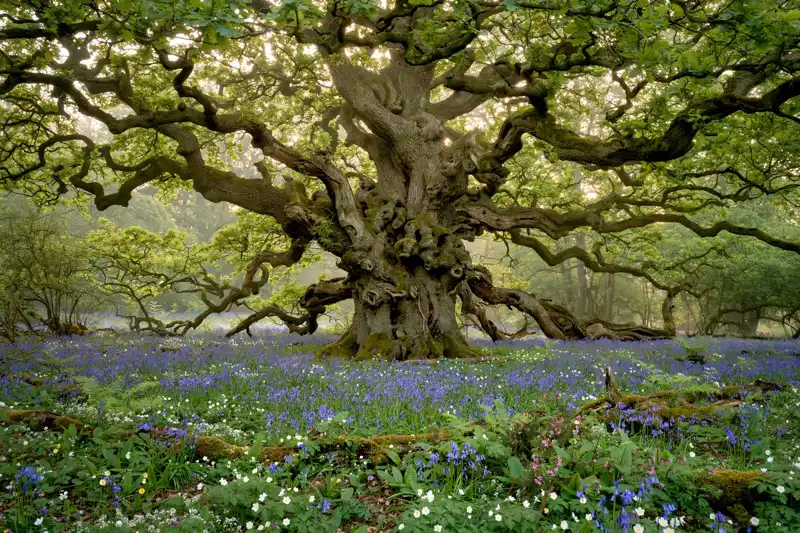
Some habitats can be recreated with effort and patience, but ancient woodland is not one of them. In England and Wales, land is classed as ancient woodland if it has been continuously wooded since at least 1600, and in Scotland the threshold stretches back to 1750. Over those centuries, an undisturbed wood develops soils, fungi, plants and wildlife communities that exist nowhere else, built layer by layer in a way no planting scheme can fast-forward. That irreplaceability is why ancient woodland is protected in planning policy, and why understanding what makes it special is essential for anyone who works with trees, land or development in the UK.
What Makes Ancient Woodland Different
An ancient wood is far more than a group of old trees. Its soil has never been ploughed or fertilised, so it holds a living archive: dormant seeds, fungi networks that connect tree roots, and invertebrate communities that depend on undisturbed ground. Certain plants act as living signposts to this history: bluebells, wood anemone, wild garlic and dog’s mercury spread so slowly that finding them together strongly suggests the wood has stood for centuries. Veteran and ancient trees add another layer, their hollow trunks, dead limbs and peeling bark supporting bats, owls, beetles and fungi found in few other places. Our guide to how native tree species support local ecosystems explains how these long-established relationships between trees and wildlife develop over time.
Ancient woods come in two broad kinds. Ancient semi-natural woodland is made up of native trees that grew naturally on the site. Plantations on ancient woodland sites were replanted with crops such as conifers during the twentieth century, but even these keep their ancient soils and much of their wildlife value, and many are now being gradually restored to native species.
Why Ancient Woodland Cannot Be Replaced
New woodland is valuable, and planting more of it matters enormously, but it is not a substitute for what already exists. A newly planted site starts with ordinary soil and a handful of young species; an ancient wood holds centuries of accumulated complexity that would take as many centuries to rebuild. Some of its fungi, insects and soil organisms cannot simply be moved to a new site, and once the ground is cleared, built on or deeply disturbed, that continuity is broken permanently. This is the heart of the case made in our article on why tree conservation is essential for environmental protection: the oldest habitats carry the most value per acre and deserve the strongest protection.
How the Law and Planning System Protect It
Because ancient woodland is considered irreplaceable, national planning policy in England states that development resulting in its loss or deterioration should be refused unless there are wholly exceptional reasons and a suitable compensation strategy, a deliberately high bar. Individual ancient and veteran trees can also be protected by Tree Preservation Orders, and our guide to protected trees law and UK rules for tree protection sets out how those orders work. Woodlands may carry further designations, such as Site of Special Scientific Interest status, where the habitat is of national importance. Anyone planning work near an old wood should check its status early: ancient woodland inventories maintained by the national nature agencies show where recorded sites lie, although small woods are sometimes missed, so local records and site evidence matter too.
Threats Ancient Woods Still Face
Protection on paper does not remove every pressure. Development at the edge of a wood can damage roots, change drainage and bring light, noise and litter into a previously quiet interior; our guide to best practices for protecting mature trees during construction work covers the practical safeguards that reduce this harm. Overgrazing by deer prevents young trees from regenerating, invasive species such as rhododendron shade out the ground flora, and tree diseases threaten some of the very species these woods are known for. Neglect can hurt too: many ancient woods were traditionally managed by coppicing, and where that cycle has stopped, the darker, denser canopy can squeeze out the flowers that depend on periodic light.
The Wildlife That Depends on It
Ancient woods shelter an outsized share of the UK’s woodland wildlife. Dormice nest in hazel coppice, woodland birds breed in the layered canopy, and raptors hunt along the rides and edges, as our guide to England’s birds of prey describes. Bats roost in veteran trees, and the deadwood supports fungi and beetles that are rare anywhere else. Protecting the wood protects this whole community at once, which is far more effective than trying to help each species separately. The preservation principles in our article on why tree preservation matters for urban development projects apply with even greater force here, because what is lost cannot be replanted.
Enjoying Ancient Woodland Responsibly
Most ancient woods welcome visitors, and a spring walk through bluebells is one of the great pleasures of the British countryside. Keep to paths where they exist, since woodland soil and its plants are easily damaged by trampling, take litter home, and give ground-nesting birds and sensitive plants space in spring and summer. If you own or manage such a wood, small steps help most: control invasive species, encourage natural regeneration, retain deadwood where it is safe to do so, and take advice before felling or planting.
Ancient woodland is the UK’s richest terrestrial habitat, built over centuries and impossible to recreate within any human timescale. Protecting it asks little of us: respect its status, plan around it, and leave its soils and old trees undisturbed. In return, it keeps doing what it has done for four hundred years and more: sheltering wildlife, storing carbon and offering anyone who walks into it a glimpse of the landscape as it once was.
