

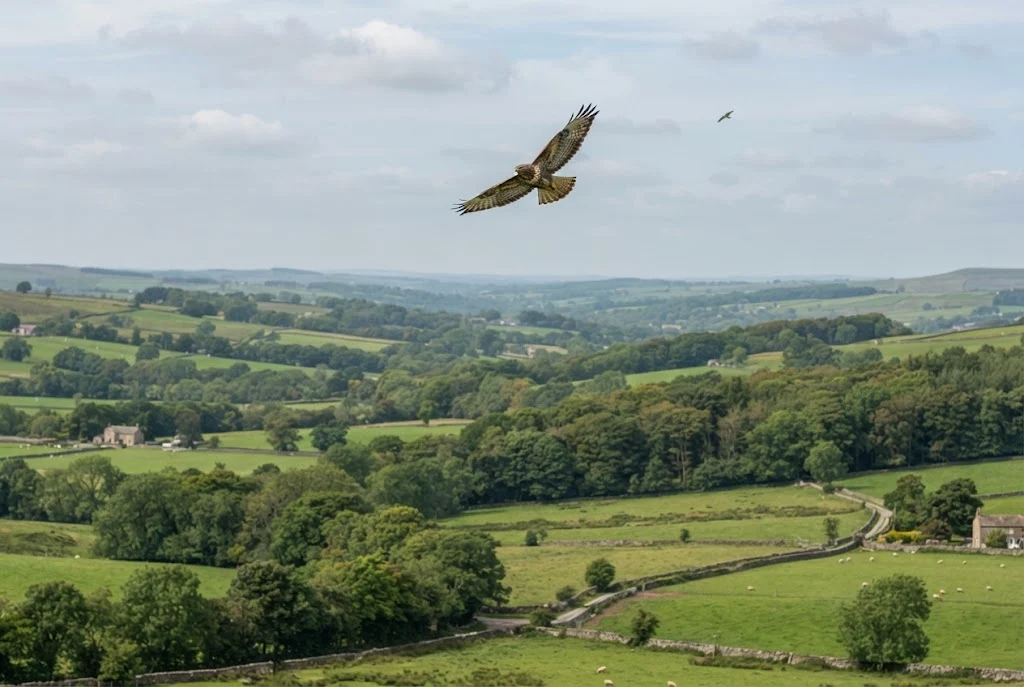
England birds of prey include some of the UK’s most recognisable and fascinating wildlife, from hovering kestrels and soaring buzzards to agile falcons and enormous eagles. Although many raptors can look similar at a distance, their size, silhouette, flight behaviour, habitat and markings can help you work out what you are seeing. Learning these differences is also an important part of appreciating the role birds of prey play in healthy ecosystems.
Whether you are watching wildlife from a woodland path, looking across farmland or simply noticing a large bird circling above a road, understanding the main types of predatory birds can make identification much easier. This guide explains some of the most familiar raptors associated with England and Britain, including how to distinguish common species in flight.
What Are Birds of Prey?
Birds of prey, often called raptors, are predatory birds adapted for hunting or scavenging. They generally have powerful feet and talons, strongly curved bills and keen eyesight. However, not every raptor hunts in exactly the same way. Some pursue birds at speed, some catch small mammals, while others take fish or make use of carrion.
The UK’s raptors include hawks, falcons, buzzards, kites, harriers, ospreys and eagles. Their different hunting strategies are reflected in their body shapes. A kestrel’s ability to hover is very different from the fast pursuit flight of a peregrine, while the broad wings of a buzzard are designed for efficient soaring.
Wild birds in Britain are protected by legislation, including the Wildlife and Countryside Act 1981. The Act provides protections relating to wild birds, their nests and eggs, with additional provisions applying to certain species and circumstances.
England Birds of Prey: Common Species to Know
Common Buzzard
The common buzzard is one of the easiest raptors to encounter across England. It is now the UK’s most common and widespread bird of prey, according to the RSPB. Its broad, rounded wings and relatively short tail are particularly noticeable when it is soaring.
Buzzards are highly variable in colour, which can make identification confusing. Many are brown, but some individuals appear considerably paler. When soaring, they commonly hold their wings in a shallow V and fan their tail. Their characteristic mewing call can sometimes be heard before the bird is spotted.
For beginners, the combination of broad wings, a relatively short tail and a soaring flight is a useful starting point when identifying a buzzard.
Kestrel
The kestrel is one of Britain’s most familiar small birds of prey. It is especially famous for hovering almost motionless while scanning the ground for prey. This behaviour has earned it the traditional nickname “windhover”.
When watching a possible kestrel, look for pointed wings, a relatively long tail and the characteristic hovering behaviour. Kestrels can often be seen above grassland, roadside verges, farmland and other open areas where small mammals are available.
The kestrel is therefore a strong candidate whenever you see a small raptor apparently suspended in the air with its head held remarkably steady.
Sparrowhawk
The sparrowhawk is a smaller woodland hunter that has adapted particularly well to gardens and urban green spaces. It is built for speed and manoeuvrability rather than prolonged soaring.
One useful clue is its flight pattern. A sparrowhawk often alternates several rapid wingbeats with a short glide. In flight, its long tail and relatively short, rounded wings can produce a distinctive T-shaped silhouette.
Sparrowhawks frequently hunt smaller birds and may use trees, hedges, buildings and garden vegetation as cover before making a sudden attack. If birds around a garden feeder scatter in an instant, a sparrowhawk may be nearby.
Red Kite
The red kite is one of the UK’s most distinctive raptors. Its deeply forked tail is the key feature to look for, particularly when the bird is circling high overhead. Its long wings and reddish-brown body also help separate it from more common brown raptors.
Red kites are especially associated with Wales and parts of southern and central England, although their range has expanded. Their broad wings allow them to soar efficiently, and they can often be seen over open countryside.
The forked tail is usually the quickest way to distinguish a red kite from a common buzzard. A buzzard has a shorter, fanned tail rather than the unmistakable fork of a red kite.
Peregrine Falcon
The peregrine is a powerful falcon renowned for its speed and aerial hunting ability. Its shape is quite different from a buzzard or kite. Look for pointed wings and a comparatively short tail when the bird is flying.
Peregrines occur in a range of habitats, including uplands, coastal cliffs and increasingly urban environments. Tall buildings can provide suitable nesting locations in some towns and cities.
The dark head and strong facial markings can also help with identification when you get a closer view. In flight, however, overall shape and wing position are often more useful than colour.
Types of Hawk in the UK
When people search for types of hawk in UK, they are often referring to birds such as sparrowhawks and goshawks. These species belong to the hawk family and have adaptations suited to hunting in and around woodland.
The sparrowhawk is smaller and considerably more widespread. Goshawks are much larger and more powerful, with females potentially reaching a wingspan of around 165cm. Goshawks are also relatively secretive and are most strongly associated with wooded landscapes.
Knowing the difference between these two species can prevent a common identification mistake. A large raptor moving through woodland at speed may initially resemble a sparrowhawk, but the much greater size and heavier build of a goshawk are important clues.
Big Bird of Prey: Which Is the Biggest in Britain?
The phrase big bird of prey can refer to several impressive species, but the white-tailed eagle is the UK’s largest bird of prey. Adults can have wingspans reaching approximately 240cm, giving them an enormous appearance in flight.
White-tailed eagles have exceptionally broad wings, a large head and a powerful bill. Adult birds also develop the distinctive white tail that gives the species its name. Their huge, broad-winged silhouette can make them look very different from the slimmer golden eagle.
Golden eagles are also among Britain’s largest raptors. They are strongly associated with mountainous and moorland landscapes, particularly in Scotland. In the air, their longer and more strongly shaped wings can help distinguish them from white-tailed eagles.
These species are important examples of how large predators can become symbols of successful conservation and wildlife recovery.
Are There Eagles in the UK?
Yes, there are eagles in the UK. The two native eagle species most commonly discussed are the golden eagle and the white-tailed eagle.
Golden eagles are strongly associated with the Scottish Highlands and islands. White-tailed eagles have also been reintroduced and are now seen in parts of England as well as Scotland. Their return and range expansion are significant developments in modern British wildlife conservation.
When trying to identify an uk eagle, size is an important first clue, but location and flight shape can be equally valuable. A very large bird soaring over mountainous terrain may suggest a golden eagle, while an enormous bird with exceptionally broad wings and a pale adult tail may indicate a white-tailed eagle.
Black Birds of Prey: Why Colour Can Be Misleading
Some searches for black birds of prey come from sightings of raptors that appear almost black when viewed from below or against a bright sky. However, plumage colour alone is rarely enough for reliable identification.
Lighting, distance, age, individual variation and the angle of the bird can all alter how its colours appear. A dark-looking buzzard, for example, should not automatically be identified as a different species.
Instead of focusing on colour alone, combine several features: wing shape, tail length, flight pattern, size, habitat and behaviour. This approach is much more reliable than trying to match a bird to a single colour description.
How to Identify Birds of Prey Silhouettes in the UK
Learning to identify birds of prey silhouettes UK observers encounter can be especially useful because many sightings happen at a distance. When details such as eye colour or plumage markings cannot be seen, the outline becomes your most useful source of information.
Look at the Wings
Broad wings with obvious finger-like primary feathers often point towards larger soaring species. Narrower, pointed wings are more typical of falcons. Shorter, rounded wings combined with a long tail can suggest a woodland hunter such as a sparrowhawk.
Check the Tail
The tail is another valuable identification feature. Red kites have a strongly forked tail, buzzards have a shorter fanned tail, and sparrowhawks have a long tail that contributes to their distinctive silhouette.
Watch the Flight Pattern
Flight behaviour can be just as informative as physical appearance. A hovering raptor over a roadside verge is likely to be a kestrel, while a bird repeatedly flapping and gliding through woodland may be a sparrowhawk.
Buzzards and eagles can spend long periods soaring, taking advantage of rising air currents. Peregrines, by contrast, have a more powerful and streamlined flight style suited to aerial pursuit.
Raptor Bird Identification: A Simple Approach
For reliable raptor bird identification, avoid trying to name a species immediately. Start by recording what you can actually observe.
- Size: Is it smaller than a crow, around buzzard-sized or dramatically larger?
- Wing shape: Are the wings broad, rounded, pointed or unusually long?
- Tail: Is it long, short, rounded, fanned or forked?
- Flight: Is the bird hovering, soaring, flapping rapidly or gliding?
- Habitat: Was it over woodland, farmland, wetlands, moorland, coast or an urban area?
- Colour: What colours and markings are visible once the silhouette has been assessed?
- Behaviour: Was it hunting, carrying prey, calling, soaring or simply travelling?
This method is particularly useful for raptor identification in flight, where a photograph may only show a distant silhouette.
What Is Britain’s Smallest Bird of Prey?
The merlin is widely recognised as Britain’s smallest bird of prey. It is a compact falcon with a relatively short wingspan, and its hunting style is very different from that of a soaring buzzard or hovering kestrel.
Merlins breed mainly in upland areas and the Scottish Islands. During winter, some birds move into lower coastal and wetland areas. Their small size and fast, low hunting flight are useful clues when distinguishing them from other falcons.
If you are searching for the smallest British bird of prey, the merlin is therefore an important species to learn, although size comparisons can be difficult when birds are viewed at different distances.
Sparrowhawk or Buzzard: How Can You Tell?
The difference between a sparrowhawk or buzzard becomes much easier once you focus on proportions and behaviour.
A buzzard is substantially bulkier, with broad wings and a short tail. It commonly soars in wide circles, often holding its wings in a shallow V. A sparrowhawk is smaller and more agile, with a longer tail and shorter, more rounded wings. It is much more likely to move rapidly through vegetation while pursuing smaller birds.
If the bird is circling high over open countryside, a buzzard is a reasonable possibility. If it flashes between trees or suddenly appears around garden feeders, a sparrowhawk deserves closer consideration.
Why Birds of Prey Matter to Conservation
Birds of prey occupy important positions in food webs and are valuable indicators of the health and diversity of landscapes. Their presence connects woodland, farmland, wetlands, moorland and coastal environments with the wider ecosystem.
Conservation has also played an important role in the recovery and protection of several UK raptors. Changes in legal protection, reductions in certain harmful pressures and targeted conservation work have contributed to the recovery of species such as the common buzzard and red kite.
However, conservation challenges remain. Habitat change, disturbance, poisoning, illegal persecution and other forms of wildlife crime can affect birds of prey. The Wildlife and Countryside Act 1981 provides important legal protection for wild birds in Great Britain, while additional protections apply to particular species and circumstances.
For anyone interested in woodland management or habitat conservation, understanding which raptors use an area can therefore provide useful insight into the wildlife associated with that landscape.
Enjoying England’s Birds of Prey Responsibly
Watching raptors can be rewarding without approaching nests or disturbing birds. Binoculars and a camera with a suitable zoom lens allow observers to study birds from a safe distance.
Extra care is particularly important during the breeding season. Avoid approaching nests, repeatedly flushing birds or entering sensitive areas simply to obtain a closer photograph. Responsible wildlife watching gives birds space while still allowing people to learn about them.
Bird identification also becomes more rewarding when you keep notes about location, habitat, behaviour and weather rather than relying only on a quick visual impression. Over time, these observations can help you recognise the distinctive flight patterns of the raptors you encounter locally.
Building Your UK Wildlife Knowledge
Birds of prey are only one part of Britain’s diverse wildlife. Once you become comfortable identifying raptors, listening to British bird sounds can add another layer to wildlife observation, particularly when a bird is hidden among woodland vegetation.
Owls provide another fascinating group to explore. Learning about British owl sounds can help you recognise nocturnal species even when they are almost impossible to see.
The wider wildlife picture also includes seasonal movements and mammals. Understanding geese migration provides useful context for bird movement across Britain, while learning about wild deer can broaden your knowledge of the mammals sharing woodland and countryside habitats.
Final Thoughts on England Birds of Prey
England birds of prey range from the tiny merlin to the enormous white-tailed eagle, with kestrels, sparrowhawks, buzzards, red kites, peregrines and other raptors occupying a remarkable variety of habitats in between. Their different body shapes, hunting techniques and flight patterns make them an excellent introduction to wildlife identification.
The most reliable approach is to look at the whole picture rather than one feature. Combine size, silhouette, wings, tail, flight behaviour, habitat and visible markings before reaching an identification. With practice, even a distant shape high above a field can become a recognisable part of Britain’s natural landscape.
For conservation-minded observers, learning these species is about more than naming birds. It is also a way to understand the habitats they depend on and appreciate why protecting healthy woodland, farmland, wetlands, moorland and coastal environments matters.

1 Comment
Pingback: British Owl Sounds: How to Identify UK Owls by Call