

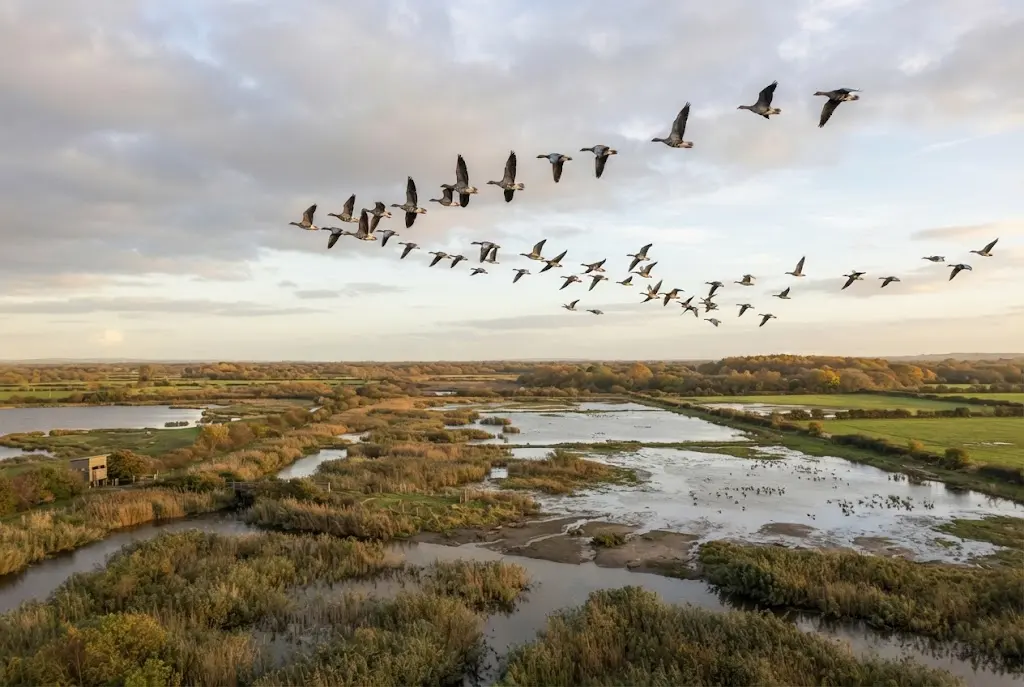
Geese migration is one of the most spectacular seasonal wildlife events in Britain. Every autumn, large flocks arrive from northern breeding grounds, filling wetlands, estuaries, farmland and coastal landscapes with their calls and distinctive V-shaped formations. Some remain throughout winter before heading north again in spring, while resident species stay in Britain throughout the year.
Understanding British geese migration means looking beyond the birds themselves. Their journeys are closely connected to food availability, weather, wetlands and safe places to rest. Britain provides important wintering habitat for several goose populations, making its countryside and wetlands a vital part of wider migration routes.
What Is Geese Migration?
Geese migration is the seasonal movement of geese between breeding and wintering areas. Many populations that spend winter in Britain breed much farther north, including Iceland, Greenland, Svalbard, Arctic Canada and northern Russia.
The timing of migration is influenced by several environmental factors. Shortening days, falling temperatures and changing food availability help signal the approach of autumn migration. In spring, improving conditions and increasing food supplies encourage birds to return towards their breeding grounds.
Migration is not simply a single uninterrupted journey. Geese may stop at wetlands, estuaries and agricultural areas along the route to feed and rest. These stopover locations can be essential to completing the journey successfully.
British Geese Migration: Why Do Geese Come to the UK?
Britain’s relatively mild winter climate and abundance of suitable feeding and roosting habitat make it an important destination for many northern geese. Wetlands provide safe overnight roosts, while nearby grasslands and farmland can provide feeding opportunities.
WWT explains that geese arriving in Britain can gather in very large numbers after breeding across northern regions. During migration, they depend on relatively few important sites where they can refuel and rest before continuing their journeys.
The UK therefore acts as more than simply a final destination. Different goose populations use British sites as seasonal wintering grounds or as parts of broader migration networks.
Where Do Geese Migrate to the UK From?
The answer depends on the species. There is no single migration route followed by all UK geese species.
Pink-footed geese arrive mainly from Iceland, Greenland and Spitsbergen. Barnacle geese visiting Britain come from populations breeding in Greenland and Svalbard. Some white-fronted geese arrive from Russia, while the Greenland population winters mainly in Ireland and western Scotland.
Brent geese also make remarkable journeys from Arctic breeding grounds. The light-bellied population that winters in Northern Ireland travels from the Canadian High Arctic through Greenland and Iceland.
These different origins explain why Britain’s goose populations can vary significantly between regions. A species that is common in northern Scotland may be much less familiar in southern England.
Types of Geese in the UK
There are several wild goose species that regularly occur in Britain, alongside resident or feral populations. Learning the main types of geese in Britain makes it easier to understand their different migration patterns.
Pink-Footed Goose
The pink-footed goose is one of Britain’s most important winter visitors. It breeds in Iceland, Greenland and Spitsbergen and arrives in large numbers during autumn.
RSPB identifies its key features as pink legs and feet, a grey-brown body, and a short dark bill with a pink band. It does not breed in the UK but spends the winter here, particularly in eastern and northern England and parts of Scotland.
The scale of this migration is particularly impressive. RSPB reports that a very large proportion of the world’s pink-footed goose population winters in Britain.
Barnacle Goose
Barnacle geese are medium-sized geese with black heads and necks, white faces and silvery-grey bodies. Wild birds arrive in Britain during autumn and winter from Arctic breeding areas.
The RSPB states that wild barnacle geese visiting Britain migrate from Greenland and Svalbard and spend the colder months around coastal wetlands and estuaries in Scotland, northern England and Ireland.
The species is particularly recognisable when large flocks fly overhead in long formations while producing their characteristic calls.
White-Fronted Goose
White-fronted geese occur in different populations with different migration routes. Russian white-fronted geese can reach southern and eastern England, while Greenland white-fronted geese mainly winter in Ireland and western Scotland.
These populations illustrate why the phrase migration of geese UK can describe several very different journeys. The same broad species name does not necessarily mean the birds follow the same route or winter in the same part of Britain.
Brent Goose
Brent geese are smaller and darker than many other geese found in Britain. They are closely associated with coastal habitats, including saltmarshes and estuaries.
Two main populations occur as winter visitors: dark-bellied and pale-bellied brent geese. Their breeding grounds are separated geographically, resulting in different migration routes.
Light-bellied brent geese undertake a particularly impressive trans-Atlantic journey. WWT reports that birds returning to Strangford Lough in Northern Ireland can travel from the Canadian High Arctic via Greenland and, typically, Iceland.
Greylag Goose
The greylag goose is one of the larger grey geese associated with Britain. Unlike some of the Arctic visitors, greylag geese include populations that breed in Britain as well as birds that move seasonally.
This means that not every large flock of geese seen in Britain during winter represents a long-distance migrant arriving from overseas. Understanding whether a population is resident, migratory or partly migratory is important when interpreting sightings.
Canada Goose
The Canada goose is now a familiar sight in parks, wetlands and other green spaces across Britain. Unlike many of the Arctic geese discussed above, it is not primarily a long-distance seasonal visitor to the UK.
The species originated in North America and was introduced to Britain centuries ago. It has subsequently established widespread populations. RSPB describes Canada geese as occurring across most of the UK, including urban and suburban habitats, farmland, wetlands and grassland.
This is an important distinction when researching Canada geese migration UK. Large flocks may move locally between feeding and roosting areas, but their presence should not automatically be interpreted as the same kind of international migration undertaken by pink-footed or barnacle geese.
Where Do Geese Migrate to in the UK?
There are several important regions for wintering geese. The exact location depends on the species and population.
Eastern and northern England are especially important for pink-footed geese. RSPB identifies areas including Norfolk and other eastern and northern sites among their important wintering locations.
Scotland is important for several species, including pink-footed and barnacle geese. The Solway Firth is another significant area for wintering geese, while northern coastal sites and estuaries can attract large concentrations.
In Northern Ireland, Strangford Lough is particularly important for light-bellied brent geese. WWT reports that around 90% of the world’s light-bellied brent geese gather there, highlighting the international significance of the site.
Where Do Geese Migrate to From the UK?
The spring journey reverses much of the autumn movement. Wintering geese leave Britain and head towards their northern breeding grounds as conditions improve.
For example, pink-footed geese return towards Iceland, Greenland and Spitsbergen after spending the winter in Britain. Barnacle geese also head back towards Arctic breeding grounds in Greenland and Svalbard.
These journeys can involve several stages. Birds may use different stopping points depending on weather, food availability and conditions along the route.
For wildlife watchers, spring departure can therefore be just as significant as the spectacular autumn arrival.
When Does Geese Migration Happen?
Autumn is the main period when many migratory geese become noticeable in Britain. The first arrivals can begin in early autumn, with numbers increasing as more birds reach their wintering grounds.
WWT identifies October as a particularly important month for the arrival of migratory geese at wetlands, with large wintering concentrations developing later in autumn and into winter.
Spring migration generally takes place later in the winter and early spring, although exact timing varies between species, populations and weather conditions.
This seasonal pattern makes autumn and winter especially rewarding periods for anyone interested in observing large goose flocks.
Why Do Geese Fly in V Formation?
One of the most recognisable sights during geese migration is a flock travelling in a V-shaped formation. This arrangement allows birds to coordinate their flight while travelling long distances.
The formation also reduces the difficulty of sustained flight for birds positioned behind and to the side of another bird. Instead of each goose flying completely independently, the flock works as a coordinated group.
Large migrating flocks may change shape repeatedly as individuals adjust their position. Birds can also call to one another while flying, helping maintain group cohesion.
WWT notes that wintering geese often travel between feeding and roosting locations in dramatic formations, particularly around dawn and dusk.
How Far Do Geese Migrate?
The distance varies enormously between species. Some British geese are essentially resident or make relatively short local movements, while others cross seas and international borders to reach their wintering grounds.
Pink-footed geese crossing from Iceland to Britain undertake a demanding North Atlantic journey. WWT’s Martin Mere account describes birds travelling more than 800 miles to reach Britain, with stopovers such as the Faroe Islands helping break up the journey.
Light-bellied brent geese can travel even farther. Their journey between the Canadian High Arctic and Northern Ireland can involve a route of around 3,000 miles, according to WWT.
These distances demonstrate why secure feeding areas and wetlands along migration routes are so important.
How Weather Affects Geese Migration
Weather can influence the timing and progress of migration. Strong winds, storms and poor visibility can make long journeys more difficult, while favourable winds can help birds cross open water and reach their destination more efficiently.
Food availability also matters. A goose needs enough energy to complete its journey, so suitable feeding grounds are essential before, during and after migration.
At major wetland sites, geese may gather in very large numbers because they can combine safe roosting areas with nearby food-rich farmland or grassland. WWT’s description of pink-footed geese at Martin Mere illustrates how roosting water and surrounding feeding fields can work together as part of a migration stopover.
Why Wetlands Are Essential for Migrating Geese
Wetlands are among the most important habitats for migratory geese. They provide water for roosting, grasslands and vegetation for feeding, and open landscapes where large flocks can gather safely.
However, geese do not depend only on wetlands themselves. Many species move between water and nearby farmland, sometimes travelling considerable distances between their overnight roost and daytime feeding areas.
Protecting this wider landscape is therefore an important part of conservation. Losing either the roosting site or the surrounding feeding habitat can reduce the value of an otherwise suitable wintering area.
Threats Facing Migrating Geese
Long-distance migration exposes geese to numerous challenges. Extreme weather, disturbance, habitat loss and changes in food availability can all affect their ability to complete their journeys successfully.
WWT notes that migrating birds face challenges including severe weather, human disturbance and other pressures during their journeys. Protecting resting and refuelling sites is consequently an important conservation priority.
Climate change can also influence migration patterns and wintering distributions. Changes in temperature and food availability may alter where birds stop and how long they remain at particular sites.
Conservation efforts therefore need to consider migration routes as connected systems rather than isolated reserves.
How to Watch Geese Migration Responsibly
Watching a large flock of geese arrive at a wetland can be an unforgettable wildlife experience. However, visitors should avoid disturbing birds, particularly when large numbers are resting or feeding.
- Use established paths, hides and viewing areas where available.
- Keep a respectful distance from feeding and roosting flocks.
- Avoid deliberately flushing birds into the air.
- Keep dogs under control around sensitive wetland and farmland areas.
- Use binoculars or a suitable camera lens instead of approaching closely.
- Follow instructions provided by nature reserves and land managers.
Responsible observation allows people to enjoy migration without unnecessarily increasing the energy costs for birds already undertaking demanding seasonal journeys.
Geese Migration and the Wider UK Bird Cluster
Geese are only one part of Britain’s remarkable seasonal bird movements. If you are learning to recognise birds by sound, our guide to British bird sounds provides a useful introduction to common UK calls and songs.
For nocturnal species, you can also explore British owl sounds and learn how tawny owls, barn owls and other species can be identified by their vocalisations.
Raptors offer another perspective on British wildlife. Our guide to England birds of prey explains how flight shape, behaviour and habitat can help identify species such as buzzards, kestrels, red kites and eagles.
Final Thoughts on Geese Migration
Geese migration connects Britain’s wetlands, farmland and estuaries with some of the most northerly breeding grounds in the world. Pink-footed geese arrive from Iceland and Greenland, barnacle geese travel from Greenland and Svalbard, and brent geese can cross the North Atlantic from Arctic Canada.
The journeys differ between species, but the principle is the same: geese need reliable places to feed, rest and shelter throughout their annual cycle. Britain’s wetlands and surrounding countryside provide essential wintering habitat for many of these birds.
For wildlife enthusiasts, the arrival of geese is one of the clearest signs that autumn has begun. For conservationists, it is also a reminder that protecting wildlife requires cooperation across landscapes and international migration routes.
