

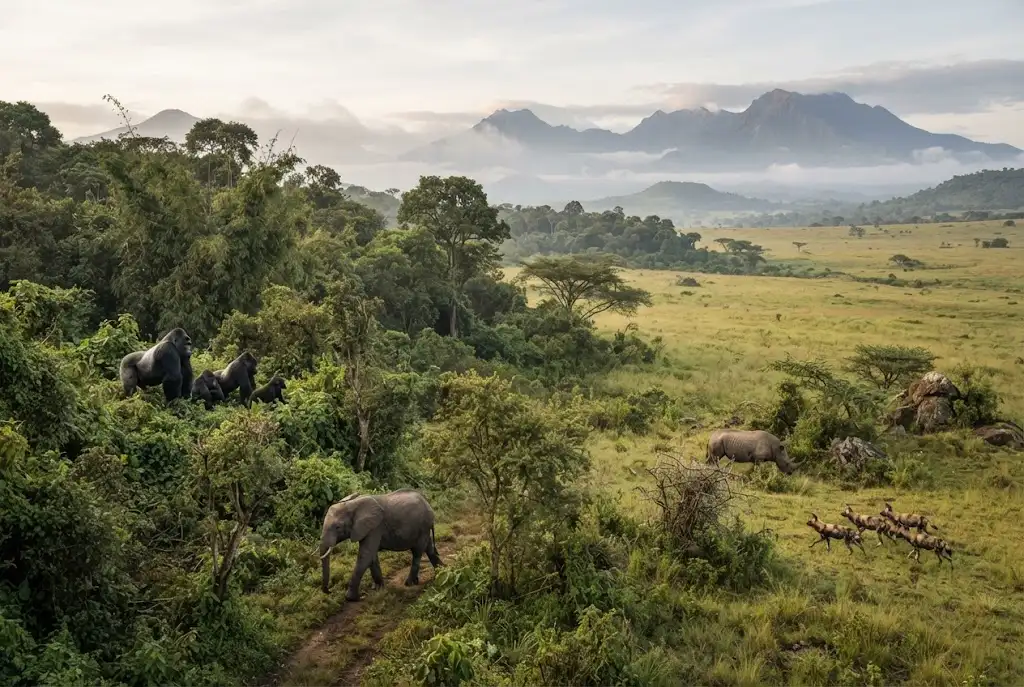
Endangered wildlife in Africa represents some of the world’s most remarkable and ecologically important species. From elephants and rhinos to great apes, big cats, and specialised forest animals, Africa supports an extraordinary range of wildlife. However, habitat loss, illegal hunting, climate pressures, pollution, disease, and human-wildlife conflict continue to place many species under serious pressure.
Understanding which animals are at risk is an important part of understanding Africa’s wider ecosystems. Conservation is not only about protecting individual animals; it also means safeguarding forests, grasslands, rivers, wetlands, and other habitats on which entire communities of species depend.
Why Endangered Wildlife in Africa Matters
Africa’s wildlife plays a major role in maintaining healthy ecosystems. Predators can influence prey populations, large herbivores can shape vegetation, and many birds, mammals, insects, and other organisms contribute to seed dispersal, pollination, nutrient cycling, and other natural processes.
When a species becomes rare, the consequences can extend beyond that animal. The loss of one species may affect food webs and ecological relationships that have developed over thousands of years.
Africa is also home to habitats that are globally significant. Tropical forests, savannahs, mountain ecosystems, deserts, rivers, and wetlands support animals with highly specialised adaptations. Protecting these environments therefore benefits both threatened species and the wider river wildlife and terrestrial communities that share them.
Major Threats Facing African Wildlife
Habitat Loss and Fragmentation
One of the most significant pressures on wildlife is the conversion of natural habitat for agriculture, infrastructure, settlements, mining, and other human activities. When large habitats are divided into smaller areas, animals may struggle to find food, shelter, mates, or safe migration routes.
Forest-dependent species can be particularly vulnerable because they may have limited options when their habitat is fragmented. Protecting connected landscapes is therefore an important part of long-term conservation planning.
Illegal Hunting and Wildlife Trade
Illegal hunting has historically placed severe pressure on several African species. Animals may be targeted for meat, body parts, trophies, or illegal trade. The effects can be especially serious when species reproduce slowly and populations cannot recover quickly.
Strong law enforcement, responsible tourism, community involvement, and international cooperation can all contribute to reducing illegal wildlife exploitation.
Climate and Environmental Change
Changing rainfall patterns, increasing temperatures, drought, wildfires, and other environmental pressures can alter habitats and food availability. Species already affected by habitat loss may have fewer opportunities to move into suitable areas as conditions change.
Water-dependent ecosystems are also important. Rivers and wetlands support diverse communities of animals and other organisms, making the protection of aquatic habitats an important part of broader wildlife conservation.
Examples of Endangered Species from Africa
There is no single group that represents all endangered species from Africa. Threatened wildlife can be found across forests, savannahs, mountains, wetlands, and coastal ecosystems. Conservation status can also change over time as new assessments become available.
African Forest Elephants
African forest elephants are adapted to the forests of central and western Africa. Their smaller size compared with savannah elephants is one of their notable characteristics, but their ecological importance is even more significant. By feeding on vegetation and moving through forests, elephants can influence plant communities and help disperse seeds.
Habitat loss and illegal killing have contributed to major population declines. Protecting remaining forest habitat and maintaining safe landscapes are central to their conservation.
Black Rhinoceroses
Black rhinoceroses are among Africa’s best-known threatened mammals. Their populations have been heavily affected by historical poaching, although conservation programmes have helped some populations recover from extremely low numbers.
Continued protection remains essential because rhinos reproduce relatively slowly and remain vulnerable to illegal wildlife trafficking.
Mountain Gorillas
Mountain gorillas live in a restricted range of montane forest in central Africa. Their limited habitat makes them particularly vulnerable to environmental and human pressures.
Conservation initiatives involving habitat protection, veterinary care, monitoring, tourism management, and local communities have played an important role in their protection.
African Wild Dogs
African wild dogs are highly social predators that require substantial areas in which to hunt and move. Habitat fragmentation can isolate groups and make it harder for populations to remain genetically and ecologically connected.
Protecting large landscapes and wildlife corridors can therefore be especially valuable for this species.
What About the Top 10 Almost Extinct Animals?
Searches for the top 10 almost extinct animals often produce lists of species facing extremely serious population declines. However, there is no universally fixed global list because conservation categories depend on formal assessments and can change as populations and scientific knowledge change.
Instead of focusing only on a ranking, it is more useful to understand why a species is declining. A critically threatened animal may require urgent protection from hunting, while another may need habitat restoration, disease management, captive breeding, or stronger protection of breeding sites.
This approach also helps avoid misleading claims about animals that are supposedly destined to disappear within a particular year.
Are There Animals That Will Be Extinct by 2025?
The phrase animals that will be extinct by 2025 is commonly used in online searches, but extinction cannot normally be predicted with certainty simply by assigning a particular year. Conservation scientists assess population size, trends, habitat, threats, reproduction, and other factors rather than treating a specific calendar year as a guaranteed extinction date.
Some species can decline rapidly, while others may remain at very low numbers for decades if effective conservation measures protect their remaining populations. For that reason, responsible wildlife information should focus on documented conservation status and current threats rather than presenting speculative extinction dates as facts.
What Is the Rarest Creature in the World?
There is no universally agreed answer to the question of the rarest creature in the world. Rarity can mean a very small population, a highly restricted geographical range, or extremely limited sightings.
Some species may have only a small number of known individuals, while others may be difficult to observe because they live in remote forests, deep waters, underground environments, or other inaccessible habitats. A species can therefore be exceptionally rare without necessarily being the same species considered the world’s most endangered.
This distinction matters when discussing African wildlife. Population estimates, distribution, and conservation status should be considered together rather than relying solely on how frequently people encounter an animal.
How Conservation Can Protect African Wildlife
Effective conservation usually requires several approaches working together. Protected areas can preserve important habitats, while wildlife corridors can connect fragmented landscapes and allow animals to move between suitable areas.
Local communities are equally important. Conservation programmes are more likely to succeed when people living alongside wildlife have meaningful economic and social incentives to protect natural habitats. Responsible ecotourism can sometimes contribute to local employment and conservation funding when it is carefully managed.
Technology also supports modern wildlife protection. Camera traps, satellite tracking, acoustic monitoring, drones, geographic information systems, and field surveys can help researchers understand animal movements and identify changes in populations.
Protecting Habitats, Not Just Individual Animals
Wildlife protection works best when conservation considers complete ecosystems. A forest cannot be protected solely for one mammal if the birds, insects, plants, rivers, and other organisms within that environment are ignored.
This broader approach connects endangered African species with other areas of ecological study, including what types of animals live in the forest. Forest ecosystems contain complex communities in which predators, herbivores, decomposers, plants, and microorganisms depend on one another.
Similarly, wetlands provide breeding, feeding, and shelter opportunities for numerous species. Understanding wetland organisms helps explain why protecting water-based habitats is essential for wildlife conservation.
The Importance of Long-Term Wildlife Conservation
Protecting endangered wildlife in Africa is a long-term task rather than a single conservation project. Species need secure habitats, viable populations, food sources, genetic diversity, and protection from major human-driven threats.
Successful conservation also depends on reliable research and continued monitoring. Conservation status can change as populations recover or decline, so wildlife protection strategies must adapt to new evidence.
Africa’s wildlife is part of a much larger ecological system. Protecting endangered species therefore means protecting the landscapes and ecological relationships that allow them to survive. By combining habitat conservation, scientific monitoring, community participation, responsible tourism, and strong action against illegal wildlife exploitation, it is possible to give threatened species a better chance of surviving for future generations.
For authoritative information on species conservation status and global assessments, readers can consult the IUCN Red List of Threatened Species, which provides assessments used widely in conservation planning and biodiversity research.
