

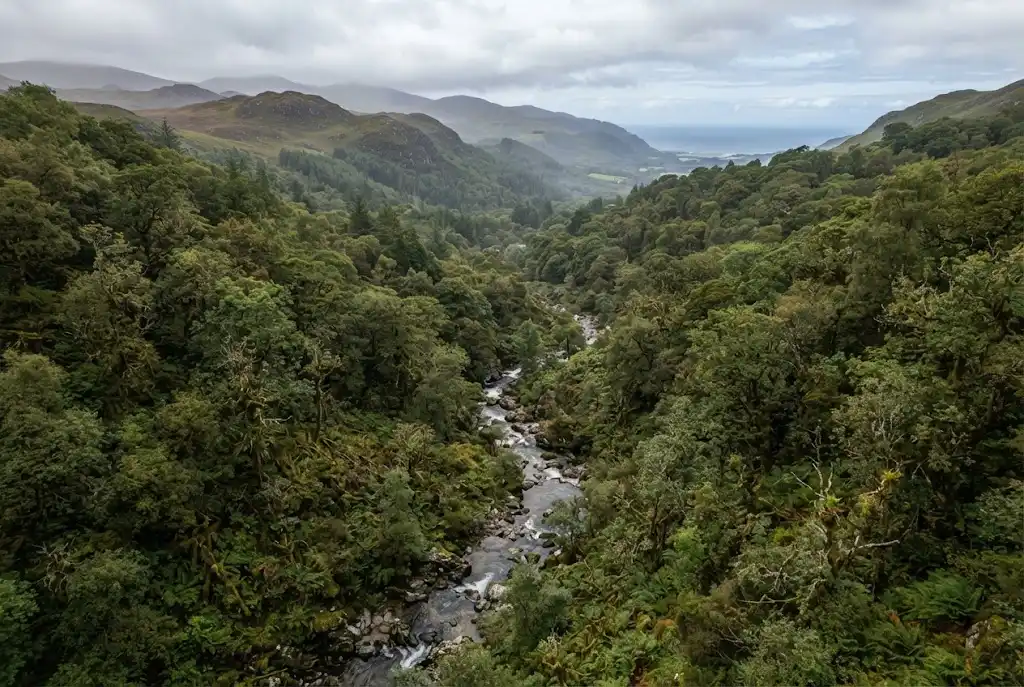
A UK rainforest map reveals something many people find surprising: Britain has its own form of rainforest. These are not tropical jungles but rare temperate, Atlantic or Celtic rainforests that thrive in parts of the country’s wetter western landscapes. They are associated with high rainfall, humidity, relatively mild conditions and ancient native woodland, creating habitats that support unusual plants, fungi, lichens and wildlife.
Rather than forming one continuous rainforest, Britain’s remaining temperate rainforest occurs in scattered areas and fragments. The main regions are found along western Scotland, Wales and parts of south-west England, with suitable rainforest habitat also recognised in Northern Ireland. Understanding where these areas occur helps explain both their ecological importance and the challenges involved in protecting them.
What Does the UK Rainforest Map Show?
The UK rainforest map broadly follows the western and Atlantic-facing parts of Britain where climatic conditions are particularly wet and humid. These conditions are strongly influenced by the Atlantic Ocean and help create an environment suitable for moisture-loving species.
According to the Woodland Trust, Britain’s temperate rainforest is scattered along the western coasts and includes areas of Scotland, Wales, Devon, Cornwall and Cumbria. The UK government’s strategy for England also identifies suitable temperate rainforest conditions in parts of Devon, Cornwall and Cumbria, while suitable climates occur in western Scotland, North and West Wales and parts of Northern Ireland.
It is important to understand that a climate zone capable of supporting rainforest is not automatically the same thing as an intact rainforest woodland. Existing woodland, its ecological condition and the presence of specialist species all matter when identifying genuine temperate rainforest habitat.
Where Are UK Rainforests Located?
The country’s remaining rainforest areas are concentrated primarily in western regions. Their distribution reflects the combination of rainfall, humidity, temperature and suitable native woodland conditions.
Scotland
Scotland contains the largest remaining concentration of Britain’s temperate rainforest. Much of it lies along the western coast and islands, where the Atlantic climate produces high rainfall and relatively mild temperatures.
Argyll is particularly important. The Woodland Trust notes that more than half of Scotland’s rainforest is found in Argyll, while western Highland areas also contain important rainforest landscapes. Examples include woodland around Loch Arkaig, Ben Shieldaig and other sites across the western Highlands and islands.
Scotland’s rainforest is notable for its abundance of mosses, liverworts, lichens, fungi and ferns. These moisture-loving communities can cover tree trunks, rocks, branches and the forest floor, giving the woodland its distinctive appearance.
Wales
Wales contains important fragments of Atlantic rainforest, particularly in western and northern parts of the country. Deep valleys, wooded gorges, streams and areas exposed to moist Atlantic weather can provide favourable conditions.
Places such as Llennyrch illustrate the character of Welsh rainforest. Moist woodland, rocky landscapes and river environments can create sheltered conditions for specialist plants and other organisms.
These habitats also demonstrate the close relationship between forests and freshwater. Rivers and streams running through woodland can create additional ecological niches for amphibians, insects, birds and other river wildlife.
South West England
South-west England contains important temperate rainforest landscapes, particularly in Devon and Cornwall. Deep wooded valleys, steep-sided gorges and high rainfall create suitable conditions in some locations.
Sites in Devon include Fingle Woods, Ausewell Wood and other rainforest landscapes. The region’s wooded valleys and streams provide habitat for specialist lichens, mosses, fungi and wildlife.
Government research estimates that approximately 18,000 hectares of temperate rainforest remain in England, with Devon, Cornwall and Cumbria identified as areas where this habitat occurs.
Cumbria
Cumbria is another important part of the British rainforest story. The wetter western landscape and areas of native woodland can provide conditions suitable for Atlantic rainforest communities.
Although the region may not immediately resemble the rainforest image associated with tropical countries, its combination of rainfall, woodland, mosses, lichens, streams and humid microclimates can create a distinctly rainforest-like ecosystem.
Northern Ireland
Northern Ireland also contains areas with climatic conditions suitable for temperate rainforest. The wider British and Irish Atlantic rainforest zone extends along western-facing landscapes where wet and humid conditions occur.
The distribution is fragmented, however, so a broad climate zone should not be interpreted as one continuous forest stretching across the country.
Why Does Britain Have Rainforest?
The key is climate. Temperate rainforest does not require tropical temperatures. Instead, Britain’s Atlantic rainforests depend on a combination of frequent rainfall, high humidity and relatively mild conditions.
The Atlantic Ocean plays a major role. Moist air arriving from the west can produce substantial rainfall when it meets the UK’s western landscapes. Mountains and hills can further influence rainfall patterns, creating particularly wet conditions in some valleys and coastal areas.
This wet environment supports organisms that require consistently moist conditions. Mosses, liverworts, lichens and fungi can thrive on trees and rocks, while dense vegetation provides shelter and food for insects, birds and mammals.
What Animals Live in UK Rainforests?
Britain’s temperate rainforests are home to a variety of animals, although they do not contain the large tropical mammals people might associate with the word rainforest.
Wildlife found in these habitats can include otters, red squirrels, dormice, bats and woodland birds. Species such as pied flycatchers, wood warblers and redstarts are associated with suitable western woodland habitats.
Small creatures are particularly important. The abundance of insects provides food for birds and other animals, while damp leaf litter, fallen wood and moss-covered surfaces create shelter for numerous invertebrates and amphibians.
This is why a rainforest ecosystem should not be judged by the size or number of large animals it contains. Much of its ecological value comes from specialist species that may be extremely difficult to see.
Forest in Animals: How Wildlife Uses Rainforest Habitats
The phrase forest in animals can refer to the animals that depend on woodland ecosystems for food, shelter and reproduction. Britain’s rainforest habitats demonstrate how different species use different layers of a forest.
Birds may feed among mature branches, mammals can travel through dense vegetation, insects occupy leaves and bark, and amphibians take advantage of damp ground and streams. Fallen trees and decaying wood can provide further habitat for beetles, fungi and other organisms.
Understanding what types of animals live in the forest therefore means looking at the complete ecosystem rather than concentrating only on large, recognisable wildlife.
Why the UK Rainforest Is Important
Temperate rainforest is exceptionally valuable because it supports specialist biodiversity. The Woodland Trust describes Britain’s rainforests as globally rare ecosystems with important communities of mosses, liverworts, lichens, fungi and other organisms.
These forests also store carbon, protect soils and help regulate local water systems. Trees and vegetation can slow rainfall, stabilise slopes and contribute organic material to streams and surrounding ecosystems.
Rainforest woodland can also provide important ecological corridors. When connected areas of habitat remain intact, animals and plants have greater opportunities to move and maintain viable populations.
Threats Shown by the UK Rainforest Map
Looking at the distribution of rainforest habitat also highlights one of its biggest challenges: fragmentation. Instead of one continuous woodland, many rainforest areas now exist as isolated fragments surrounded by other land uses.
Fragmentation can make it harder for species to move between habitats. It can also reduce the resilience of small populations and make some ecological communities more vulnerable to environmental changes.
Other pressures include plantation forestry, invasive species, excessive grazing, deer browsing, development, changes in land management and climate-related pressures. The Woodland Trust’s recent assessment reports that many rainforest areas are in poor or unfavourable condition.
Rhododendron and Other Invasive Plants
Invasive plants can create significant problems in some rainforest landscapes. Rhododendron, for example, can form dense growth that suppresses native vegetation and changes the structure of woodland habitats.
When invasive vegetation becomes dominant, it can reduce the diversity of plants growing beneath the canopy. This can have knock-on effects for insects, birds and other animals that depend on native vegetation.
Controlling invasive plants can therefore be an important part of rainforest restoration and habitat management.
UK Rainforest and River Wildlife
One of the most interesting features of Britain’s temperate rainforest is its relationship with water. Streams and rivers frequently run through or alongside rainforest woodland, creating a network of connected habitats.
Water can influence the humidity of woodland and provide habitat for aquatic species. Meanwhile, trees along riverbanks can shade streams, stabilise soil and contribute leaves and other organic material to freshwater food webs.
Protecting wetland organisms and freshwater habitats is therefore closely connected with protecting surrounding rainforest landscapes.
Can You Visit a UK Rainforest?
Yes. There are rainforest sites and woodland landscapes that can be visited across parts of Scotland, Wales and England. The Woodland Trust lists rainforest sites and walks in locations including western Scotland, Wales, Devon, Cornwall and Cumbria.
Visitors should remember that these are fragile ecosystems. Staying on appropriate paths, following local access guidance, avoiding damage to vegetation and respecting wildlife can help reduce pressure on sensitive habitats.
A rainforest walk can also be very different from a conventional woodland visit. Moss-covered trunks, dripping branches, ferns, lichens, streams and humid ravines can make these landscapes feel remarkably different from drier forests elsewhere in Britain.
How UK Rainforests Can Be Protected
Protecting Britain’s rainforests requires both conservation and restoration. Existing ancient and semi-natural woodland needs protection, while damaged sites may require active management.
Restoration can involve controlling invasive plants, reducing damaging pressures, reconnecting fragmented habitats and encouraging native woodland regeneration. Maintaining healthy river corridors and surrounding wetlands can also strengthen the wider ecosystem.
The UK government’s strategy for England describes investment, protection and partnership as key parts of its approach to recovering England’s temperate rainforests.
Why a UK Rainforest Map Matters
A UK rainforest map is more than a way to locate interesting woodland walks. It helps reveal the geographical pattern of one of Britain’s rarest habitats and shows why conservation needs to be targeted at the landscapes where suitable climate and native woodland conditions overlap.
From the rainforests of western Scotland to Welsh valleys and the wooded landscapes of Devon and Cornwall, these habitats form part of Britain’s natural heritage. Their survival depends on protecting the remaining fragments, improving habitat condition and reconnecting woodland wherever possible.
Understanding their location also makes it easier to appreciate the wider ecological network surrounding them. Forests, rivers, wetlands and wildlife are closely connected, and protecting one component can strengthen the resilience of the others.
For current information about Britain’s temperate rainforests and conservation work, the Woodland Trust’s Britain’s rainforests resource provides maps, habitat information and examples of rainforest sites.
