

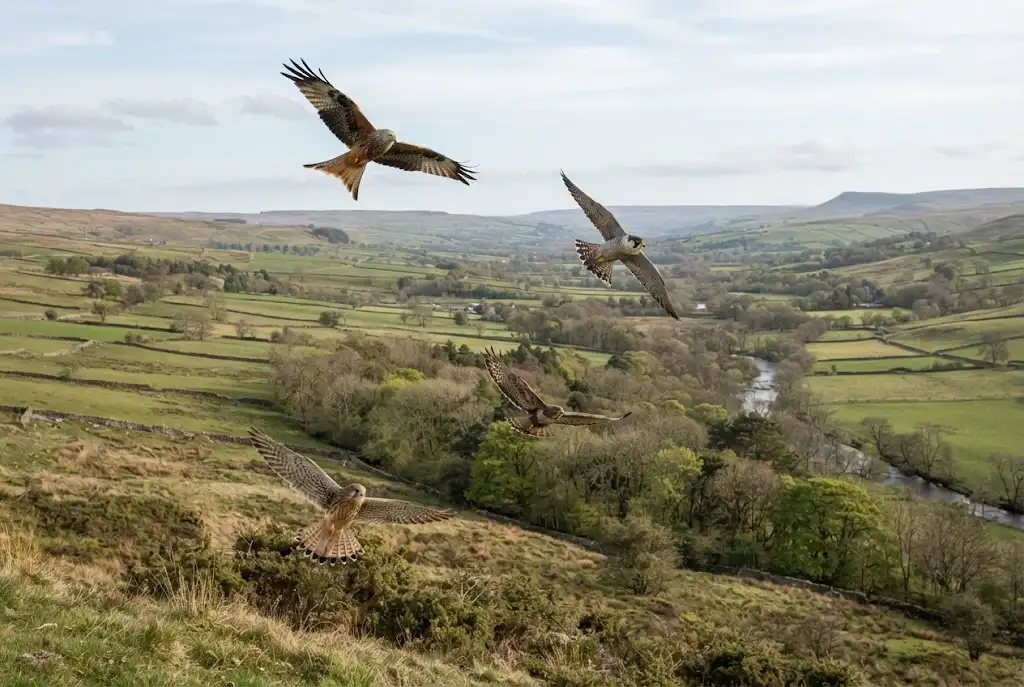
Looking at pictures of predatory birds can be one of the easiest ways to begin identifying Britain’s birds of prey. Raptors can look remarkably similar when they are high in the sky, but their silhouette, wing shape, tail, flight behaviour, markings and habitat can provide valuable clues. From hovering kestrels and fast peregrines to soaring red kites and enormous white-tailed eagles, the UK has an impressive variety of birds of prey.
Bird identification becomes much easier when you learn to look at several characteristics rather than relying on colour alone. A bird’s size, proportions and behaviour can often reveal its identity even when you cannot see fine feather details. The RSPB recommends considering size, body silhouette, beak and feet, colour and markings, behaviour, habitat and time of year when identifying birds.
How to Use Pictures of Predatory Birds for Identification
Photographs are useful because they allow you to compare the shape and markings of different raptors. However, a single photograph does not always provide enough information. Lighting, distance, viewing angle, age and sex can all change how a bird appears.
When comparing pictures of predatory birds, start with the overall silhouette. Look at whether the wings are broad, narrow, rounded or sharply pointed. Then examine the tail. A long square tail, a deeply forked tail or a short pointed tail can immediately narrow down the possibilities.
Finally, consider what the bird was doing. Was it hovering over grassland, soaring in circles, flying low over a moor, chasing another bird or gliding with almost no wing movement? Behaviour can be just as useful as appearance.
Types of Predatory Birds Found in the UK
Britain’s birds of prey include falcons, hawks, harriers, kites, buzzards, eagles and ospreys. The species vary considerably in size, habitat and hunting technique.
The RSPB’s current identification guide covers UK birds of prey ranging from the tiny Merlin to the enormous white-tailed eagle.
Kestrel
The common kestrel is one of the UK’s most recognisable raptors. It is particularly famous for hovering almost motionless while searching the ground for prey.
In photographs, look for the relatively long tail, pointed wings and dark markings. Male kestrels typically have a slate-grey head and upper tail, while females are generally browner. Both sexes have a distinctive dark mark below the eye.
The kestrel’s hovering behaviour is one of its strongest identification clues. It commonly hunts over grassland, farmland, heathland and roadside verges.
Sparrowhawk
The Eurasian sparrowhawk is a compact woodland hunter that is often seen moving rapidly through gardens, parks and wooded areas.
Its flight silhouette is particularly useful. Sparrowhawks have relatively short, rounded wings and a long square-ended tail. Their characteristic flight can include several quick wingbeats followed by a glide.
Adult males have a blue-grey back and warm orangey-brown barring underneath, while females are larger and generally browner.
Common Buzzard
The common buzzard is one of the UK’s most widespread birds of prey. It can often be seen soaring over countryside, woodland edges, farmland and open landscapes.
Buzzards can vary significantly in colour, which makes identification based purely on plumage unreliable. Their broad wings and relatively broad, rounded appearance in flight are more useful clues.
When soaring, compare the overall shape with other large raptors. A buzzard’s tail is not deeply forked like a red kite’s, making the two easier to separate when viewed together.
Red Kite
The red kite is particularly easy to recognise once you know its distinctive silhouette. Its long, deeply forked tail is one of the most obvious identification features.
Red kites have long angular wings, reddish-brown bodies and pale areas beneath the wings. Their tail is constantly adjusted while soaring, helping them steer through the air.
The species has also made a notable recovery in Britain following reintroduction efforts. Today, red kites can be seen across much of Wales and parts of England, Scotland and Northern Ireland.
England Birds of Prey to Look For
There are many England birds of prey, ranging from familiar countryside species to specialised raptors associated with particular habitats.
Kestrels can be seen in open countryside and sometimes urban areas. Buzzards are widespread, while sparrowhawks are frequently encountered around woodland and gardens. Peregrine falcons can occur in both natural cliff environments and urban areas, where tall buildings can provide suitable nesting and hunting locations.
Red kites are another increasingly familiar sight in many parts of England. Meanwhile, marsh harriers are associated with wetlands and reedbeds, and hobbies can be seen hunting over open countryside during the warmer months.
The exact likelihood of seeing a species depends on location, season and habitat, so local distribution information should always be considered alongside visual identification.
Biggest Bird of Prey in the UK
If you are searching for the biggest bird of prey in Britain, the white-tailed eagle is the key species to know. It is the UK’s largest bird of prey, with a wingspan that can reach approximately 2.4 metres.
White-tailed eagles are enormous, heavy-set birds. Adults have broad wings, a large yellow bill and a pale head and tail. Their huge wings can appear almost rectangular when they soar.
Golden eagles are also exceptionally large. They are slightly smaller than white-tailed eagles but remain among Britain’s most impressive raptors. Golden eagles are strongly associated with upland and mountainous landscapes, particularly in Scotland.
Big Bird of Prey Identification: Eagle or Buzzard?
Large raptors can be difficult to identify at a distance. A common mistake is to assume that every large soaring bird is an eagle.
Start with proportions. White-tailed eagles have exceptionally broad wings and a very heavy appearance. Golden eagles have long wings that create a different silhouette and are often seen soaring over mountains and moorland.
Buzzards are considerably smaller and much more common. When viewed high overhead, however, their apparent size can be deceptive. Comparing the bird with nearby species, landscape features or familiar birds can help establish a better sense of scale.
Raptor Bird Identification in Flight
Raptor bird identification becomes particularly interesting when a bird is flying because its silhouette may be easier to see than its plumage.
Look at these features:
- Wing shape: Are the wings broad, narrow, rounded or sharply pointed?
- Tail shape: Is the tail long, short, rounded, square or forked?
- Wing position: Are the wings flat, slightly raised or held in a shallow V?
- Flight pattern: Does the bird flap continuously, flap and glide, hover or soar?
- Speed: Is it moving slowly over the landscape or making rapid hunting manoeuvres?
- Habitat: Is it above woodland, farmland, wetlands, cliffs, coast or mountains?
The RSPB specifically highlights wing and tail shape as useful clues when identifying birds in flight. For example, a red kite’s forked tail contrasts strongly with the wedge-shaped tail of a buzzard.
Raptor Identification in Flight: Key Species
Peregrine Falcon
The peregrine is Britain’s largest falcon and has a powerful, streamlined appearance. Its wings are pointed and triangular, while its tail is relatively short.
Peregrines are exceptionally fast hunters and can be difficult to follow visually. When seen at a distance, their pointed wings and compact body can distinguish them from broad-winged soaring species.
Merlin
The merlin is Britain’s smallest bird of prey. Its compact shape, pointed wings and short tail are useful identification features.
Merlins are fast and agile hunters that pursue small birds. Their rapid wingbeats followed by short glides can help separate them from larger falcons.
Osprey
The osprey is particularly distinctive because it specialises in catching fish. From below, its predominantly white underparts and angled wings can make it resemble a large gull at a distance.
One of its strongest identification clues is the dark patch around the wrist area of the wing. Ospreys also have a characteristic dark eye stripe and pale grey legs rather than the yellow legs common in many other UK raptors.
Hen Harrier
Hen harriers are relatively slim raptors that often fly low over open ground. They frequently hold their wings in a shallow V while searching for prey.
Males are predominantly grey with darker wing tips, while females are brown and streaked. Both sexes have a noticeable pale rump, which can be helpful when the bird is viewed from behind.
The species is among the UK’s rarer birds of prey and is classified as Red-listed by the RSPB.
Black Birds of Prey: What Could You Be Seeing?
The phrase black birds of prey can be misleading because very few UK raptors are uniformly black. Dark lighting, distance and silhouette can make brown or grey birds appear black.
Juvenile and adult plumages can also differ considerably. A young bird may look much browner or more heavily streaked than an adult of the same species.
Instead of relying on colour alone, examine the shape of the bird. A forked tail suggests a kite, while broad wings and a heavy silhouette may point towards an eagle. Pointed wings and a compact body can indicate a falcon.
How to Identify Birds of Prey From Photographs
When using photographs, try to obtain several views whenever possible. A side-on image can reveal plumage and body proportions, while an underside view can show wing patterns and the shape of the tail.
Do not overlook the background. The habitat can provide valuable information. A raptor over a mountain range may suggest a different set of possibilities from one hunting over a reedbed or hovering above a roadside verge.
Time of year can also matter. Some birds of prey are resident throughout the year, while others migrate or have seasonal movements. The hobby, for example, is a summer migrant to the UK and is usually present from around April to October.
Why Birds of Prey Matter to Ecosystems
Predatory birds play important roles in natural food webs. They hunt mammals, birds, reptiles, insects and other prey depending on the species. Some also consume carrion.
By influencing prey populations and participating in natural food webs, raptors form an important part of healthy ecosystems. Their presence can also make them valuable subjects for ecological monitoring and conservation.
Protecting birds of prey therefore involves more than protecting individual birds. It requires maintaining suitable habitats, protecting nesting sites, preserving food sources and reducing threats such as persecution, disturbance and habitat loss.
Connecting Birds of Prey With Forest Wildlife
Many raptors depend on woodland or use forests as hunting and nesting habitats. Others prefer open landscapes but may move between woodland, grassland and wetlands during their daily activities.
This makes birds of prey part of the broader forest ecosystem. Understanding what types of animals live in the forest can help explain how predators, prey, trees, insects and other organisms interact.
Raptors can also hunt around rivers and wetlands, where fish, amphibians, waterbirds and small mammals provide potential food. This connects their ecology with wider river wildlife and wetland habitats.
Final Tips for Raptor Identification
The next time you see a bird of prey, resist the temptation to identify it immediately from colour alone. First determine its approximate size, then examine the wing and tail shape. Watch how it flies, note its habitat and consider the season.
With practice, these observations become much easier. Even a distant silhouette can provide enough information to narrow down the possibilities.
For a reliable starting point, the RSPB’s bird-of-prey identification guide provides photographs and identification features for numerous UK raptors, from kestrels and sparrowhawks to peregrines, kites and eagles.
Learning to recognise these birds is not simply a birdwatching skill. It is also a way of appreciating the predators that form an important part of Britain’s wider ecological network.
