

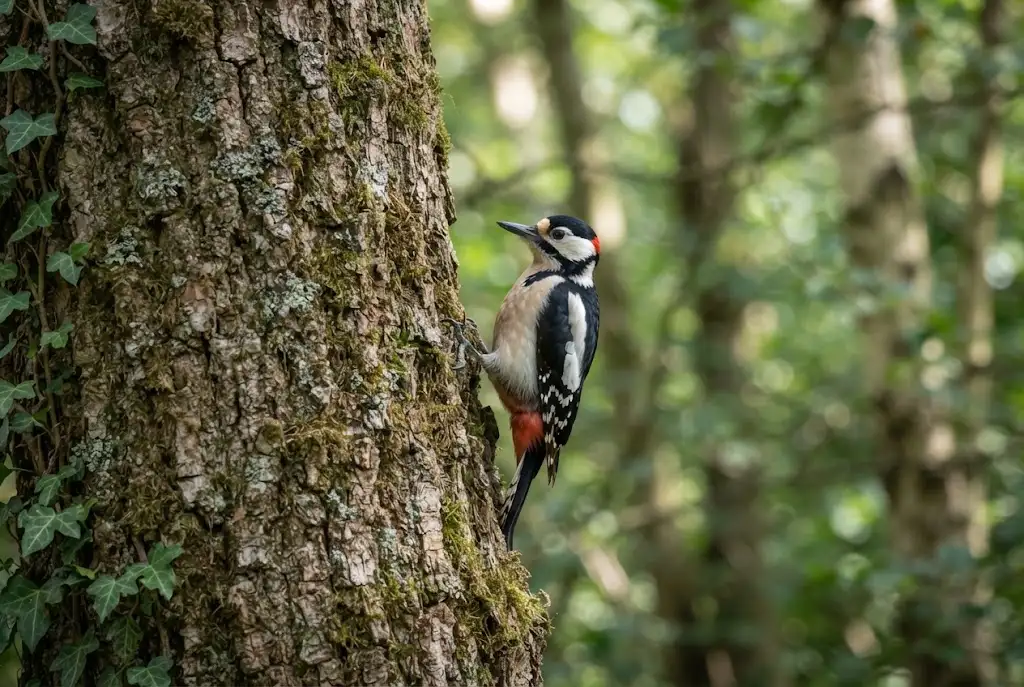
Learning UK woodpeckers identification becomes much easier once you know what to look for in plumage, size, habitat, flight and sound. Britain has three resident woodpecker species: the Great Spotted Woodpecker, Green Woodpecker and Lesser Spotted Woodpecker. Although all three are adapted to life around trees, they look and behave quite differently.
For beginners, the biggest challenge is often seeing the bird clearly. Woodpeckers can stay on the far side of a trunk, move quickly between branches or remain high in the canopy. Fortunately, their calls, drumming, colouring and preferred habitats provide useful clues. Understanding these features can also make identifying other British field birds much easier when exploring woodland, parks and countryside.
UK Woodpeckers Identification: The Three Resident Species
When identifying British woodpeckers, start by considering size and overall colour. The three resident species are not simply smaller or larger versions of the same bird. Each has distinctive characteristics that can help separate it from the others.
Great Spotted Woodpecker
The Great Spotted Woodpecker is probably the species most people associate with a traditional black, white and red woodpecker. It is roughly Blackbird-sized but more slender, with bold black-and-white markings and red colouring around the lower body. Adult males have a red patch on the back of the head, while juveniles have a red crown.
Its strong contrast makes it relatively straightforward to recognise once you have a good view. The bird also has a characteristic bouncing or undulating flight. In gardens, parks and woodland, it may cling vertically to a tree trunk before quickly moving around to the other side.
Great Spotted Woodpeckers can also visit garden feeders, particularly where suitable food is available. Looking carefully at tree trunks, larger branches and garden feeding stations can therefore be productive for anyone beginning bird identification.
Green Woodpecker
The Green Woodpecker is noticeably different from the other two resident species. As its name suggests, it has predominantly green upperparts, while its yellow-green rump and red colouring around the head create a distinctive appearance.
It is the largest of Britain’s three breeding woodpeckers and is often associated with woodland edges, parks, grassland and open areas near trees. Unlike the Great Spotted Woodpecker, it frequently spends time feeding on the ground, where it searches for ants.
Its voice is one of the easiest identification clues. The Green Woodpecker has a distinctive laughing or descending call, sometimes described as a “yaffle”. If you hear this sound before seeing the bird, it can immediately narrow down the possibilities.
Lesser Spotted Woodpecker
The Lesser Spotted Woodpecker is the smallest and least common of Britain’s three resident woodpeckers. At around House Sparrow size, it can be surprisingly difficult to notice, especially because it often spends time high in the canopy.
Its plumage is mainly black and white, with barred markings across the back and wings. Males have a red crown, while females have a black crown. Unlike the Great Spotted Woodpecker, it does not have red colouring on the belly.
The species is particularly associated with mature broadleaved woodland containing deadwood. Its small size, quieter behaviour and preference for higher branches mean that patience is often essential. Calm mornings can be useful because its softer calls and lighter drumming may otherwise be lost among other woodland sounds.
How to Identify Woodpeckers by Sound
Sound can be just as important as appearance when identifying a woodpecker. Birds are often heard before they are seen, particularly in dense woodland where trunks and foliage obstruct the view.
One of the most recognisable sounds is the rapid drumming of the Great Spotted Woodpecker. Rather than being a series of ordinary pecks while feeding, drumming is a communication behaviour and can carry surprisingly far through woodland.
If you hear a rapid burst of tapping coming from a tree, stop and listen before moving closer. Try to determine whether the sound is repeated from the same area and then scan the nearby trunks and branches.
The Lesser Spotted Woodpecker also drums, but its drumming is lighter and faster. Its smaller size and quieter behaviour make listening particularly valuable when searching suitable woodland.
By contrast, the Green Woodpecker is better known for its distinctive laughing call than for the powerful drumming associated with the Great Spotted Woodpecker. Learning these different sounds can dramatically improve your chances of finding birds that remain hidden from view.
Where Can You Find Woodpeckers in the UK?
Habitat is another important part of UK woodpeckers identification. Instead of looking at every bird as a completely open-ended identification challenge, consider whether the habitat matches the species.
Great Spotted Woodpeckers occur in a wide range of wooded environments and are also regular visitors to gardens and parks. Mature trees provide feeding opportunities, nesting sites and suitable surfaces for drumming.
Green Woodpeckers are commonly associated with a mixture of woodland, grassland and open ground. Because ants are an important part of their diet, grassy areas around trees can be especially useful places to search.
Lesser Spotted Woodpeckers have more specialised requirements and are strongly associated with suitable mature woodland. Their tendency to remain high in trees also means that looking upwards is essential.
When exploring any woodland, avoid focusing only on the most obvious trees. Listen first, then scan trunks, branches and canopy levels systematically. This approach is useful for woodpeckers as well as many other UK bird species associated with different habitats.
Great Spotted Woodpecker Sound and Other Clues
The great spotted woodpecker sound most people notice is its rapid drumming. A short burst can be surprisingly loud and may appear to come from much closer than the bird actually is.
Its sharp call provides another useful clue. If you hear a brief, repeated call followed by movement between trees, look for a black-and-white bird with flashes of red. The combination of sound, flight and appearance is much more reliable than relying on one feature alone.
Season can also influence what you hear. Drumming is particularly associated with the breeding period, although woodpeckers remain vocal at other times. A quiet woodland walk during the appropriate season can therefore be an excellent opportunity to practise identifying woodland sounds.
UK Woodpeckers Identification Tips for Beginners
If you are new to birdwatching, avoid trying to memorise every feature immediately. Instead, work through a simple checklist.
- Check the size: Does the bird look closer to a House Sparrow or Blackbird in size?
- Look at the main colours: Is it predominantly green, or black and white?
- Check for red: Note where the red appears on the head or body.
- Watch the flight: A bouncing, undulating flight can provide a useful clue.
- Listen carefully: Distinctive calls and drumming can identify a bird before you see it.
- Consider habitat: Think about whether you are in mature woodland, a park, garden or open grassland.
- Look at the canopy: Do not only search low tree trunks; Lesser Spotted Woodpeckers may be much higher.
It is also worth remembering that identification should be based on several clues together. A single flash of red or a distant tapping sound may not be enough to identify a species confidently.
Protecting Woodland Habitats for Woodpeckers
Woodpeckers depend on healthy habitats that provide food, nesting opportunities and suitable trees. Dead and decaying wood can be particularly valuable because it supports insects and provides surfaces for feeding and drumming.
This does not mean every dead tree should automatically be removed or left unmanaged. Woodland management involves balancing safety, habitat value and the wider ecological needs of a site. Where appropriate, retaining standing deadwood and fallen timber can contribute to a more diverse woodland ecosystem.
The Lesser Spotted Woodpecker illustrates why habitat quality matters. Its declining population and specialised woodland requirements make suitable habitat particularly important for conservation. Understanding the needs of individual species is therefore an important part of wider UK wildlife conservation.
How Woodpecker Identification Fits Into British Birdwatching
Woodpecker watching is a useful introduction to wider bird identification because it encourages observers to combine visual and acoustic evidence. Once you become comfortable recognising a Great Spotted Woodpecker’s drumming or a Green Woodpecker’s distinctive call, you can start applying the same approach to other woodland and wetland species.
For example, when exploring wetlands, identification often depends on body shape, bill length, behaviour and habitat. Comparing species such as herons and cranes requires a different set of visual clues, while identifying types of seagulls in the UK involves paying close attention to size, plumage and seasonal appearance.
The same principle applies across British wildlife. Start with habitat, observe the animal’s behaviour, note distinctive physical features and then use calls or other sounds where available. With regular practice, identification becomes less about guessing and more about recognising patterns.
Final Thoughts on UK Woodpeckers Identification
UK woodpeckers identification is easiest when you combine appearance, sound, behaviour and habitat rather than relying on one feature. The Great Spotted Woodpecker stands out through its black, white and red plumage and powerful drumming, while the Green Woodpecker is recognised by its green colouring, ground-feeding habits and distinctive laughing call. The much smaller Lesser Spotted Woodpecker requires greater patience because it often stays high in mature woodland.
Take time to listen as well as look. A sound from high in the canopy, a bouncing shape crossing between trees or a flash of red on a trunk can all provide valuable clues. With repeated visits to suitable habitats, identifying Britain’s woodpeckers becomes a rewarding part of learning about the country’s wider ecology and wildlife.
For reliable bird identification guidance and species information, the RSPB bird identification resources are a useful starting point for further learning.

2 Comments
Pingback: What Does Squirrel Eat? UK Diet and Feeding Habits
Pingback: Interesting Facts About Birds: 25 Facts You Should Know