

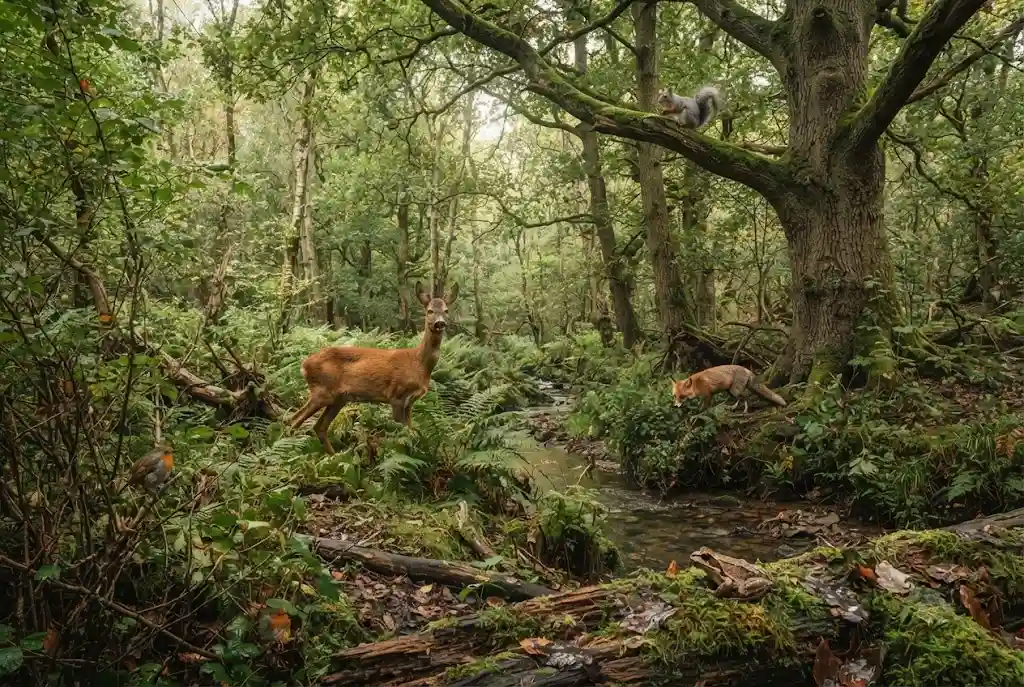
Wondering what types of animals live in the forest? Forests support some of the most diverse animal communities on Earth. From large mammals and birds of prey to reptiles, amphibians, insects, and tiny organisms hidden beneath leaves and soil, forest habitats provide food, shelter, breeding areas, and protection for an enormous variety of wildlife.
Not every forest contains the same animals. Climate, vegetation, altitude, water availability, geography, and habitat structure all influence which species can survive in a particular woodland. A temperate forest in the UK, for example, has a very different wildlife community from a tropical rainforest in Africa or South America.
Understanding forest animals also means looking beyond individual species. Forest ecosystems are interconnected environments where plants, animals, fungi, microorganisms, rivers, wetlands, and soil communities all contribute to ecological balance.
What Types of Animals Live in the Forest?
Forests can be divided into several habitat layers, and each layer supports different wildlife. The forest floor may contain mammals, reptiles, amphibians, insects, worms, and decomposers. Shrubs and lower vegetation provide feeding and nesting opportunities, while tree trunks and branches support climbing animals, birds, insects, and other species. The canopy can form a separate ecosystem high above the ground.
Common groups of forest animals include:
- Mammals
- Birds
- Reptiles
- Amphibians
- Insects
- Arachnids
- Molluscs
- Worms and other invertebrates
- Microscopic organisms
The combination varies from one forest to another, but these groups illustrate how much life can exist within a relatively small area.
Forest Mammals
Mammals are among the most familiar forest in animals. They range from tiny rodents and bats to large herbivores and predators. Many mammals have evolved specialised features that help them find food and move through woodland environments.
Herbivores
Herbivorous mammals feed on leaves, grasses, fruits, seeds, bark, roots, shoots, or other plant material. Deer, squirrels, some primates, elephants, and many other mammals can use forest vegetation as an important food source.
Herbivores influence forests through their feeding behaviour. By consuming vegetation, spreading seeds, and moving through different parts of a habitat, they can affect plant growth and forest structure.
Predatory Mammals
Forests also support predators. Depending on the region, these can include foxes, wild cats, wolves, bears, mustelids, and other carnivorous or omnivorous mammals.
Predators are important because they help regulate populations of prey species. Their presence can contribute to a functioning food web in which different animals occupy different ecological roles.
Tree-Dwelling Mammals
Some mammals spend much of their lives above ground. Squirrels, certain primates, gliding mammals, and many species of bats use trees for shelter, feeding, movement, or reproduction.
These animals may have adaptations for climbing, gripping branches, jumping between trees, or navigating complex vegetation. A continuous canopy can therefore be particularly valuable for species that rarely travel across open ground.
Birds of the Forest
Birds are another major component of forest biodiversity. Woodlands can provide nesting sites, insects, seeds, fruits, nectar, small animals, and other food sources.
Forest birds occupy different parts of the habitat. Some feed on the ground, others search tree trunks for insects, while canopy species may spend most of their time high among branches and leaves.
Birds can also contribute to forest regeneration. Fruit-eating species may consume berries and disperse seeds over considerable distances. Predatory birds, meanwhile, can help control populations of smaller animals.
Some forest birds are also raptors. If you are interested in identifying these species, a future guide to pictures of predatory birds can help distinguish different types of birds of prey and their physical characteristics.
Reptiles in Forest Habitats
Reptiles can occupy a range of forest environments, particularly where suitable temperatures, moisture, shelter, and prey are available. Depending on geography, forest reptiles may include snakes, lizards, turtles, tortoises, and other specialised species.
Snakes can live on the forest floor, climb trees, or spend time around streams and other sources of water. Lizards may bask on exposed surfaces or search vegetation and leaf litter for insects.
Forest reptiles are part of complex food webs. Some consume insects and small animals, while larger reptiles can become prey for mammals and birds.
Amphibians and Moist Forest Environments
Frogs, toads, salamanders, and newts are particularly associated with damp environments. Many amphibians depend on water or moist conditions during part of their life cycle.
Forest streams, temporary pools, leaf litter, fallen logs, and shaded ground can provide valuable microhabitats. Because amphibians can be sensitive to changes in moisture and environmental quality, healthy forest ecosystems can be important for maintaining their populations.
Forests near rivers can provide especially diverse habitat. This creates a direct connection between forest biodiversity and river wildlife, because animals can move between woodland and freshwater environments depending on their needs.
Insects and Other Small Forest Animals
When considering what types of animals live in the forest, it is easy to focus on large mammals and birds. Yet insects and other small creatures represent a huge part of forest biodiversity.
Beetles, butterflies, moths, ants, bees, wasps, flies, grasshoppers, dragonflies, and many other insects can occupy different ecological niches. Some feed on plants, some pollinate flowers, some hunt other insects, and others break down dead organic material.
Spiders and other arachnids also contribute to forest food webs. They can control populations of insects and become food for birds, amphibians, reptiles, and mammals.
These small animals may be difficult to notice, but their ecological contribution can be substantial.
Animals of the Land and the Forest Floor
The phrase animals of the land includes many creatures that spend much of their time away from water. Forest floors can provide a particularly rich environment because fallen leaves, branches, roots, rocks, fungi, and decaying wood create numerous hiding and feeding places.
Small mammals may burrow beneath the ground, while reptiles and amphibians can shelter beneath logs or leaf litter. Invertebrates occupy spaces within the soil and decomposing vegetation.
The forest floor is also an important part of nutrient cycling. Dead leaves and fallen branches are broken down by fungi, microorganisms, insects, worms, and other organisms. The nutrients can then become available to plants again.
Animals That Live in Forest Canopies
The canopy is one of the most biologically active parts of many forests. It receives substantial sunlight and contains leaves, flowers, fruits, cavities, branches, and interconnected vegetation.
Birds may build nests among branches, while squirrels and primates can travel through the canopy. Insects feed on leaves, nectar, pollen, and other plant material. Predators may also hunt among the branches.
In tropical forests, canopy habitats can be especially complex. Multiple layers of vegetation create opportunities for species with highly specialised feeding and movement strategies.
Forest Animals and Food Chains
Forest wildlife does not exist as a collection of unrelated species. Animals form food chains and wider food webs based on relationships between producers, herbivores, predators, scavengers, and decomposers.
Plants form the foundation of many forest food webs. Herbivores consume plant material, predators consume other animals, and decomposers process dead organic matter. Omnivores can occupy multiple positions depending on what they eat.
For example, a fruit-producing tree may provide food for insects, birds, and mammals. Those animals may then become prey for larger predators. Meanwhile, fallen fruit and leaves contribute organic material to the forest floor, supporting decomposers and soil organisms.
How Forests Connect With Rivers and Wetlands
Forest ecosystems are frequently connected to freshwater habitats. Streams can flow through woodland, while rivers may form boundaries or corridors between forest areas. Floodplains can also create temporary or permanent wetland habitats.
These connections allow wildlife to move between different ecological environments. Some animals depend on both forest vegetation and freshwater during different stages of their lives.
Wetlands within or alongside forest landscapes can support amphibians, aquatic insects, waterbirds, fish, and many other wetland organisms. Protecting one habitat can therefore benefit wildlife beyond its immediate boundaries.
Why Forest Diversity Matters
A diverse forest is generally made up of many different habitats and ecological relationships. Variety in tree species, vegetation layers, water sources, soil conditions, deadwood, and open spaces can create opportunities for different animals.
Habitat diversity is important because species have different requirements. One animal may need mature trees with cavities, another may depend on dense shrubs, while another may require clean streams or undisturbed leaf litter.
When a forest loses structural diversity, some species can lose the specific conditions they need to survive even if trees remain standing.
Threats Facing Forest Animals
Forest wildlife can be affected by habitat loss, fragmentation, pollution, invasive species, unsustainable resource use, disease, climate change, and human disturbance.
Deforestation removes habitat directly, while fragmentation divides continuous forest into smaller isolated patches. This can make movement more difficult and reduce access to food, breeding sites, and shelter.
Climate change can create additional pressure by changing temperature, rainfall, wildfire patterns, and the distribution of plants and prey species. Animals with narrow habitat requirements may be particularly vulnerable to rapid environmental change.
Some forest species also face direct exploitation through hunting or illegal wildlife trade. Protecting habitats therefore needs to be combined with effective wildlife management and enforcement.
How Forest Wildlife Can Be Protected
Forest conservation starts with protecting existing habitats. Maintaining large, connected areas of natural forest can provide wildlife with greater opportunities to move, feed, reproduce, and adapt to environmental changes.
Restoration can also help damaged landscapes recover. Planting appropriate native vegetation, restoring streams, protecting mature trees, and allowing natural regeneration can improve habitat quality.
Wildlife corridors are another useful conservation approach. Connected habitats can allow animals to move between isolated forest areas rather than becoming trapped in small populations.
People can contribute by supporting responsible forestry, respecting protected areas, avoiding disturbance of wildlife, reducing waste, and learning about local species. Even small woodland habitats can provide valuable ecological benefits when they are managed carefully.
Forest Animals Are Part of a Larger Ecosystem
Learning what types of animals live in the forest reveals how closely different species depend on one another. Mammals, birds, reptiles, amphibians, insects, and microscopic organisms all interact with trees, plants, soil, water, and one another.
Forest conservation should therefore focus on ecosystems rather than individual animals alone. Protecting mature trees can create nesting opportunities for birds and shelter for mammals. Maintaining streams can benefit amphibians and aquatic species. Preserving leaf litter and deadwood can support insects and decomposers.
This interconnected perspective is essential for understanding wildlife conservation more broadly. The same principle applies when studying endangered wildlife in Africa, where protecting threatened species also requires protecting the forests, grasslands, rivers, and other habitats on which they depend.
Final Thoughts
Forests are living ecosystems rather than collections of trees. They provide homes for mammals, birds, reptiles, amphibians, insects, and countless smaller organisms, while also connecting with rivers and wetlands. By protecting habitat diversity, maintaining ecological connections, and reducing human pressures, we can help forest wildlife continue to thrive.
For authoritative information about woodland and forest habitats in the UK, readers can also explore resources from Forestry England and the Forestry Commission.

1 Comment
Pingback: Pictures of Predatory Birds: UK Birds of Prey Guide