

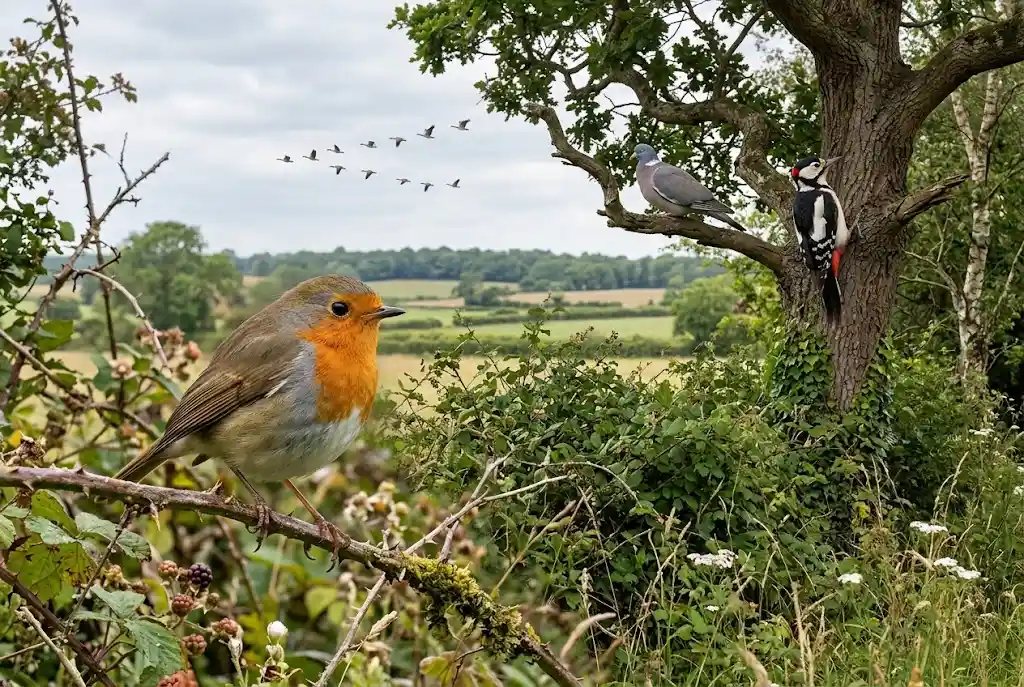
Looking for interesting facts about birds? Britain’s birdlife offers plenty to discover, from remarkable migrations and unusual feeding habits to complex communication, impressive flight abilities and surprisingly varied nesting behaviour. Some birds are familiar garden visitors, while others spend much of their lives at sea, in wetlands, woodland or remote countryside.
Birds are also excellent examples of how wildlife adapts to its environment. Their bodies, behaviour and seasonal movements are closely connected to where they live and the resources available to them. Whether you are beginning to identify common birds in the UK or simply want to understand them better, these facts provide a useful introduction.
Interesting Facts About Birds and Their Amazing Adaptations
Birds belong to a remarkably diverse group of animals. Although all modern birds share important characteristics, individual species have evolved specialised features that help them survive in particular habitats.
1. Birds Have Feathers
Feathers are one of the defining characteristics of birds. They provide insulation, help with flight and can also play important roles in communication, camouflage and attracting a mate.
Not every feather performs the same job. Wing and tail feathers are important for movement through the air, while smaller body feathers contribute significantly to insulation and protection.
2. Not Every Bird Uses Flight in the Same Way
Flight varies enormously between species. Some birds are powerful fliers capable of travelling long distances, while others specialise in hovering, gliding or rapid manoeuvring between trees.
Birds such as swifts spend extraordinary amounts of time in the air, whereas species such as Woodpigeons frequently move between feeding areas and trees. Flight style is therefore a useful feature when identifying unfamiliar birds.
3. Birds Have Lightweight Skeletons
Many birds have hollow or partly hollow bones that help reduce body weight. However, describing bird bones as simply “empty” is misleading because their structure includes internal supports that provide strength.
The combination of a relatively lightweight skeleton and powerful flight muscles helps many birds generate the lift and movement required for flight.
4. Birds Have Different Types of Beaks
A bird’s bill can reveal a great deal about its lifestyle. Different shapes have evolved for different feeding strategies.
- Long, narrow bills can help birds probe mud or shallow water.
- Hooked bills are useful for birds of prey that tear food.
- Short, strong bills can help crack seeds.
- Broad bills can be useful for filtering or gathering food.
- Long pointed bills can help some birds catch prey in water.
This is why looking at a bird’s bill is one of the most useful steps in identification.
Unique Facts About Birds and Their Senses
Birds do not experience their surroundings in exactly the same way humans do. Their senses have evolved to suit different lifestyles, and some species have extraordinary abilities.
5. Birds Can Have Excellent Vision
Vision is extremely important to many birds. Birds of prey, for example, rely heavily on sight when searching for prey across open landscapes.
Other birds use vision to locate food, navigate their surroundings, identify potential predators and communicate through visual displays.
6. Some Birds Use the Earth’s Magnetic Field
Research has shown that some migratory birds can detect information associated with Earth’s magnetic field. This ability forms part of a wider navigation system that can also involve landmarks, celestial cues and other environmental information.
Migration is therefore much more complicated than simply flying in a particular direction. Birds may combine several sources of information when travelling between seasonal habitats.
7. Bird Calls Have Different Purposes
Bird sounds are not limited to one form of communication. Calls can be used to warn other birds of danger, maintain contact, attract mates or communicate with young.
Birdsong is particularly associated with territorial behaviour and reproduction in many species. Learning to recognise calls can therefore be just as valuable as learning plumage when identifying birds.
Interesting Information About Birds and Migration
8. Some Birds Travel Huge Distances
Migration allows birds to move between areas that offer different seasonal resources. Some species travel thousands of kilometres between breeding and wintering grounds.
Britain is both a destination and a stopover point for many migratory birds. The species present in the country can therefore change significantly as the seasons progress.
9. Geese Can Form Large Migratory Flocks
Goose migration is one of the most visible examples of seasonal bird movement in Britain. Large flocks can gather on wetlands, estuaries and agricultural land during the colder months.
Species such as Pink-footed Geese travel to Britain from northern breeding areas. Their arrival can transform the appearance and sound of suitable wintering habitats.
Our guide to winter with animals explores seasonal wildlife behaviour in greater detail, including migration and how animals cope with colder conditions.
10. Migration Is Closely Linked to Food
Migration is not simply about escaping cold temperatures. Food availability is one of the most important factors influencing seasonal movements.
Birds may leave a breeding area when its food supply becomes less reliable and travel to regions where suitable resources are available. In spring, they may return when conditions become favourable again.
Interesting Facts About Birds and Their Feeding Behaviour
11. Different Birds Eat Very Different Foods
Bird diets range from seeds, fruit and nectar to insects, fish, small mammals and carrion. Some species are highly specialised, while others can exploit a broad range of food sources.
This flexibility helps explain why certain birds can adapt successfully to changing landscapes. Gardens, parks and farmland can provide additional feeding opportunities for species capable of using them.
12. Birds Can Help Control Insect Populations
Insect-eating birds form an important part of many food webs. By consuming insects and other invertebrates, they participate in ecological relationships that connect plants, insects, birds and other animals.
This is one reason healthy habitats need more than attractive scenery. They must support the wider range of organisms that birds depend on for food.
13. Some Birds Store Food
Certain bird species collect and hide food for later use. This behaviour can be particularly useful when food is temporarily abundant but becomes harder to find at other times.
Remembering where food has been hidden requires spatial awareness and behaviour suited to the species’ environment.
Interesting Facts About Birds and Their Nests
14. Birds Build Many Different Types of Nests
Nests vary considerably between species. Some birds construct elaborate structures from grass, moss, twigs and other materials, while others use cavities, ledges or existing structures.
The location and design of a nest reflect the needs of the species. Protection from predators, weather and disturbance can all influence nesting choices.
15. Both Parents May Help Raise Young
Parental care differs between species. In some birds, both parents contribute to incubation and feeding. In others, one parent performs most of the work.
The amount of care required also depends on how developed young birds are when they hatch. Some chicks are relatively helpless and require considerable parental support, while others are able to move around soon after hatching.
16. Nest Building Can Be Part of Courtship
For some species, nest construction is more than a practical task. The quality or location of a nest can form part of courtship behaviour and may influence mate choice.
This illustrates how reproduction, behaviour and habitat can be closely connected in bird ecology.
Facts About Deers and Other British Wildlife
Birdwatching often develops into a broader interest in British wildlife. Learning about birds can naturally lead to questions about mammals, reptiles and other animals that share the same habitats.
For example, facts about deers can help explain the role large herbivores play in woodland and grassland ecosystems. Deer influence vegetation through grazing and browsing, which can in turn affect the plants and smaller animals living within those habitats.
Likewise, understanding what different species eat helps reveal how wildlife is connected. Birds may feed on insects, seeds or fruit, while mammals may depend on vegetation, fungi or other animals. These relationships form interconnected food webs rather than isolated species.
17. Birds Are Important Parts of Food Webs
Birds occupy many different positions within ecosystems. Some consume plants and seeds, others specialise in insects, while birds of prey may hunt other animals.
They can also become food for other predators. This means birds can connect several levels of an ecosystem and contribute to the movement of energy through food webs.
18. Birds Can Disperse Seeds
Fruit-eating birds can help plants spread by consuming fruit and later depositing seeds elsewhere. This is a natural process that can contribute to plant distribution and regeneration.
The relationship can benefit both sides. Birds gain a food source while plants gain an opportunity to move their seeds beyond the immediate area around the parent plant.
19. Some Birds Are Extremely Long-Lived
Bird longevity varies enormously. Small birds often have relatively short typical lifespans, while some larger species can survive for many years.
Even familiar garden birds can live longer than people might expect in exceptional circumstances. Ringing records provide valuable information about individual survival because researchers can identify birds when they are recaptured or observed again.
For example, our article about Woodpigeon lifespan explains the difference between typical survival and the maximum recorded age for this familiar British species.
20. Birds Can Adapt to Urban Environments
Many bird species have learned to use towns and cities. Buildings can provide nesting opportunities, while parks, gardens and street trees can provide food and shelter.
Urban environments are not identical to natural habitats, but adaptable species can exploit the resources they contain. This is one reason birdwatching does not always require a trip into remote countryside.
Bird Identification Facts Worth Remembering
21. Colour Is Not Always the Best Clue
Colour can be useful, but it should not be your only identification feature. Lighting, distance, weather and seasonal plumage can all affect how a bird appears.
Shape, size, bill, legs, flight style and behaviour often provide more reliable clues. This is particularly important when two species have similar colouring.
22. Male and Female Birds Can Look Different
Sexual differences in plumage are common among birds. Males of some species have much brighter or more contrasting markings than females.
Juveniles may look different again, which can make identification challenging. A bird that does not resemble the adult you expected may simply be at a different stage of its life.
23. Habitat Helps Narrow Down Identification
Where you see a bird can provide an important clue. Wetlands attract waterbirds and waders, woodland supports specialist species, and gardens can attract a mixture of adaptable birds.
This is why good bird identification considers the whole observation rather than relying on one visual feature.
24. Birds Can Be Indicators of Habitat Change
Changes in bird populations and distribution can provide useful information about the condition of habitats and wider environmental changes. Scientists and conservation organisations monitor birds because their numbers, breeding success and distribution can reveal important ecological patterns.
Birds are therefore valuable not only because they are interesting to watch, but also because they form an important part of ecological monitoring and conservation.
25. Birdwatching Can Start Anywhere
You do not need specialist equipment or access to a remote nature reserve to begin observing birds. A garden, local park, canal, woodland path or roadside hedgerow may reveal several species.
Start by watching familiar birds and recording what you see. Over time, you can learn their calls, recognise seasonal visitors and identify subtle differences between similar species.
Why Birds Matter to UK Wildlife
Birds are woven into almost every type of British habitat. They help move seeds, consume insects, pollinate some plants, participate in food webs and provide prey for other animals. Their movements also connect ecosystems across countries and continents.
Learning about birds can therefore change how you view the landscape around you. A wetland is no longer simply a body of water; it becomes feeding and nesting habitat. A hedgerow becomes a source of shelter and food. A garden becomes part of a much wider ecological network.
Interesting Facts About Birds for Young Wildlife Watchers
Birds can also make an excellent introduction to wildlife education. Children can begin by learning simple species names and gradually explore more complex subjects such as migration, food chains, habitats and adaptation.
Simple activities can make learning more engaging. Ask children to identify five birds from a garden, record which species visit during different months or create a small quiz about animals based on the wildlife they have observed.
Games can also use simple clues. For example, ask which bird has an orange breast, which bird has a long curved bill or which bird of prey has a particular flight shape. These activities encourage observation rather than memorisation alone.
Animals Five Letters Long: A Simple Wildlife Challenge
A word-based wildlife game can be another way to make nature education enjoyable. Try creating a list of animals five letters long and asking participants to identify them from clues.
Examples include “otter”, “eagle” and “mouse”. You can make the activity more challenging by giving habitat or behaviour clues instead of the animal’s name.
Activities like this are simple, but they can encourage children and adults to think about species characteristics, habitats and ecological relationships while developing their wildlife vocabulary.
How to Learn More About British Birds
The best way to remember wildlife facts is to connect information with real observations. When you learn that a species has a particular feeding behaviour, look for it in the field. When you learn that a bird migrates, pay attention to when it appears and disappears from your local area.
Keeping a notebook or digital record can help you build a personal wildlife database. Record the date, location, habitat, species and any unusual behaviour you notice.
You can also compare your observations with reliable identification resources. The more species you learn, the easier it becomes to recognise patterns across different habitats and seasons.
Final Thoughts on Interesting Facts About Birds
These interesting facts about birds show how much there is to discover beyond simply learning species names. Birds have specialised bills, feathers and flight adaptations, communicate in different ways, migrate between continents, build varied nests and play important roles within ecosystems.
Britain’s familiar birds are an ideal place to begin. A Robin in a garden, a Woodpigeon on a lawn or a goose crossing a winter sky can all lead to wider questions about behaviour, habitat, migration and conservation.
The more closely you observe birds, the more connected the landscape begins to appear. Birdwatching is therefore not only about identification; it is a practical way to understand the relationships between animals, plants, habitats and the changing seasons.
For reliable information about identifying and learning about British birds, the RSPB’s birds and wildlife resources provide further guidance on species, behaviour, habitats and conservation.
