

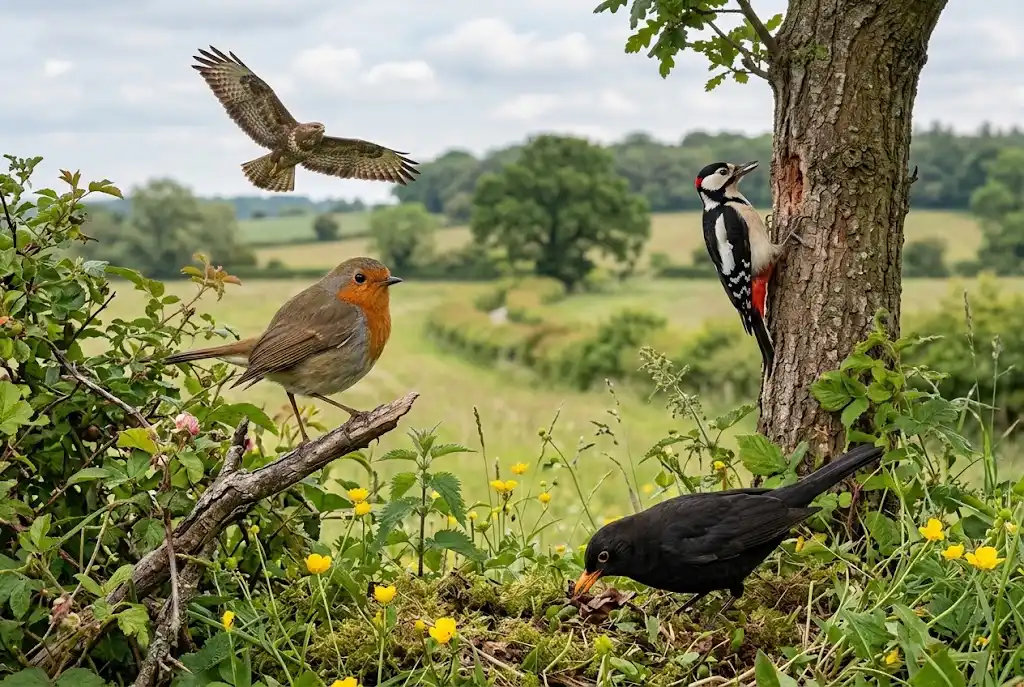
Learning to identify common birds in UK habitats can turn an ordinary walk, garden visit or trip to the countryside into a fascinating wildlife experience. Britain is home to a wide variety of familiar garden birds, woodland species, birds of prey, waterbirds and coastal species, each with its own distinctive appearance and behaviour.
You do not need to be an expert to get started. By paying attention to a bird’s size, shape, colour, bill, legs, call, habitat and behaviour, you can often narrow down its identity surprisingly quickly. This guide covers some of the most useful identification groups and connects them with other areas of UK wildlife, including crane and heron identification.
Common Birds in UK: Where Should You Start?
If you are new to birdwatching, begin with species you are likely to encounter regularly. Robins, Blackbirds, Blue Tits, Great Tits, House Sparrows, Woodpigeons and Magpies are familiar sights in many parts of Britain.
Instead of attempting to memorise every species at once, concentrate on a few obvious features. Ask yourself whether the bird is small or large, whether it has a short or long bill, what its main colours are and whether it is feeding on the ground, in trees or around water.
Its behaviour can be just as useful as its appearance. A bird repeatedly climbing a tree trunk, for example, deserves a different identification approach from one hovering over open countryside.
UK Woodpeckers Identification: What to Look For
UK woodpeckers identification becomes easier once you know the main species and their characteristic markings. The Great Spotted Woodpecker is the most widespread of Britain’s woodpeckers and is often recognised by its black-and-white plumage with red markings.
Green Woodpeckers are larger and have predominantly green plumage, with a distinctive red crown. They are often associated with lawns, parks, woodland edges and other areas where they can search for ants.
Lesser Spotted Woodpeckers are considerably smaller and are less frequently encountered. Their declining population means that seeing one can be a particularly special experience for a birdwatcher.
Woodpecker identification should not rely solely on colour. Size, habitat, feeding behaviour and the sound of drumming can all provide additional clues.
Types of Hawk in UK: Identifying Birds of Prey
Knowing the main types of hawk in UK landscapes is useful when a fast-moving bird of prey appears overhead. However, the term “hawk” is often used casually for several different birds of prey, so it is better to consider the individual species.
The Sparrowhawk is a relatively common garden visitor. It has short, rounded wings and a long tail, which help it manoeuvre rapidly through trees while hunting smaller birds.
The Common Buzzard is another widespread bird of prey. It tends to have broader wings and a stockier shape. Buzzards can often be seen soaring over farmland and open countryside, sometimes circling on rising air currents.
Peregrine Falcons are also found throughout Britain, including urban environments. They are famous for their speed and hunting ability, but their pointed wings and overall shape make them quite different from a Sparrowhawk or Buzzard.
When identifying a bird of prey, look at its silhouette before trying to determine subtle colour differences. Wing shape, tail length and flight behaviour can be particularly helpful.
Types of Geese UK Birdwatchers Should Know
There are several types of geese UK birdwatchers may encounter, either as resident birds or seasonal visitors. Greylag Geese are Britain’s native wild geese and can be found in a variety of wetland and agricultural environments.
Canada Geese are also widespread, although they were introduced to Britain rather than being a native species. They are easily recognised by their large size, brown body, black head and distinctive white cheek patches.
Barnacle Geese and Pink-footed Geese are among the migratory species that can be seen in Britain during the colder months. Their arrival provides an excellent example of how seasonal movements can change the birdlife found in UK landscapes.
If migration interests you, understanding seasonal wildlife and bird migration can help explain why certain species become much more noticeable at particular times of year.
British Native Lizards and Their Place in Wildlife Identification
Birdwatching often leads naturally into broader wildlife observation. While they are not birds, British native lizards are another interesting group to look for when exploring heathland, grassland, woodland edges and other suitable habitats.
The Common Lizard is Britain’s most widespread native lizard. Despite its name, it can be difficult to spot because it often relies on camouflage and quickly disappears into vegetation when disturbed.
The Sand Lizard is much rarer and is associated with specialised habitats such as sandy heathland and dunes. The Slow Worm is also frequently discussed alongside Britain’s lizards, although it is actually a legless lizard rather than a snake.
Learning to identify different wildlife groups encourages you to look more carefully at habitats as a whole rather than focusing on a single species.
Bird With Orange Chest UK: Which Species Could It Be?
If you are searching for a bird with orange chest UK birdwatchers commonly encounter, the Robin is an obvious possibility. Its bright orange-red breast contrasts strongly with its brown back and pale underside.
Robins are familiar in gardens, parks, woodland and hedgerows. They are also known for their upright posture and confident behaviour around people.
However, colour alone is not enough for reliable identification. Lighting can make plumage appear different, particularly in photographs. Always consider the bird’s size, shape, behaviour and habitat alongside its colour.
Black Bird Red Beak UK: A Familiar Identification Question
A black bird red beak UK birdwatchers often notice is the Blackbird, particularly when looking at adult males. Male Blackbirds have predominantly black plumage and a bright yellow-orange bill, along with a similarly coloured eye-ring.
Blackbirds are extremely familiar in gardens and other habitats containing suitable feeding areas. Females look different, with predominantly brown plumage and more subtle colouring.
This is an important reminder that male and female birds of the same species can sometimes look surprisingly different. Juvenile plumage can also create additional identification challenges.
Green Birds in UK Gardens and Countryside
There are several green birds in UK habitats, although some are easier to identify than others. The Green Woodpecker is one of the most distinctive because of its large size, green body and red crown.
Greenfinches are another possibility. These smaller birds have greenish-yellow plumage and are often seen around gardens, hedgerows and areas with suitable food sources.
Parakeets can also appear green, particularly the Ring-necked Parakeet, which has established populations in parts of England. Its vivid green plumage and long tail make it relatively distinctive.
When you spot a green bird, consider whether the colour is genuinely green or a mixture of yellow, olive and grey. Comparing several features will produce a much more reliable identification.
How to Identify Common UK Birds by Shape
Shape is one of the most useful tools for bird identification. Before concentrating on colour, look at the bird’s overall silhouette.
- Round-bodied garden birds: Species such as Robins and some finches have compact shapes.
- Long-tailed birds: Tits, Magpies and several other species can be recognised partly by tail proportions.
- Long-legged birds: Herons, waders and cranes have very different proportions from garden birds.
- Hook-billed birds: Birds of prey have bills designed for tearing food and often have powerful silhouettes.
- Long-winged birds: Swifts, gulls and many birds of prey can often be narrowed down through their wing shape.
This approach is particularly valuable when a bird is far away or partly hidden. Even when colours are difficult to see, the silhouette may remain clear.
Listen to Bird Calls as Well as Looking
Bird identification does not have to be visual. Calls and songs can provide an important clue, particularly when dense vegetation makes the bird difficult to see.
Some species have highly distinctive sounds, while others require more practice. Over time, regular exposure to the sounds around your home can help you recognise which species are present without seeing them.
Try to associate a sound with the habitat, season and time of day in which you hear it. This creates a broader identification picture and can prevent you from relying on a single uncertain feature.
Where to Look for Common Birds in the UK
Different habitats support different bird communities. Gardens can attract Robins, Blackbirds, Tits, Finches and Woodpigeons. Woodland provides opportunities to see woodpeckers, Treecreepers and other woodland specialists.
Wetlands are particularly productive for waterbirds and waders. Rivers, lakes, estuaries, marshes and reedbeds can all produce very different sightings depending on the season.
Open farmland and grassland can be excellent places for birds of prey, Skylarks and other countryside species. Coastal areas bring another group of birds, including gulls, waders and seabirds.
Understanding habitat therefore makes identification easier. Instead of asking only “What bird is that?”, ask “What bird is likely to live or feed in this particular habitat?”
Simple Tips for Better Bird Identification
You can improve your identification skills with a few straightforward habits.
- Observe before guessing: Spend a few seconds studying the bird rather than immediately choosing a species.
- Estimate size: Compare it with familiar birds whenever possible.
- Study the silhouette: Look at the body, wings, tail, legs and bill.
- Note distinctive markings: Pay attention to patches around the head, wings, breast and tail.
- Record the habitat: A garden, woodland, wetland or coastline can significantly narrow the options.
- Listen carefully: Calls and songs can provide additional evidence.
- Consider the season: Some species migrate, while others change appearance or behaviour during breeding.
Keeping a simple wildlife notebook can also help. Record the date, location, habitat and features you noticed. Over time, these observations will reveal patterns in the wildlife around you.
Building Your Own UK Bird Identification List
Rather than trying to learn every species immediately, create a personal checklist of birds you regularly encounter. Start with familiar garden birds and gradually add woodland species, waterbirds, waders and birds of prey.
Once you have mastered the common species, unusual sightings become easier to recognise because you have a stronger understanding of what is normally present. You can then investigate less familiar birds with greater confidence.
This is also where broader wildlife knowledge becomes valuable. Bird identification can lead into questions about migration, feeding behaviour, habitats, breeding and seasonal changes. For example, understanding interesting facts about birds can add useful context to the species you encounter in everyday life.
Final Thoughts on Common Birds in UK
Identifying common birds in UK habitats is less about memorising hundreds of names and more about learning how to observe. Size, shape, plumage, bill, legs, calls, behaviour and habitat all provide valuable evidence.
Whether you are trying to recognise a woodpecker in woodland, a hawk above farmland, a goose on a reservoir or a colourful garden bird, take your time and look at several features together. With regular practice, even unfamiliar birds become easier to place.
Most importantly, bird identification encourages closer attention to Britain’s wider natural environment. A single garden bird can lead you to discover migration, food chains, wetland conservation and the seasonal behaviour of wildlife across the UK.
For authoritative guidance when you are unsure about a species, the RSPB bird identification resources provide practical information to help observers compare birds using appearance, behaviour, habitat and other identifying features.
