

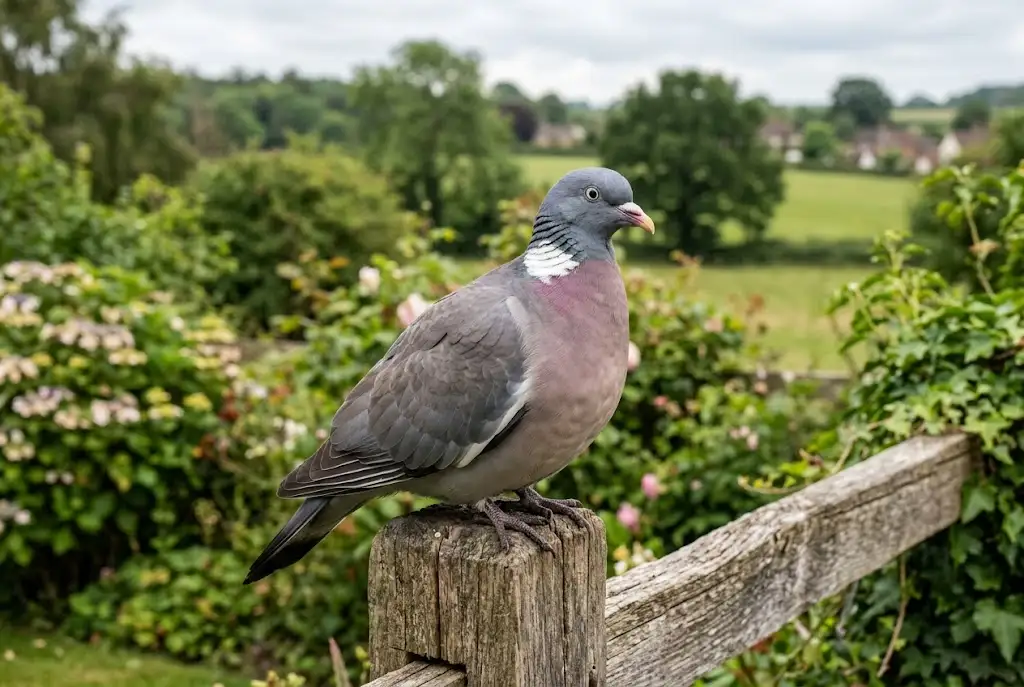
The woodpigeon lifespan can be surprisingly difficult to judge because most wild birds do not reach their maximum possible age. In the UK, Woodpigeons are familiar sights in gardens, parks, farmland, woodland and towns, yet the length of time an individual bird survives depends on age, food availability, weather, predators, disease and other environmental pressures.
According to British Trust for Ornithology (BTO) ringing data, the typical life expectancy of a Woodpigeon that reaches breeding age is around three years. However, individual birds can live much longer. A ringed Woodpigeon has been recorded at more than 17 years old, showing the considerable difference between typical survival and the maximum recorded age.
Understanding how long these familiar birds live also provides a useful introduction to the wider subject of wildlife behaviour. Their feeding, breeding and seasonal movements reveal how a common British bird adapts successfully to changing environments.
Woodpigeon Lifespan in the UK
When discussing woodpigeon lifespan, it is important to distinguish between average or typical life expectancy and the oldest known individual. These figures tell us different things.
BTO data gives a typical life expectancy of around three years for a Woodpigeon that reaches breeding age. This does not mean that every Woodpigeon dies at three years old. Some survive for considerably longer, while many younger birds do not reach adulthood.
The maximum recorded age is much higher. Ringing records include a Woodpigeon that reached 17 years, 8 months and 19 days. Such an age is exceptional rather than representative of the species as a whole.
This difference is common in wildlife. A species may have the biological capacity to live for many years, while the typical lifespan in the wild is considerably shorter because of the risks animals face throughout their lives.
How Long Do Wild Pigeons Live?
If you are asking how long do wild pigeons live, the answer depends on which pigeon species you mean. The Woodpigeon is Britain’s largest pigeon species and has a different life history from species such as the Feral Pigeon or Stock Dove.
For Woodpigeons, ringing data provides one of the most useful ways of understanding survival. Researchers can identify individual birds by their rings and record when they are encountered again. These records help estimate survival rates and identify unusually long-lived birds.
Wild birds face many challenges that do not affect birds in captivity in the same way. Finding enough food, avoiding predators, surviving severe weather and successfully raising young all influence whether an individual reaches old age.
Therefore, a maximum recorded age should not be interpreted as the age most Woodpigeons can expect to reach.
Why Do Some Woodpigeons Live Longer Than Others?
Several factors can influence how long a Woodpigeon survives. Food availability is important because birds need enough energy for everyday activity, particularly during colder weather and the breeding season.
Habitat also matters. Woodpigeons are highly adaptable and can use woodland, farmland, gardens, parks, grassland and urban areas. Access to feeding areas and suitable nesting locations can influence their ability to survive and reproduce.
Weather creates additional challenges. Cold conditions, storms and prolonged periods of poor weather can make finding food more difficult. Young birds can be particularly vulnerable because they have not yet developed the experience needed to cope with changing conditions.
Predation, collisions and disease can also affect individual survival. Consequently, the lifespan of a wild bird is shaped by a combination of biological and environmental factors rather than a single cause.
The Woodpigeon Life Cycle
The squirrel life cycle and Woodpigeon life cycle are very different, but both illustrate how wildlife moves through distinct stages of development. A Woodpigeon’s life begins in an egg, followed by hatching, growth, fledging and eventual breeding.
Woodpigeons typically lay two eggs. Both parents participate in incubation, which lasts around 17 days. Once hatched, the young remain dependent on their parents while they develop and grow.
Young Woodpigeons eventually leave the nest and begin learning how to find food independently. Reaching breeding age is an important milestone because it marks the point at which an individual can contribute to the next generation.
The species can breed over a relatively long period rather than being restricted to a very short nesting season. This flexibility is one of the characteristics that has helped Woodpigeons become so widespread in Britain.
What Do Woodpigeons Eat?
Food availability is closely connected to survival, so understanding what these birds eat helps explain their behaviour. Woodpigeons mainly feed on plant material, including crops, seeds, leaves, buds and other vegetation.
They are commonly seen feeding on lawns and agricultural land, where they can search for accessible plant food. Gardens can also provide feeding opportunities, particularly where suitable vegetation is available.
Diet can change according to what is available in the local environment and the time of year. This flexibility allows Woodpigeons to exploit a broad range of habitats.
For comparison, questions such as what squirrels eat reveal a similarly interesting relationship between wildlife and food availability. Looking at diet is often one of the easiest ways to understand why a species chooses a particular habitat.
Where Do Woodpigeons Live?
Woodpigeons are remarkably widespread across Britain. They can be found in woodland, farmland, grassland, parks and urban areas. Their ability to use both rural and built-up environments has helped them become one of the UK’s most familiar birds.
They are particularly easy to spot where there is a combination of trees and open feeding areas. A garden beside woodland, for example, can provide both shelter and access to food.
Although the species is associated with woodland by name, Woodpigeons are not restricted to forests. Their adaptability means they can thrive in a wide range of landscapes.
Woodpigeons and Seasonal Behaviour
Woodpigeons are present in Britain throughout the year, but their numbers and movements can change seasonally. BTO records show that the species is widespread in every month, while large flocks can also be observed moving through Britain during autumn.
These seasonal movements are particularly noticeable when thousands of birds are seen flying together. Some Woodpigeons migrate from northern areas towards warmer parts of Europe, while Britain also receives continental birds during the colder months.
This makes Woodpigeons a useful example of why wildlife behaviour should not be viewed as completely static. A bird that appears to be a permanent resident may still participate in seasonal movements.
For more examples of how wildlife responds to changing conditions, our guide to winter with animals explores seasonal behaviour across different species.
Do Woodpigeons Stay in the Same Place?
Not necessarily. Some Woodpigeons can remain relatively local, particularly where food and shelter are readily available, while others undertake seasonal movements.
The distinction between resident and migratory behaviour can therefore be more complicated than simply classifying a species as one or the other. Individual birds can behave differently depending on where they live and the environmental conditions they experience.
Large autumn movements are particularly impressive. Flocks can contain thousands of birds, creating one of the more noticeable wildlife spectacles associated with Woodpigeons in Britain.
How Woodpigeons Raise Their Young
Woodpigeon parents share responsibility for raising their young. The species usually lays two eggs, and both adults take part in incubation.
The chicks hatch relatively undeveloped and depend on their parents for food and protection. As they grow, they gradually develop the feathers and strength needed to leave the nest and become independent.
Successful breeding is an important part of population survival. A species does not need every individual to live for many years if enough birds survive long enough to reproduce successfully.
This is why population trends cannot be understood simply by looking at the age of individual birds. Breeding success, juvenile survival and adult survival all contribute to the health of a population.
How to Recognise a Woodpigeon
Woodpigeons are relatively easy to identify once you know their key features. They are large pigeons with predominantly grey plumage, a pinkish breast and a distinctive white patch on the side of the neck.
The white markings on the wings are particularly noticeable when the bird takes flight. Their loud wing clatter can also provide an identification clue before the bird is clearly visible.
Their familiar cooing call is another characteristic sound. Because Woodpigeons occur in so many different habitats, learning their call can help you recognise them even when vegetation or buildings block your view.
If you are developing your broader knowledge of common birds in the UK, Woodpigeons are a useful species to learn early because they are widespread and have several distinctive identification features.
Woodpigeons in Gardens
Many people encounter Woodpigeons without deliberately going birdwatching. Gardens, parks and residential streets can all attract them, especially where there are lawns, trees or suitable feeding areas.
Their presence can sometimes be surprising because they are considerably larger than many familiar garden birds. Their size also makes them easy to spot when they walk across grass or perch on a roof or tree.
Watching Woodpigeons in your garden can provide an opportunity to observe natural behaviour at close range. You may notice feeding patterns, interactions between birds, courtship behaviour or changes in activity throughout the day.
Why the Woodpigeon Is Successful in Britain
The Woodpigeon’s widespread distribution demonstrates the importance of adaptability in wildlife. Rather than depending on one highly specialised habitat, the species can use a variety of environments.
Its flexible diet, ability to breed successfully and capacity to use both rural and urban landscapes have all contributed to its success. BTO monitoring shows that the UK’s Woodpigeon population has increased substantially over the long term, although population trends should always be interpreted using systematic monitoring rather than individual sightings.
This adaptability is also a reminder that a bird being common does not make it uninteresting. Familiar species can reveal a great deal about how wildlife responds to human-managed landscapes.
What Does Lifespan Tell Us About Wildlife?
Lifespan is only one part of understanding an animal. A species with a relatively short typical lifespan may still maintain a healthy population if reproduction and survival rates are sufficient.
Likewise, an exceptionally old individual does not necessarily represent the experience of the typical animal. This is why wildlife researchers use ringing, monitoring and population surveys to understand species over time.
For birdwatchers, these findings can make everyday sightings more meaningful. A Woodpigeon sitting on a garden fence is not simply a common bird; it is part of a much larger population whose movements, breeding and survival can be studied across generations.
Final Thoughts on Woodpigeon Lifespan
The woodpigeon lifespan is best understood by separating typical survival from exceptional longevity. BTO data indicates that a Woodpigeon reaching breeding age has a typical life expectancy of around three years, while the oldest recorded ringed bird lived for more than 17 years.
Food, habitat, weather, predation, disease and breeding success all influence the survival of individual birds. At the same time, the species’ ability to use gardens, farmland, woodland and urban environments has helped it become one of Britain’s most familiar birds.
Next time you see a Woodpigeon, take a moment to observe it rather than simply dismissing it as an everyday garden bird. Its behaviour, seasonal movements and life cycle offer a useful window into the wider ecology of British wildlife.
For detailed species information and current monitoring data, the British Trust for Ornithology’s Woodpigeon BirdFacts profile provides information on identification, distribution, breeding, survival and population trends.
