

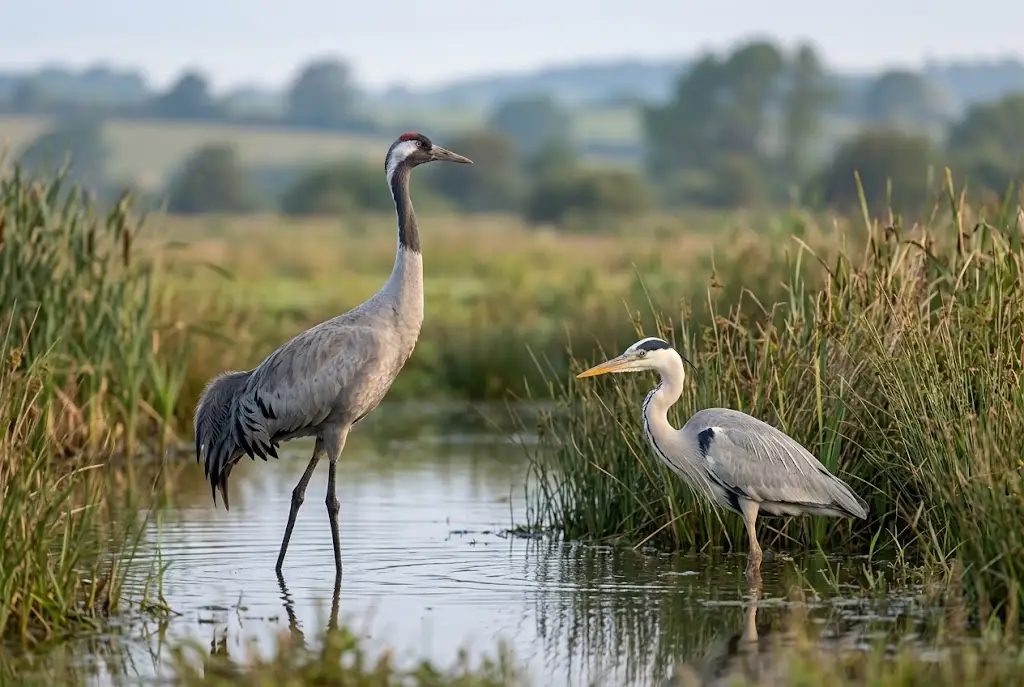
Trying to decide whether you have spotted a crane or heron can be surprisingly difficult, especially when a large, long-legged bird is standing in the distance beside a wetland, river or reedbed. Both birds have long legs, long necks and a striking presence, but they differ considerably in size, shape, colour, behaviour and habitat.
For anyone exploring common birds in the UK, learning these differences is a useful step towards becoming a more confident wildlife observer. Once you know what to look for, features such as the bill, neck position, body shape and flight pattern can make identification much easier.
Crane or Heron: What Is the Main Difference?
The simplest way to distinguish a crane from a Grey Heron is to consider overall size and proportions. The Common Crane is a very large, elegant bird with a long neck and exceptionally long legs. The Grey Heron is also tall, but it has a more compact appearance and a noticeably different posture.
Common Cranes can stand up to around 1.2 metres tall, making them the tallest bird species found in the UK. Grey Herons are smaller by comparison. The difference becomes particularly noticeable when the two species are seen in the same landscape.
The birds also have different colouring. A Common Crane is predominantly grey, with a distinctive black-and-white head and neck pattern and a red area on the crown. A Grey Heron has grey, black and white plumage, including a darker head and a long, pointed bill.
How to Identify a Crane in the UK
If you are wondering whether a bird is a crane or heron, start by looking at its silhouette. A Common Crane has a graceful, upright appearance, with very long legs extending well beyond the body when it is standing. Its neck is long and usually held in a relatively straight position.
The Common Crane also has a distinctive head and neck pattern. Its mostly grey body contrasts with black and white markings around the head and neck, while adults have a noticeable red patch on the crown.
Another useful clue is behaviour. Cranes can be highly vocal, producing a distinctive bugling call that can carry over considerable distances. During the breeding season, they are also known for their elaborate courtship displays.
In the UK, cranes have a small breeding population in Norfolk as well as a reintroduced population in Somerset. Smaller numbers can also pass through Britain during migration.
How to Identify a Grey Heron
The Grey Heron is one of the most recognisable large wetland birds in Britain. It has a tall, slender appearance, long legs, a long pointed bill and grey, black and white feathers.
One of the best identification clues is its neck. When a Grey Heron is standing and hunting, it often folds its neck into a distinctive S-shaped curve. At other times, particularly when alert or flying, the neck can be extended.
Grey Herons are frequently found beside rivers, ponds, lakes, canals, wetlands and coastal areas. They often stand motionless in shallow water while waiting for prey, making patience another characteristic that can help distinguish them from more active wetland birds.
They are resident birds in the UK and can be seen throughout the year. During the breeding season, Grey Herons may gather in nesting colonies known as heronries.
Crane Like Bird: What Else Could You Have Seen?
If the bird does not quite look like either a crane or heron, there are several other long-legged birds worth considering. Wetlands and coastal habitats support a wide range of waders and waterbirds, and some can appear remarkably similar when viewed from a distance.
For example, Great White Egrets are large white herons that can appear imposing when standing beside shallow water. Little Egrets are smaller white herons with black legs and distinctive yellow feet. Bitterns are another member of the heron family, although their streaked brown plumage makes them look very different from a Grey Heron.
Spoonbills are another possibility in suitable wetland habitats. Their broad, spoon-shaped bills are a particularly useful identification feature. These examples show why looking at the complete shape of the bird is more reliable than judging it simply by its height.
Bird With Long Legs: What Features Should You Check?
When you see a bird with long legs, do not rely on leg length alone. Instead, look at several features together. This approach can quickly narrow down the possibilities.
- Overall size: Compare the bird with nearby species, trees, fencing or other familiar objects where possible.
- Neck shape: A Grey Heron often holds its neck in a characteristic S-shape, while a crane generally appears more upright and elongated.
- Bill: Look at the length, shape and colour of the bill.
- Legs: Note their colour, length and how far they extend beyond the body.
- Plumage: Look for distinctive head, neck, wing or body markings.
- Behaviour: Consider whether the bird is standing motionless, walking through reeds, feeding in shallow water or displaying in a group.
- Habitat: The type of wetland or landscape can provide an important identification clue.
The RSPB recommends considering size, silhouette, beak, legs, colour, behaviour, habitat and time of year when identifying birds. Looking at several characteristics together is much more dependable than focusing on one feature alone.
Crane or Heron in Flight: What Should You Look For?
Flight can provide some of the clearest clues when deciding between a crane or heron. Both species have long wings and legs, but their flight silhouettes are different.
A Grey Heron typically flies with its long neck folded back into an S-shape. Its legs extend behind the body. This folded-neck posture is one of its most useful identifying characteristics.
A Common Crane, by contrast, normally flies with its neck extended and its long legs projecting behind its body. When several cranes are flying together, their large size and elongated silhouettes can be especially noticeable.
If you are watching from a distance, avoid relying solely on colour. Light conditions can alter how plumage appears, while juvenile birds may have different markings from adults. The shape of the bird in flight can therefore be more useful than subtle colour differences.
Where Are These Birds Found in the UK?
Habitat is another valuable clue when identifying a crane or heron. Grey Herons are widespread and adaptable. They can be found around many types of freshwater and coastal habitats, including ponds, lakes, rivers, reservoirs, marshes and estuaries.
Common Cranes have a more restricted UK distribution. They are particularly associated with wetland landscapes, reedbeds, floodplains and areas where suitable breeding habitat is available.
This means that location alone cannot confirm an identification, but it can help you decide which possibilities deserve closer attention. Keeping a note of where and when you saw the bird can also make later identification easier.
Marsh Birds UK: Why Wetlands Matter
Wetlands are among the most rewarding places to look for marsh birds in the UK. Reedbeds, flooded grasslands, shallow pools and estuaries can support a diverse range of species, from herons and cranes to ducks, geese and smaller waders.
These habitats provide feeding and nesting opportunities as well as places for migrating birds to rest. As a result, the species you see can change considerably between seasons.
When visiting a wetland, give birds plenty of space and avoid disturbing nesting areas. A pair of binoculars can make identification much easier without requiring you to approach wildlife closely.
Wading Birds Names List: Species to Look Out For
If you are building your own wading birds names list, there are many UK species worth learning. Common examples include Curlew, Redshank, Dunlin, Knot, Turnstone, Snipe and Lapwing.
Some have obvious identification features. Curlews have a long, strongly curved bill, while Redshanks are notable for their bright red legs. Turnstones can often be found around rocky shores, where they search for food beneath stones and seaweed.
Learning these species alongside larger birds such as Grey Herons and Common Cranes can make wetland birdwatching considerably more rewarding. You can also use a seasonal wildlife guide to understand why certain species become easier to spot at different times of the year.
Wading Birds UK List: A Simple Identification Approach
A useful wading birds UK list should not simply contain names. It should help you recognise the features that separate similar species.
Start with the bird’s approximate size. Then consider the bill: is it short, straight, long or curved? Next, look at the legs and plumage. Finally, pay attention to where the bird is feeding and how it behaves.
For example, a bird probing mud with a long curved bill may point towards a Curlew, while a smaller bird with contrasting plumage and a different feeding technique could belong to another wader group. Taking several observations together is the key.
How to Become Better at Identifying UK Birds
Bird identification becomes easier with practice. Rather than trying to memorise every species immediately, learn to recognise broad groups first. Large wetland birds, birds of prey, garden birds and waders each have their own useful identification patterns.
When you see an unfamiliar bird, write down what you noticed before checking a guide. Record its size, colours, body shape, habitat, behaviour and the time of year. If possible, take a photograph from a respectful distance.
You can then compare your observations with a reliable identification guide. This method is especially useful when several species have similar silhouettes.
As your knowledge develops, you will find that one observation often leads naturally to another. A question about a crane or heron may lead to learning about wading birds, wetland habitats, migration and seasonal changes in British wildlife. That wider understanding is what makes wildlife identification more than simply naming a species.
Final Thoughts on Crane or Heron Identification
When deciding between a crane or heron, focus on the whole bird rather than one isolated feature. Size, neck position, bill shape, plumage, leg length, flight posture, behaviour and habitat can all help you reach a more confident identification.
Common Cranes are exceptionally tall, elegant grey birds with long straight necks and distinctive black, white and red markings around the head. Grey Herons are slightly smaller, widespread UK birds with grey, black and white plumage, long bills and a characteristic S-shaped neck when standing or flying.
With regular observation, these differences become much easier to recognise. Whether you are exploring a local wetland, watching birds from a garden or building a personal wildlife checklist, careful observation is one of the best ways to understand the UK’s diverse birdlife.
For further guidance on identifying British birds, the RSPB’s bird identification resources provide practical advice on using size, silhouette, beak shape, markings, behaviour and habitat when identifying unfamiliar species.
