

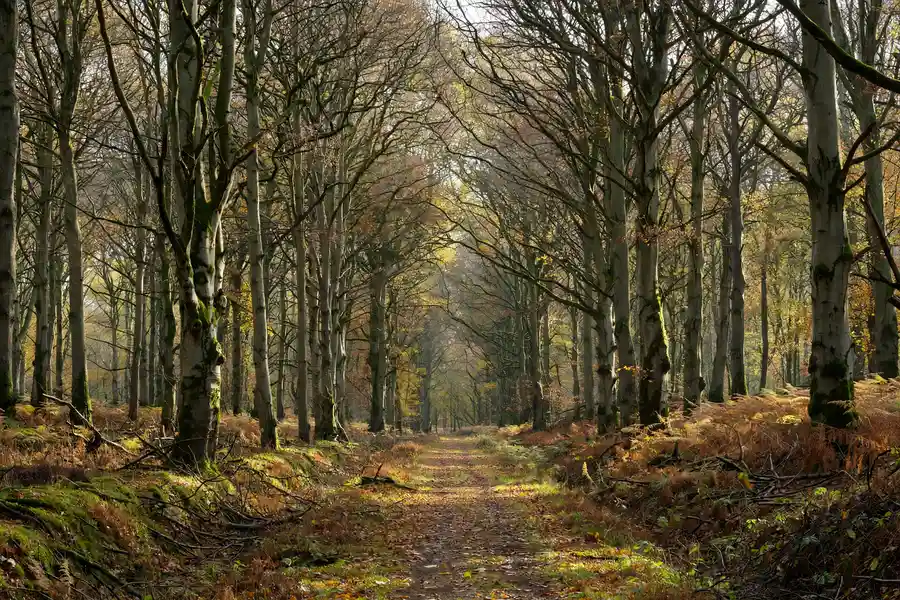
Ash trees are one of the most familiar sights in the British countryside, lining hedgerows, woodlands and roadsides across the country. In recent years, however, many of them have begun to look thin, sickly and bare — often because of ash dieback, a fungal disease that has become the most serious threat facing ash in the UK. Understanding what ash dieback is, how to recognise it and what can sensibly be done helps tree owners, landowners and anyone who walks in woodland make better decisions about the trees in their care.
What Is Ash Dieback?
Ash dieback is a disease of ash trees caused by the fungus Hymenoscyphus fraxineus. The fungus, which originated in Asia, was first confirmed in the UK in 2012 and has since spread widely through natural spore dispersal and the movement of infected planting stock. In its native range the fungus lives on Asian ash species without causing serious harm, but European ash has very little natural resistance to it, which is why the disease has proved so damaging here.
The fungus infects a tree through its leaves. It then grows into the shoots and branches, blocking the tissues that carry water and nutrients. Over successive seasons this causes the crown to thin, branches to die back from the tips, and in many cases the whole tree to decline and eventually die. Young trees and coppice regrowth tend to be killed quickly, while mature trees often decline more slowly over a number of years. Ash is covered in more depth in our guide to common UK trees, which explains where it grows and why it matters to British wildlife.
Signs of Ash Dieback to Look For
The disease is easiest to spot during the growing season. Leaves may wilt, turn black and hang limply on the tree rather than falling. You may see dark, diamond-shaped lesions where a leaf stalk meets a stem or branch, and under the bark of an affected shoot the wood often shows brown or grey discolouration. Higher up, the crown develops the classic pattern that gives the disease its name: twigs and branches die back from the outside in, leaving a sparse, see-through canopy.
Later in the year, look for blackened leaf stalks (rachises) persisting on the tree or lying in the leaf litter beneath it — a tell-tale sign of infection. It is worth remembering that not every struggling ash has dieback: drought, waterlogging and other pests can produce similar symptoms. A careful look at several signs together gives a much better picture than any single symptom.
How Ash Dieback Spreads
The fungus produces tiny fruiting bodies on fallen ash leaf stalks in the leaf litter during summer. These release airborne spores that can travel considerable distances on the wind, which is why the disease has spread so effectively across the country and why it cannot realistically be eradicated. Spores land on the leaves of nearby ash trees, germinate, and the cycle begins again.
Human activity can move the disease too. Infected nursery stock was an important route into and around the country, and moving ash logs, firewood and plants can carry the fungus into new areas. Good biosecurity — cleaning boots, tools and machinery between sites, and not moving ash material from infected areas — remains one of the few practical ways to slow local spread. These wider pressures on tree health sit alongside the issues covered in our article on how climate change is impacting the UK arboriculture industry.
What the Disease Means for Your Trees
There is currently no cure for ash dieback, and no treatment that reliably saves an infected tree. That does not mean every infected ash should be felled straight away. Many trees decline slowly and continue to provide shade, screening and valuable habitat for years. Some ash also appear to tolerate the disease better than others, and those tolerant trees are important for the future of the species, so they are worth retaining wherever it is safe to do so.
The main exception is safety. As dieback advances, infected ash wood can become brittle, and dead or dying trees near roads, footpaths, buildings and gardens can drop branches or fail without much warning. Where safety is a concern, have the tree assessed rather than guessing. The legal context for tree work in the UK, including permissions, is covered by our guide to the latest UK tree care regulations, and regular checks follow the same principles as general tree maintenance.
Managing Ash Dieback: Practical Steps
For most tree owners, management comes down to a few sensible habits. First, monitor your ash trees at least once a year, ideally in summer when symptoms are clearest, and keep a simple record of how each tree is changing. Second, reduce other stresses where you can: avoid compacting or digging through root zones, and keep mulch around young trees to help them through dry spells. A healthy, unstressed tree withstands infection better than a struggling one.
Third, think ahead about replacement planting. Where an ash is clearly declining and will eventually need to come down, planting a diverse mix of other native species nearby means the landscape does not lose all its canopy at once. Our guide to evergreen trees is a good starting point for year-round structure to sit alongside native broadleaves. Finally, dispose of infected material responsibly: leaves can be left or composted on site, since the spores spread by wind regardless, but ash timber and plants should not be moved to uninfected areas.
When to Call an Arborist
Professional advice is worth seeking in three situations: when an infected ash stands within falling distance of a road, path, building or play area; when you are unsure whether symptoms are dieback or something else; and when a tree may be protected or part of a planning application, where a formal survey is required. Our guide to the BS5837 tree survey explains what professional surveys involve and when they are needed.
Ash dieback will change the look of many British landscapes over the coming years, but it does not spell the end of the ash tree. Tolerant trees, natural regeneration and thoughtful replanting all give the species a future. For the individual tree owner, the best response is the simplest one: learn the signs, keep an eye on your trees, act early where safety demands it, and plant for diversity so the woodland that follows is stronger than the one it replaces.

2 Comments
Pingback: How Climate Change Is Impacting the UK Arboriculture Industry
Pingback: Legal Risks of Unauthorized Tree Removal in the UK