

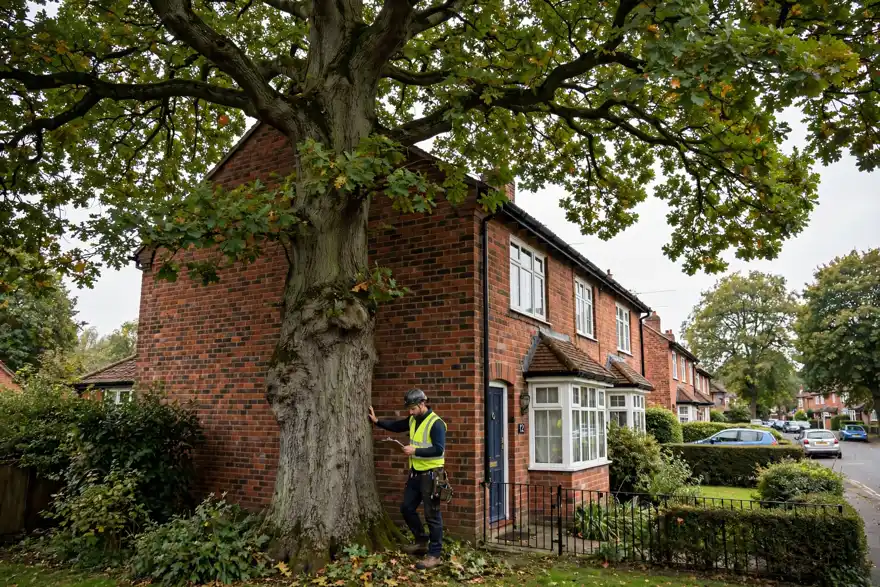
Few things worry a homeowner more than finding cracks in a wall and a large tree standing a few metres away. The link between trees and subsidence is real, but it is also widely misunderstood. Most trees cause no damage at all, yet in the wrong soil, at the wrong distance, a thirsty tree can draw enough moisture from the ground to make a house move. Understanding how trees and subsidence interact helps you judge the real risk to your property — and it helps you respond sensibly, because cutting down a healthy tree is rarely the first or best answer.
This guide explains what subsidence is, which trees and soils carry the greatest risk, the warning signs to watch for, and what a professional assessment involves. It is written for UK homeowners, landlords and buyers, and it reflects the same cautious, evidence-led approach set out in the latest UK tree care regulations that property owners should know.
What Is Subsidence and How Do Trees Cause It?
Subsidence is the downward movement of the ground supporting a building. Several things can cause it — leaking drains, mining, poor foundations — but the most common cause in lowland Britain is shrinkage of clay soil during dry weather. Clay expands when wet and shrinks as it dries. Tree roots accelerate that drying: a mature tree can draw well over a hundred litres of water a day from the soil in summer, and its roots spread moisture extraction across a wide area around the trunk.
When the clay beneath one part of a foundation shrinks more than the rest, the foundation drops unevenly. That is when cracks appear. The movement is usually slow and seasonal — cracks may open in a dry summer and partly close again in winter as the clay rehydrates — but over repeated cycles it can damage brickwork, distort door and window frames and, in serious cases, threaten structural stability.
Which Trees and Soils Carry the Most Risk?
Risk depends on three things coming together: a shrinkable clay soil, a water-demanding tree, and a distance between tree and building that is short relative to the tree’s mature height. Sandy or chalky soils rarely shrink enough to matter, which is why subsidence is concentrated in the clay belts of London and the South East, the Midlands and parts of the South West.
Tree species matter because water demand varies. Oak, willow, poplar, elm and eucalyptus are classed as high water demand; ash, birch, cypress and plane are moderate to high; many smaller garden trees are low demand. Our guide to common UK trees will help you identify what is actually growing near your home — correct identification is the starting point of any sensible assessment. As a rough rule, concern rises when a high-demand tree stands within a distance roughly equal to its mature height from a property built on clay.
Warning Signs Worth Taking Seriously
Not every crack means subsidence. Hairline cracks in plaster are normal in most houses. The patterns that justify investigation are diagonal or stepped cracks in brickwork, cracks wider at the top than the bottom, cracks that extend through the wall and show inside and out, and doors or windows that suddenly start sticking in dry weather. Cracks that appear or widen after a hot, dry summer and partially close over winter are a classic seasonal signature of clay shrinkage.
Keep a simple record: photograph cracks with a dated coin or ruler for scale, and note when they change. That timeline is genuinely useful evidence for an insurer or an arboriculturist later, and it stops guesswork. If you are buying a property with large trees nearby, this is worth checking before exchange rather than after.
Why You Should Not Simply Fell the Tree
The instinct to remove the tree immediately is understandable — and often wrong. First, removing a large tree from clay soil can cause the opposite problem: heave. Once the roots stop extracting water, the clay slowly rehydrates and swells, which can lift foundations and cause a fresh round of damage, sometimes worse than the original subsidence. Heave can take years to stabilise.
Second, the tree may be legally protected. Many trees in gardens are covered by Tree Preservation Orders or stand in conservation areas, and unauthorised work can lead to prosecution — our guide to UK Tree Preservation Orders explains what owners must check, and the penalties for ignoring them are covered in our article on the legal risks of unauthorised tree removal. Third, insurers and courts expect evidence: felling first and asking questions later can destroy your own claim.
What a Professional Assessment Involves
A consulting arborist will identify the trees, measure distances and heights, assess their water demand and condition, and relate all of that to the building and its soil. Where damage exists, the full investigation usually combines the arboricultural report with a structural engineer’s inspection, soil sampling to confirm clay type and root presence, and a period of crack monitoring to establish whether movement is seasonal and ongoing.
Management options are then proportionate: regular crown reduction or pollarding to cut water demand, root barriers in some situations, underpinning only where monitoring proves continuing movement, and tree removal as a last resort — sometimes staged, precisely to reduce heave risk. Where disease is part of the picture, other factors come into play too: a tree weakened by ash dieback, for example, may need a different management plan from a healthy specimen.
Sensible Steps for Homeowners
If you own a property on clay with trees nearby, a few habits keep risk low. Plant new trees at safe distances and choose lower-demand species near the house. Keep existing trees professionally maintained on a regular cycle rather than letting them grow unmanaged for years and then cutting hard. Maintain drains and gutters, because leaking water changes soil moisture unevenly. And if cracks appear, document them and get advice early — most tree-related movement, caught in time, is managed with pruning and monitoring rather than surgery on either the tree or the house.
Trees and subsidence is a subject where evidence beats instinct every time. A healthy tree is an asset to a property and a street; treat it as a suspect only when the soil, the species, the distance and the cracks all point the same way — and let a qualified arborist make that call.

1 Comment
Pingback: How Smart Technology Is Transforming Modern Landscaping and Tree Care