

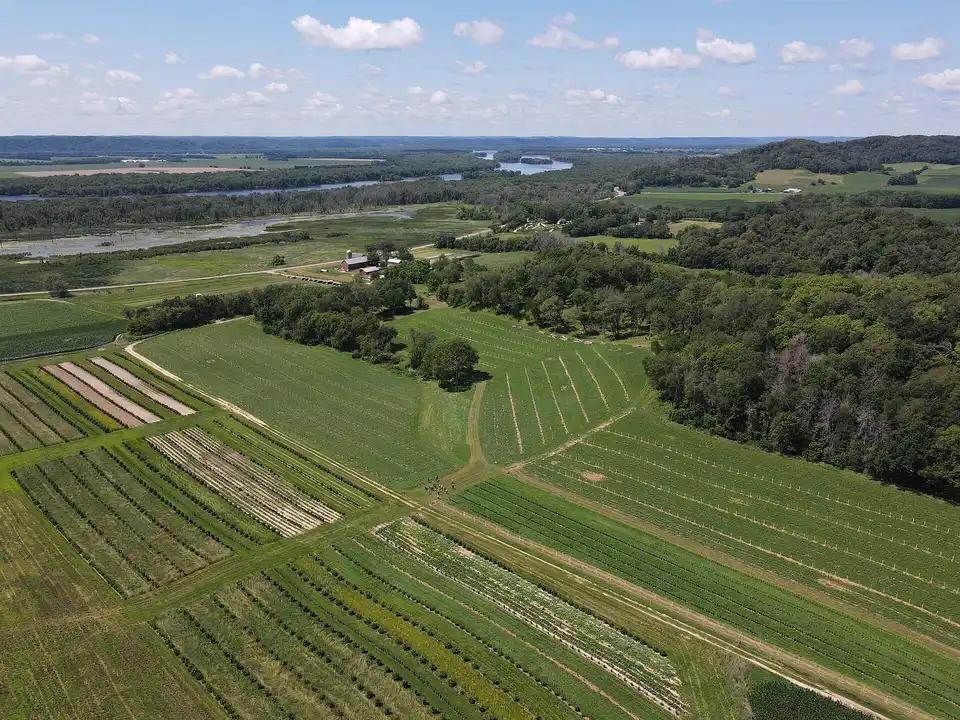
Agroforestry is the practice of growing trees and farming on the same piece of land, deliberately and together. Instead of a field here and a woodland there, an agroforestry system might run rows of apple or timber trees through a cereal crop, or shelter grazing livestock under widely spaced oaks. It is one of the oldest forms of farming in the world and, after a century of separation between forestry and agriculture, one of the newest ideas in sustainable land management. This guide explains how agroforestry works, why it matters, and where it is taking hold in the UK.
What Is Agroforestry?
At its heart, agroforestry combines three elements: trees or shrubs, crops or livestock, and a farmer who manages them as one system rather than competing uses. The trees are not decoration. They are chosen and positioned to work — providing shade, shelter, fruit, nuts, timber or fodder — while the land between and beneath them continues to produce food. Because the components interact, a well-designed agroforestry system can produce more from the same hectare than either farming or forestry alone, while building soil and habitat at the same time. It is a practical expression of the wider principles explored in our guide to sustainable tree management.
The Main Types of Agroforestry
Silvopasture combines trees with grazing livestock. Cattle or sheep graze beneath widely spaced trees, gaining shade in summer and shelter in winter, while the trees grow on to produce timber, fruit or nuts. Alley cropping grows rows of trees with crops cultivated in the alleys between them — cereals, vegetables or soft fruit beneath lines of hazel, willow or fruit trees. Forest farming cultivates high-value crops such as mushrooms, medicinal plants or honey under a managed woodland canopy. Shelterbelts and hedgerow systems use lines of trees to protect crops and stock from wind. Each type suits different land and different farm businesses, and many farms blend two or three on the same holding.
How Agroforestry Supports Sustainability
Trees are long-lived carbon stores, and planting them into farmland locks carbon into trunks, roots and soil for decades. Our detailed look at how trees capture and store carbon explains the mechanism; agroforestry applies it across working farmland rather than only in dedicated woodland. Tree roots improve soil structure, reduce erosion and help fields hold water through dry spells, while leaf fall returns nutrients to the soil. Rows of trees slow wind and runoff, protecting both crops and watercourses. For a countryside under pressure from flooding, drought and soil loss, those are not abstract benefits — they are the difference between land that degrades and land that improves year by year.
Benefits for Soil, Water and Wildlife
Farmland with trees is alive in a way open fields rarely are. Tree lines act as corridors that let birds, bats, pollinators and predatory insects move across the farm, and those species repay the welcome: pollinators serve the crops, and natural predators suppress pests. Deep tree roots reach nutrients that shallow crop roots cannot, and earthworms flourish in the undisturbed soil beneath tree rows. Water quality improves because roots and buffer strips filter runoff before it reaches streams. These are the same ecological principles behind the value of ancient woodland and of native tree species that support local ecosystems, translated into a productive, working landscape.
What Agroforestry Means for Farmers
Farmers adopt agroforestry when it pays, and increasingly it does. A silvopasture system still produces lamb or beef while a timber or nut crop matures in the background, spreading income across years instead of relying on a single harvest. Shade and shelter reduce livestock stress and can improve growth rates and lamb survival. Fruit, nut and coppice products open new markets, and environmental payment schemes in the UK now support tree planting on farms. The trade-offs are real — trees take years to mature, machinery must work around tree rows, and good design matters — but the direction of travel is clear: more farms are treating trees as a crop and an asset, not an obstacle. The tree-selection thinking in our guide to the best trees for sustainable landscaping applies just as well when choosing species for a farm system.
Agroforestry in the UK and What Comes Next
Britain’s agroforestry movement is young but growing fast. Research farms and pioneering estates have demonstrated alley cropping with cereals, silvopasture with poultry and pigs in woodland, and orchard grazing in traditional cider country. Government support through tree-planting and sustainable farming schemes has lowered the barrier for farmers who want to start small — a single shelterbelt, one field of alley cropping — and learn before expanding. Challenges remain, from tenancy rules that can discourage long-term planting to a shortage of advisors who understand both trees and farming. Even so, the logic is hard to argue with: land that feeds us, stores carbon, shelters wildlife and produces timber at the same time is land working at its full potential.
Lessons from Traditional British Systems
Agroforestry is new language for old practice. Wood pasture — livestock grazing beneath scattered, often pollarded trees — shaped landscapes such as the New Forest and Windsor Great Park for centuries, and some of Britain’s oldest trees survive precisely because they stood in working farmland rather than closed woodland. Traditional orchards were grazed by sheep and poultry long before “silvopasture” had a name, and the hedgerows that thread the countryside are linear agroforestry: shelter, browse, berries and timber woven into field boundaries. Modern systems borrow the logic and add measurement — soil carbon sampling, yield mapping and biodiversity surveys — so farmers can prove what traditional practice long suggested.
Getting Started: Small Steps for Landowners
Few farms convert wholesale, and they do not need to. The usual first step is a single field: a shelterbelt along an exposed boundary, an alley-cropping trial in one arable block, or fruit trees planted into a grazing ley. Start with the problem you most want to solve — wind exposure, poor soil, a livestock shade gap — and choose the system that answers it. Take advice early, because species choice, spacing and orientation decide whether machinery still fits in twenty years. Grants and planting schemes change regularly, so check the current support before committing. Above all, plant for the long term: the trees that transform a farm are the ones still thriving in thirty years, and that begins with the right tree in the right place.
Agroforestry asks us to stop seeing trees and farms as rivals for land. Done well, each makes the other stronger — and the landscape, the climate and the farm business all come out ahead.
