

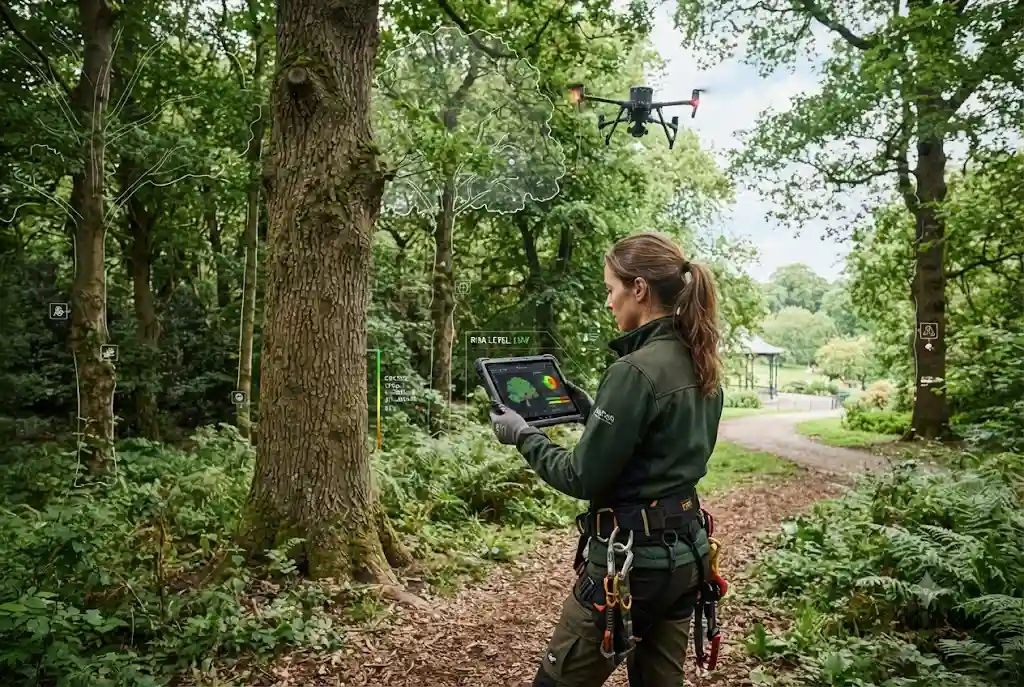
Modern arboriculture is evolving rapidly, and AI tree management is becoming one of the most valuable technologies for professionals responsible for maintaining healthy, safe, and sustainable trees. Artificial intelligence helps arborists analyse tree health, detect structural issues, predict future risks, and make data-driven decisions that improve both safety and long-term landscape management.
Whether managing urban trees, woodland environments, commercial estates, or public parks, AI-powered technologies provide faster inspections, greater accuracy, and improved planning compared to traditional manual assessments. As digital innovation continues to reshape the industry, artificial intelligence is becoming an important partner—not a replacement—for skilled arborists.
What Is AI Tree Management?
AI tree management refers to the use of artificial intelligence, machine learning, computer vision, drones, sensors, and data analytics to support tree inspection, maintenance, and decision-making.
Instead of relying solely on visual assessments, AI systems can process thousands of data points from various sources to identify potential issues that may not be immediately visible.
These technologies assist professionals by:
- Monitoring tree health continuously
- Identifying disease symptoms earlier
- Detecting structural weaknesses
- Prioritising maintenance work
- Reducing inspection time
- Improving public safety
How Artificial Intelligence Supports Modern Forestry
Artificial intelligence forestry applications extend beyond individual trees and help manage entire forests, conservation areas, and municipal tree inventories.
AI combines satellite imagery, drone surveys, GIS mapping, LiDAR scanning, and environmental data to create comprehensive digital records.
These systems can identify:
- Species distribution
- Canopy density
- Disease outbreaks
- Storm damage
- Tree growth patterns
- Environmental stress
This large-scale analysis helps forestry professionals allocate resources more effectively while supporting sustainable woodland management.
AI Tree Inspection Improves Accuracy
Traditional inspections depend heavily on visual observations and professional experience. While these remain essential, AI tree inspection technologies provide additional layers of analysis.
Computer vision software analyses photographs captured by drones, smartphones, or specialised cameras to detect:
- Dead branches
- Leaf discoloration
- Bark abnormalities
- Cracks in trunks
- Cavity formation
- Pest damage
By automatically flagging areas requiring closer inspection, arborists can focus their expertise where it matters most.
Predictive Tree Risk Assessment
One of the most significant developments in modern arboriculture is predictive tree risk assessment.
Rather than simply identifying current defects, AI models estimate future risks using historical data, weather information, soil conditions, species characteristics, and previous inspection records.
Predictive analysis helps answer questions such as:
- Which trees are most likely to fail during storms?
- Which trees require immediate maintenance?
- How will drought affect long-term health?
- Which locations present higher public safety risks?
This proactive approach allows property owners and local authorities to address problems before they become emergencies.
Smart Tree Monitoring for Continuous Health Assessment
Smart tree monitoring uses connected sensors installed on or around trees to collect real-time environmental and structural data.
Sensors may monitor:
- Soil moisture
- Root conditions
- Wind movement
- Tree stability
- Internal moisture levels
- Temperature fluctuations
AI systems continuously analyse this information and generate alerts whenever abnormal changes occur.
Instead of waiting for scheduled inspections, arborists receive early warnings that help prevent tree failures.
Benefits of AI Arboriculture
The adoption of AI arboriculture offers numerous advantages across residential, commercial, and municipal tree management.
Improved Safety
Early detection of structural weaknesses reduces the likelihood of falling branches or complete tree failures.
Faster Inspections
Drone imaging and AI-powered analysis significantly reduce the time required for large-scale tree surveys.
Better Resource Allocation
Maintenance teams can prioritise high-risk trees rather than inspecting every tree equally.
Cost Savings
Preventative maintenance often costs far less than emergency removals or damage repairs.
More Accurate Records
Digital inventories provide consistent documentation for future inspections and planning.
Where AI Tree Management Is Being Used
AI technology is increasingly being adopted across various sectors.
- Local authorities
- Highway tree management
- Rail infrastructure
- Utility companies
- Commercial estates
- Universities
- Historic properties
- Large parks and gardens
- Forestry organisations
These organisations often manage thousands of trees, making AI-powered inspections particularly valuable.
The Role of Drones in AI Arboriculture
Drones equipped with high-resolution cameras and LiDAR scanners have become important tools in modern arboriculture.
They safely inspect:
- Tall trees
- Difficult terrain
- Storm-damaged sites
- Woodland canopies
- Protected conservation areas
The collected imagery feeds directly into AI software, allowing detailed analysis without extensive climbing or manual surveying.
Challenges of AI in Arboriculture
Despite its benefits, AI does have limitations.
- Initial technology investment
- Training requirements
- Data quality dependence
- Weather affecting drone operations
- Need for expert interpretation
Artificial intelligence supports professional judgement but does not replace qualified arborists.
Combining Human Expertise with Artificial Intelligence
The most effective tree management programmes combine AI technology with experienced professional assessment.
AI excels at processing vast amounts of information, recognising patterns, and highlighting potential concerns. Arborists then evaluate those findings within the broader context of tree biology, environmental conditions, and site-specific factors.
This partnership delivers safer and more informed decision-making.
Professionals interested in digital assessment methods may also benefit from understanding drone tree surveys and how tree risk assessment supports long-term management strategies.
The Future of AI Tree Management
As sensors become more affordable and machine learning models continue improving, AI will play an increasingly important role in arboriculture.
Future developments may include automated disease recognition, advanced climate modelling, robotic inspections, and highly accurate growth forecasting. These innovations will help arborists protect valuable tree assets while improving efficiency and environmental sustainability.
Industry guidance from organisations such as the Forest Research continues to support the adoption of evidence-based technologies that improve woodland and urban tree management.
Conclusion
AI tree management is transforming arboriculture by combining advanced technology with professional expertise. From AI tree inspection and predictive tree risk assessment to smart tree monitoring and artificial intelligence forestry, these tools enable more proactive, efficient, and informed tree care.
Although technology cannot replace experienced arborists, it provides valuable insights that enhance decision-making, improve public safety, and support healthier trees for future generations.
