

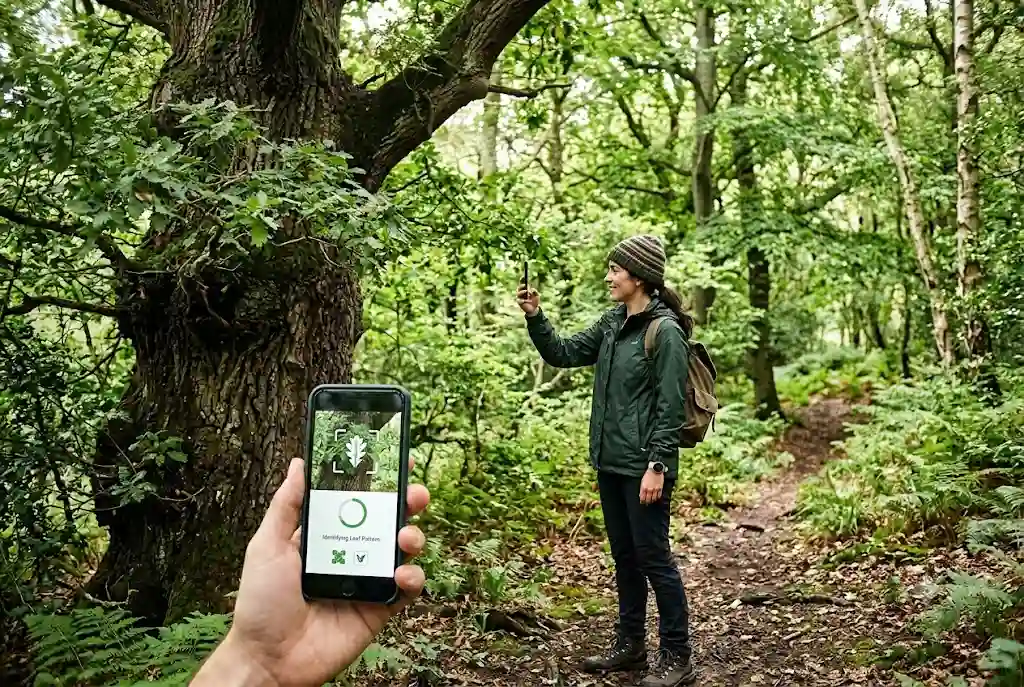
A reliable tree identification app has become an invaluable tool for arborists, students, gardeners, conservationists, and anyone interested in the UK’s diverse tree species. Instead of relying solely on field guides or expert knowledge, modern mobile apps use artificial intelligence (AI), image recognition, and extensive botanical databases to identify trees quickly and accurately.
Whether you’re exploring a woodland, managing an urban landscape, or simply curious about the tree in your garden, these apps make tree identification easier than ever while encouraging greater understanding of the natural environment.
What Is a Tree Identification App?
A tree identification app is a mobile application that helps users recognise tree species by analysing photographs or by asking a series of questions about leaves, bark, flowers, fruit, or overall tree structure.
Many apps use artificial intelligence alongside large plant databases to compare uploaded images with thousands of known species, producing likely matches within seconds.
These tools are becoming increasingly popular among both professionals and members of the public who want fast and convenient tree identification.
How Does a Tree Identifier App Work?
A modern tree identifier app combines image recognition with machine learning algorithms to analyse visual characteristics.
Depending on the application, users may:
- Photograph a leaf
- Capture bark details
- Take pictures of flowers or fruit
- Photograph the full tree
- Record GPS location
- Answer identification questions
The software then compares these features against botanical databases to suggest the most likely species.
Benefits of Using a Tree Identification App
Digital identification offers several practical advantages over traditional field guides.
Quick Results
Most apps provide likely matches within a few seconds after uploading a clear photograph.
Easy to Use
Users need little botanical experience to begin identifying common tree species.
Learning Opportunity
Many apps include educational information covering habitats, leaf characteristics, flowering periods, conservation status, and ecological importance.
Portable Reference
Instead of carrying multiple identification books, users can access information directly from their smartphone.
Identify Trees by Photo
One of the most popular features is the ability to identify trees by photo. Users simply photograph the tree or one of its distinguishing features.
For the most accurate results, photographs should be:
- Well lit
- Sharp and focused
- Taken against a simple background where possible
- Close enough to capture leaf details
- Supported with additional images of bark or fruit if available
Providing multiple images generally improves identification accuracy.
Tree Recognition Apps Support Professional Arborists
Although professional inspections still rely on expert knowledge, a tree recognition app can assist arborists during preliminary surveys, educational work, and field data collection.
These applications can help professionals:
- Confirm likely species
- Record field observations
- Support woodland surveys
- Improve digital record keeping
- Assist public engagement projects
- Speed up initial site assessments
They are particularly useful when surveying diverse woodland environments or urban tree populations.
Plant and Tree Identification Beyond Trees
Many applications now support plant and tree identification rather than focusing solely on trees.
Depending on the software, users may also identify:
- Shrubs
- Wildflowers
- Garden plants
- Ferns
- Grasses
- Climbing plants
- Ornamental species
This broader functionality makes these apps useful for gardeners, ecologists, landscape professionals, and nature enthusiasts.
AI Tree Identification Is Improving Accuracy
Advances in AI tree identification continue to improve recognition performance. Artificial intelligence can analyse subtle differences in leaf shape, bark texture, branching patterns, and seasonal characteristics that may be difficult for inexperienced users to recognise.
As machine learning models continue to develop, identification accuracy is expected to improve further, especially for native UK tree species.
Combining Tree Identification with Digital Forestry
Tree identification apps are increasingly being integrated with wider digital forestry systems. Species information collected during field surveys can be linked with GIS databases and woodland inventories.
For example, professionals managing large estates may combine identification records with GIS forestry to create accurate digital maps showing tree species, locations, and inspection histories.
Supporting Tree Mapping and Asset Management
Species identification becomes even more valuable when combined with digital inventories and mapping platforms. Many organisations use identification data alongside tree mapping systems to monitor biodiversity, maintenance schedules, and urban forest composition.
This integrated approach improves long-term planning while supporting sustainable woodland management.
Choosing the Right Tree Identification App
When selecting an application, users should consider:
- Accuracy for UK species
- Offline functionality
- Ease of use
- Regular database updates
- Educational information
- Image quality requirements
- Privacy features
- Cost and subscription options
The best app depends on whether the user is a casual nature enthusiast, student, gardener, or professional arborist.
Limitations to Keep in Mind
Although AI has improved considerably, tree identification apps are not infallible. Similar species, poor-quality images, seasonal changes, or unusual growth patterns can sometimes produce inaccurate results.
Where important management or legal decisions are involved, professional arboricultural advice remains essential.
Conclusion
A tree identification app makes recognising UK tree species faster, easier, and more accessible than ever before. Whether using AI tree identification, identifying trees by photo, or recording woodland surveys, these digital tools support education, conservation, and professional tree management.
As technology continues to advance, tree identification apps will become increasingly accurate while integrating more closely with digital mapping, GIS systems, and modern forestry management practices.
To learn more about native British trees and woodland conservation, visit the Woodland Trust, one of the UK’s leading woodland conservation charities.
