

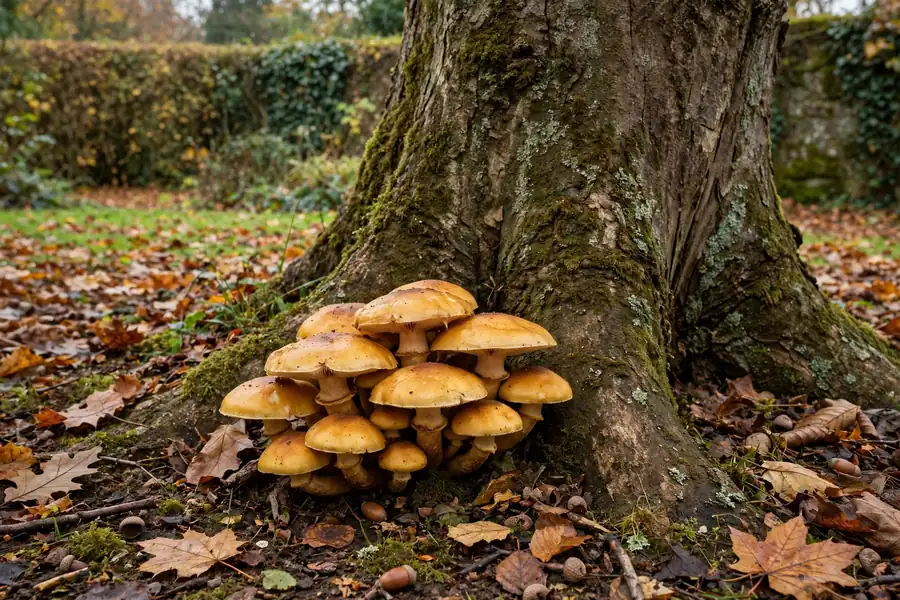
Every autumn, gardeners across the UK find the same unwelcome sight: clusters of honey-coloured toadstools sprouting at the base of a tree or shrub, often one that has looked unhappy all season. In many cases the culprit is honey fungus, a native fungal disease that attacks the roots of a wide range of woody plants and is responsible for more dead trees and shrubs in British gardens than almost any other single cause. It cannot be cured once a plant is infected, but it can be recognised early, contained, and planned around. Knowing how honey fungus behaves is the difference between losing one shrub and losing half the garden over the following years.
What Is Honey Fungus?
Honey fungus is the common name for several closely related species of Armillaria, fungi that live on the roots and stumps of trees and shrubs. Unlike many garden fungi that feed only on dead material, honey fungus can attack living roots, growing beneath the bark and destroying the tissue that carries water and nutrients from the roots to the crown. As the root system fails, the plant above ground slowly starves, even though the soil around it may be moist and fertile.
The fungus spreads mainly underground. From an infected stump or root system it sends out dark, root-like strands called rhizomorphs, often compared to black bootlaces, which grow through the soil and can reach the roots of neighbouring plants. It also spreads where healthy roots touch infected ones. A buried old stump is the classic starting point: the fungus may live on it quietly for years before moving into a living hedge, fruit tree or ornamental shrub nearby. This slow, hidden behaviour is why honey fungus often seems to strike out of nowhere when a plant collapses.
How to Spot Honey Fungus: Signs Above and Below Ground
Above ground, the symptoms are those of a plant whose roots are failing. Growth slows, leaves are smaller than usual or colour early in autumn, branches die back from the tips, and flowering and fruiting become poor. A tree or shrub may lean, produce a heavy crop of fruit in a final effort, then die suddenly, sometimes over a single season. These signs overlap with drought and other root problems, so they are a reason to investigate rather than a diagnosis on their own. Our guide to the common signs your trees need immediate professional attention is a helpful checklist when a tree starts to decline for no obvious reason.
The confirming evidence is found at the base of the plant. Peel back a small section of bark at or just below ground level on an infected plant and you will typically find a thin, white, fan-like sheet of fungal growth sandwiched between the bark and the wood, often with a strong mushroom smell. In the soil around the roots you may find the black bootlace rhizomorphs, and in autumn the fungus often gives itself away by fruiting: clusters of honey-brown toadstools, with stems that have a pale ring, appear at the base of infected plants or stumps. The toadstools last only a week or two, so their absence proves nothing, but their presence next to a declining plant is a strong clue.
Which Plants Are at Risk?
Honey fungus attacks a very wide range of trees and shrubs. Privet hedges, roses, fruit trees, lilac, viburnum and many conifers are among the frequently affected, while some plants are rarely troubled, including yew, box alternatives such as ilex crenata, ginkgo and many bamboos. No plant list is absolute, because susceptibility varies with the fungus species involved and the vigour of the plant, but the pattern matters when you plan replanting: a bed that has already lost two shrubs to honey fungus is a poor place to put another highly susceptible species.
Vigour is the other half of the equation. The fungus struggles to invade healthy, well-grown roots, and it typically gains its foothold where plants are already stressed by drought, waterlogging, compaction or competition. The routine care described in our guide to professional tree care throughout the year, such as mulching, sensible watering in dry spells and avoiding damage to roots and bark, genuinely reduces the chances of an attack taking hold, even though it cannot guarantee protection.
What to Do If You Find Honey Fungus
First, confirm the diagnosis before removing anything valuable, ideally with help from an arborist who can inspect the root collar and, if necessary, excavate a small area to check for the white fungal sheet and rhizomorphs. If a plant is dead or clearly dying and honey fungus is confirmed, the priority is to remove as much of the infected material as you reasonably can: the plant itself, its stump and as many of the larger roots as can be dug out. Stump grinding is worthwhile because a left-behind stump is the food base from which the fungus keeps spreading. Infected material should not be composted at home; check local guidance on green waste or burning for diseased wood.
Where a valued tree stands near an infected area, a physical barrier can help protect it. A heavy-duty membrane or rigid barrier sunk vertically into the soil between the infected zone and the plant you are protecting blocks the rhizomorphs, which travel mainly in the upper layers of soil. Barriers are not foolproof, and they work best as part of a wider plan, but for a specimen tree or a long hedge they can buy many years. Before removing or working on any substantial tree, check whether it is protected: our guide to protected trees law in the UK explains Tree Preservation Orders and conservation area rules, which can apply even to diseased trees.
Living With Honey Fungus: Replanting and Long-Term Management
Because the fungus persists in old roots buried in the soil, an infected garden rarely becomes completely free of it. The realistic goal is management, not eradication. Replant with species that are less susceptible, improve drainage where soil sits wet, and keep new plants growing vigorously with mulch and water while they establish. Many of the trees discussed in our guide to how native tree species support local ecosystems can play a part in a replanted scheme, provided each is a sensible choice for a site with honey fungus present. Avoid replanting the same susceptible species in the same hole, and accept that a mixed planting is more resilient than any single-species row.
It also helps to see honey fungus alongside the other pressures on garden trees, rather than in isolation. Our article on ash dieback covers a very different disease with a similar lesson: early recognition, sensible sanitation and diverse replanting are what protect a garden over the long term. For most homeowners, the day-to-day routine in our residential tree care guide is the practical foundation: healthy, unstressed trees are simply harder for honey fungus to kill. Find the toadstools early, remove what is infected, protect what is valuable, and replant wisely, and a garden with honey fungus in it can stay full, green and productive for decades.
