

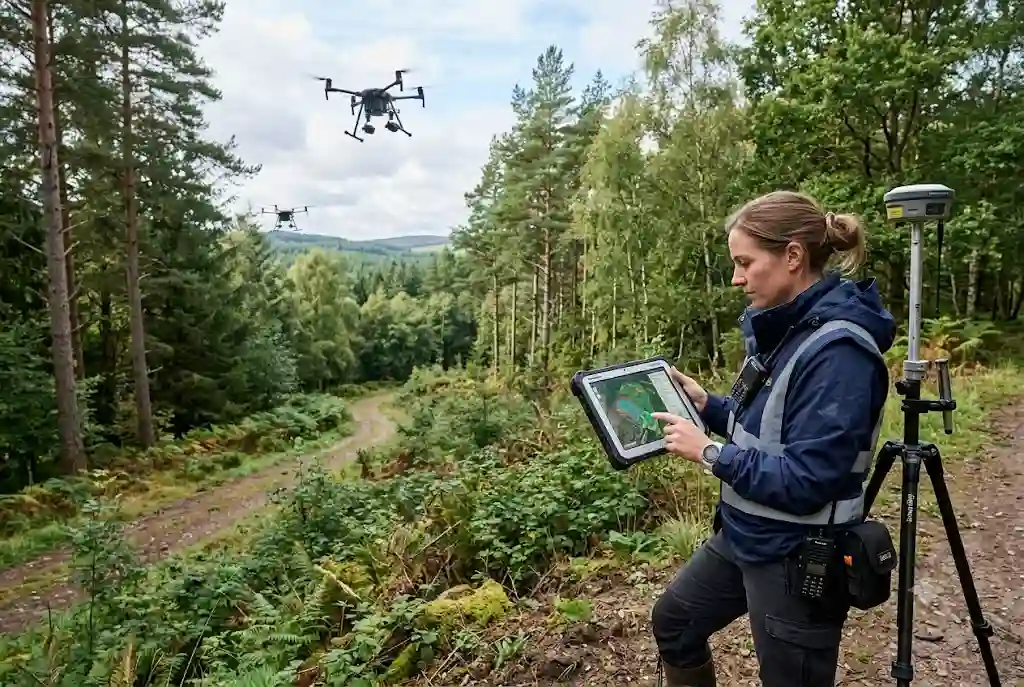
Forestry technology is reshaping how forests, woodlands, and urban tree populations are managed across the UK. Modern digital tools allow arborists, forestry professionals, landowners, and local authorities to collect more accurate data, improve operational efficiency, and make informed decisions that support sustainable woodland management.
From cloud-based software and GPS mapping to drones, artificial intelligence, and remote sensing, technology is helping professionals monitor forest health, reduce costs, and respond more effectively to environmental challenges. As climate change, biodiversity protection, and sustainable land management become greater priorities, digital innovation is becoming an essential part of modern forestry.
What Is Forestry Technology?
Forestry technology refers to the use of digital systems, software, hardware, and automated tools to improve the planning, monitoring, maintenance, and management of forests and trees.
Rather than relying solely on manual surveys and paper records, forestry professionals now use advanced technologies to collect real-time information, analyse tree conditions, and manage woodland assets more efficiently.
Today’s solutions combine mapping software, mobile applications, cloud computing, GPS, drones, satellite imagery, and data analytics to support better environmental decision-making.
Why Forestry Technology Matters
Forests provide valuable environmental, economic, and social benefits. They improve biodiversity, store carbon, reduce flooding, enhance air quality, and provide recreational spaces. Managing these natural resources effectively requires accurate information and efficient planning.
Modern technology helps organisations:
- Improve forest health monitoring
- Increase operational efficiency
- Reduce surveying costs
- Enhance public safety
- Support sustainable woodland management
- Improve long-term planning
- Maintain accurate digital records
- Respond quickly to environmental threats
Digital Forestry Is Changing Woodland Management
Digital forestry replaces traditional paper-based systems with connected digital platforms that centralise woodland information. Forestry professionals can access maps, inspection reports, maintenance records, and environmental data from virtually anywhere.
Cloud-based systems allow multiple teams to collaborate while ensuring information remains current and easily accessible.
Digital records also improve reporting, compliance, and long-term forest planning.
Smart Forestry Uses Connected Technologies
The concept of smart forestry combines multiple technologies into one integrated management approach. Instead of collecting information manually, sensors, drones, GPS devices, and mapping software work together to provide continuous environmental insights.
Examples include:
- Remote environmental monitoring
- Automated data collection
- Cloud-based inventory management
- Real-time field reporting
- Predictive maintenance planning
- Digital inspection scheduling
This connected approach improves efficiency while helping managers make evidence-based decisions.
Forestry Software Streamlines Daily Operations
Modern forestry software has become an essential management tool for many organisations.
Common software features include:
- Tree inventory management
- GIS mapping integration
- Maintenance scheduling
- Inspection reporting
- Risk assessment records
- Photo documentation
- Mobile field data collection
- Asset management dashboards
These systems reduce administrative workloads while improving data consistency across teams.
Forest Monitoring Technology Improves Environmental Awareness
Advances in forest monitoring technology allow professionals to observe woodland conditions more accurately than ever before.
Monitoring technologies may include:
- Satellite imagery
- Remote sensing
- LiDAR scanning
- Environmental sensors
- Weather monitoring stations
- Thermal imaging
- Drone surveillance
These tools help identify storm damage, disease outbreaks, pest infestations, drought stress, and changes in woodland health before problems become widespread.
Precision Forestry Enhances Decision-Making
Precision forestry applies detailed spatial data to improve woodland management. Instead of treating entire forests the same way, managers can make decisions based on specific site conditions.
Precision forestry supports:
- Targeted maintenance
- Selective harvesting
- Species management
- Habitat conservation
- Carbon monitoring
- Resource allocation
- Risk assessment
This data-driven approach improves sustainability while reducing unnecessary interventions.
GIS and Forestry Technology Work Together
One of the most valuable components of modern forestry technology is Geographic Information Systems (GIS). Accurate digital mapping allows professionals to visualise woodland assets, inspection history, and environmental data within a single platform.
Many organisations combine forestry software with GIS forestry to improve planning, tree inventory management, and long-term asset monitoring.
Drones Are Expanding Forestry Capabilities
Drone technology has become an important addition to digital forestry. High-resolution aerial imagery helps professionals inspect tree canopies, identify storm damage, and survey woodland areas quickly and safely.
Integrating a drone tree survey with GIS software creates highly accurate digital forest records that support efficient decision-making.
Artificial Intelligence in Forestry
Artificial intelligence is beginning to support forestry professionals by analysing large datasets and identifying patterns that may not be immediately visible.
Emerging AI applications include:
- Automatic tree species recognition
- Disease detection
- Canopy analysis
- Growth prediction
- Maintenance prioritisation
- Change detection over time
While human expertise remains essential, AI can improve efficiency by processing information more rapidly.
Challenges of Implementing Forestry Technology
Although digital innovation offers many benefits, organisations should consider several practical challenges before implementation.
- Initial investment costs
- Staff training requirements
- Data management responsibilities
- Software compatibility
- Cybersecurity considerations
- Equipment maintenance
Successful adoption depends on choosing scalable solutions that meet organisational needs while supporting long-term operational goals.
The Future of Forestry Technology
As technology continues to evolve, forestry professionals can expect even greater levels of automation, connectivity, and data accuracy. Improvements in satellite monitoring, autonomous drones, AI-powered analytics, and cloud computing will continue enhancing woodland management throughout the UK.
Digital innovation will also support climate resilience, biodiversity conservation, and sustainable forestry practices by providing better information for strategic planning.
Conclusion
Forestry technology has become a vital part of modern woodland management. From digital forestry platforms and smart forestry systems to forest monitoring technology and precision forestry, these innovations enable professionals to manage forests more safely, efficiently, and sustainably.
By embracing connected technologies, organisations across the UK can improve decision-making, protect valuable woodland resources, and prepare for the environmental challenges of the future.
For further information on sustainable forestry practices and woodland management, visit the Forest Research, the UK’s leading organisation for forestry and tree-related research.
