

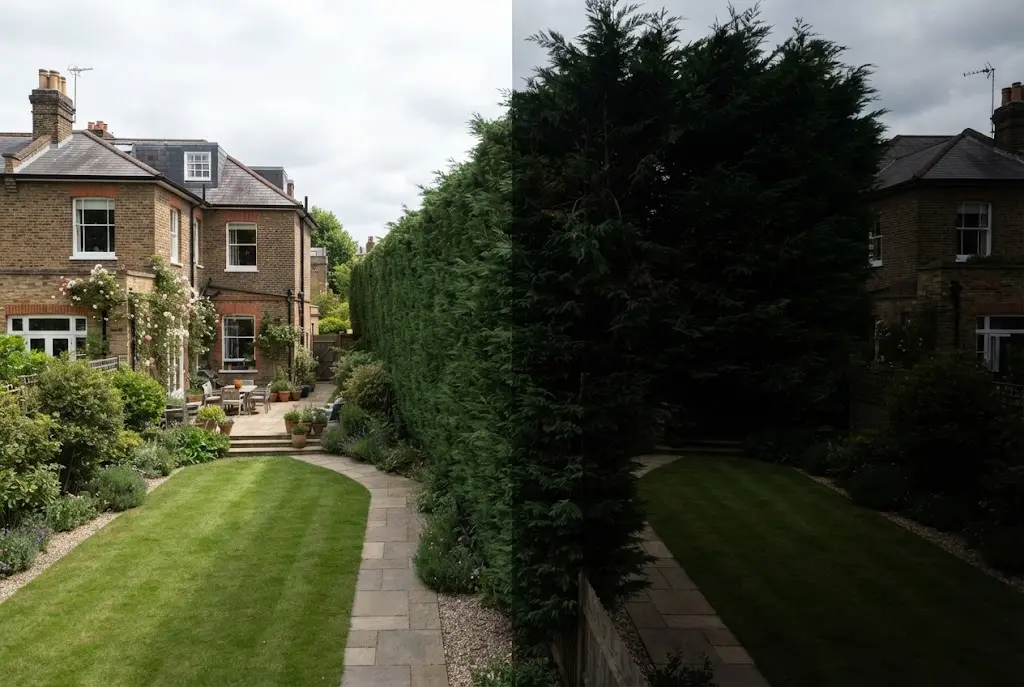
Understanding high hedge law can help homeowners deal with disputes involving tall evergreen or semi-evergreen hedges. A large hedge may provide privacy and shelter, but it can also affect daylight, sunlight, views and the reasonable enjoyment of a neighbouring home or garden. When informal discussions fail, the law provides a process through which certain high hedge complaints can be considered by the local council.
However, not every tall hedge qualifies. The statutory high hedge procedure has specific requirements, and homeowners are generally expected to try to resolve the problem with their neighbour before making a formal complaint. This guide explains the main rules, what counts as a high hedge, how complaints work and what a council can do.
What Is High Hedge Law?
In England, the main legal framework for high hedge disputes comes from Part 8 of the Anti-social Behaviour Act 2003. The legislation gives local authorities powers to deal with complaints about certain high hedges where their height adversely affects the reasonable enjoyment of a domestic property.
The procedure is designed specifically for disputes involving qualifying hedges. It does not give councils a general power to control every hedge that a neighbour considers unattractive, inconvenient or excessive.
Government guidance explains that a council must consider whether the height of the hedge is adversely affecting the complainant’s reasonable enjoyment of their home and/or garden. Where appropriate, the council can issue a formal remedial notice requiring action to address the problem.
The statutory process is therefore different from simply asking a council to decide whether a neighbour should cut their garden hedge. The legal tests have to be satisfied before the formal complaint procedure can operate.
What Counts as a High Hedge?
One of the most important points in high hedge law is understanding the definition of a qualifying high hedge.
Generally, the hedge must meet several conditions. It must consist of a line of two or more trees or shrubs, be mostly evergreen or semi-evergreen, and be more than two metres tall. It must also be capable of obstructing light or access, even where there are gaps between the trees or in the foliage.
The hedge must normally be growing on land owned or occupied by someone else, and the complainant must be the owner or occupier of the affected domestic property.
These requirements mean that a single tree is not normally dealt with through the high hedge complaint procedure. Similarly, a low deciduous hedge that loses its foliage during winter will not automatically fall within the statutory definition.
Does a Hedge Have to Be Completely Solid?
No. A hedge does not necessarily need to form a completely solid wall of vegetation. The relevant question is whether it remains capable of obstructing light or access despite gaps.
This is important because many mature hedges contain spaces between trunks, branches or sections of foliage. The existence of gaps alone does not automatically take a hedge outside the statutory framework.
The assessment is ultimately a matter of judgement based on the hedge and its effect on the affected property.
Is There a Legal Maximum Hedge Height?
There is no general rule under the high hedge legislation that says every garden hedge must remain below a particular height. The commonly mentioned two-metre measurement is part of the test for whether a hedge may qualify as a high hedge; it is not an automatic rule requiring every hedge above two metres to be cut down.
This distinction is important in neighbour disputes. A hedge being more than two metres tall does not, by itself, mean that the owner has broken the law.
The statutory complaint procedure considers the impact of the hedge on the reasonable enjoyment of the affected domestic property. The council must consider the circumstances of the particular case before deciding whether remedial action is justified.
High Hedge Complaints: What Should You Do First?
Before making a formal high hedge complaint, neighbours are expected to make reasonable attempts to resolve the disagreement themselves. The council can reject a complaint if it considers that insufficient reasonable steps have been taken to settle the matter without formal intervention.
Starting with a calm conversation can sometimes prevent a dispute from becoming more complicated. If that does not work, written communication can create a clearer record of the problem and the proposed solution.
It can also be useful to suggest practical options rather than simply demanding removal. Depending on the circumstances, these could include reducing the height, carrying out regular maintenance or agreeing a suitable maintenance schedule.
Where communication has broken down, mediation may also be worth considering before using the formal council procedure.
Keep Evidence of Your Attempts to Resolve the Dispute
If the matter eventually reaches the council, evidence showing that you tried to resolve the problem can be important. Keep copies of letters, emails and other relevant correspondence.
It can also help to record photographs showing the hedge and the effect it has on your property. Measurements, photographs taken from relevant windows and details of how the hedge affects your garden or living areas may help explain the complaint.
The purpose is not to create an unnecessarily adversarial case. Instead, good records can help demonstrate the facts and show that reasonable attempts were made to resolve the disagreement.
How to Make a High Hedge Complaint
If informal efforts have failed and the hedge appears to meet the statutory requirements, the next step is normally to contact the local authority responsible for the area where the hedge is situated.
The council’s own procedure will explain how it accepts high hedge complaints, whether a specific application form is required and whether a fee applies. The legislation allows councils to set and charge fees for handling complaints, so the cost can vary between authorities.
A complaint should clearly explain the problem and provide relevant supporting information. This can include the location and type of hedge, its approximate height, its position in relation to the property and the specific ways in which its height affects the reasonable enjoyment of the home or garden.
Government guidance recommends that complainants explain the steps they have already taken to resolve the dispute and provide relevant information supporting their case.
What Happens After a High Hedge Complaint?
Once a council receives a complaint, it must first establish whether the statutory requirements have been met. If the complaint can proceed, the hedge owner will generally have an opportunity to provide their side of the story.
The council may arrange a site visit and gather information about the hedge and its surroundings. It can consider factors such as the hedge’s height, position and effect on the affected property.
The council is not simply deciding which neighbour it prefers. Its role is to apply the statutory framework and determine whether the hedge is adversely affecting the reasonable enjoyment of the domestic property.
If the council concludes that action is necessary, it can issue a remedial notice. The notice can specify what must be done to the hedge and when the required work must be completed.
Can a Council Order a Neighbour to Remove a Hedge?
The high hedge procedure is primarily concerned with remedying the adverse effects caused by excessive height. A council can use a remedial notice to require appropriate steps to address the problem, but the legislation does not simply give councils an unrestricted power to order complete hedge removal whenever a complaint succeeds.
The appropriate remedy depends on the circumstances and the effect of the hedge. A council may determine that reducing the hedge to a particular height and maintaining it at that level is sufficient.
Importantly, two metres is not automatically the required final height. Government guidance states that the legislation does not prescribe a single height that must apply in every successful complaint.
What If the Hedge Owner Ignores the Notice?
A remedial notice is a formal requirement rather than a casual recommendation. If the hedge owner does not comply, enforcement provisions can become relevant.
The exact consequences depend on the circumstances and the applicable enforcement process. Councils may have powers to take further action where a remedial notice is breached.
This is one reason why both sides should take the formal process seriously. A successful complaint does not simply end when the council makes its decision; the requirements in any remedial notice may continue to affect how the hedge must be maintained.
Evergreen Hedge Law and Protected Trees
High hedge legislation does not necessarily override other tree protection rules. If trees forming part of a hedge are protected by a Tree Preservation Order or are located in a conservation area, additional requirements may apply before certain works are carried out.
This can create an important overlap between evergreen hedge law and wider tree legislation. A neighbour who receives a remedial notice should not assume that they can immediately carry out any specified tree work without checking whether other legal controls apply.
For a broader explanation of protected trees, ownership and statutory controls, see our guide to tree law UK and tree legislation.
Can You Cut Your Neighbour’s Hedge?
Neighbouring property owners can have rights to deal with branches or roots that cross onto their property, but those rights have limits. GOV.UK guidance explains that branches or roots crossing into a property can generally be trimmed back to the boundary, subject to important restrictions.
However, this does not mean a neighbour can simply reduce the height of someone else’s hedge because they consider it too tall. Cutting beyond the boundary or carrying out unauthorised work can create a separate property dispute and may expose the person carrying out the work to legal consequences.
Tree protection rules can also affect what work is permitted. Therefore, it is sensible to check the legal position before cutting substantial vegetation belonging to a neighbour.
High Hedge Disputes and Property Rights
High hedge disputes often involve more than the appearance of a garden. The affected homeowner may experience reduced daylight, loss of sunlight, restricted views or a diminished ability to use parts of their garden comfortably.
At the same time, the hedge owner may have planted the hedge for privacy, shelter, screening or other legitimate reasons. A fair assessment therefore needs to consider the actual circumstances rather than assuming that either neighbour automatically has priority.
The statutory process is designed to balance these competing interests. A successful complaint does not necessarily mean that the hedge owner has acted unlawfully simply by allowing the hedge to grow. Instead, the question is whether the hedge’s height has an adverse effect that justifies formal remedial action.
What High Hedge Law Does Not Usually Cover
The statutory high hedge procedure has defined limits. For example, it is not designed to resolve every disagreement about roots, individual trees, ordinary garden maintenance or general neighbour relations.
Government guidance specifically notes that the legislation does not allow councils to deal with problems caused by roots. A single tree is also not treated as a high hedge for the purpose of this particular complaint procedure.
This distinction matters because choosing the wrong legal route can waste time and money. The nature of the problem should be identified before deciding whether a high hedge complaint is appropriate.
When Should You Seek Legal Advice?
Many hedge disagreements can be resolved through direct communication or mediation. However, tree legal advice or specialist property advice may be appropriate where the dispute involves multiple legal issues.
Examples include allegations of property damage, disagreement about ownership, repeated refusal to comply with formal requirements, protected trees, boundary questions or a dispute that has already escalated into formal proceedings.
Professional advice can also help clarify which parts of the dispute fall under high hedge legislation and which may need to be addressed through another legal route.
Where the hedge includes trees that may present safety concerns, it may also be useful to consider the separate issues addressed in our guide to dangerous tree liability.
How to Prevent Hedge Disputes
Prevention is usually easier than dealing with a formal dispute after relationships have deteriorated. Anyone planting a new hedge should consider its mature size, growth rate and likely maintenance requirements rather than focusing only on how it looks when first planted.
Regular trimming can help prevent a hedge from becoming excessively tall or wide. It is also sensible to consider the position of the hedge in relation to neighbouring windows, gardens, pathways and boundaries.
Good communication can make a significant difference. If a neighbour raises concerns about a hedge, discussing practical maintenance options early may avoid the need for formal intervention.
Final Thoughts on High Hedge Law
High hedge law provides a formal mechanism for dealing with certain neighbour disputes involving tall evergreen or semi-evergreen hedges. However, the process is not an automatic height restriction. A qualifying hedge must meet specific statutory conditions, and the affected homeowner normally needs to demonstrate that its height is adversely affecting the reasonable enjoyment of their domestic property.
Trying to resolve the matter informally should generally be the first step. If that fails, a formal complaint to the relevant local authority may be available where the statutory requirements are satisfied.
Because hedge disputes can overlap with tree protection, property boundaries and liability issues, it is important to identify the precise legal problem before taking action. Understanding the relevant rules can help both neighbours approach the dispute more effectively and avoid unnecessary escalation.
