

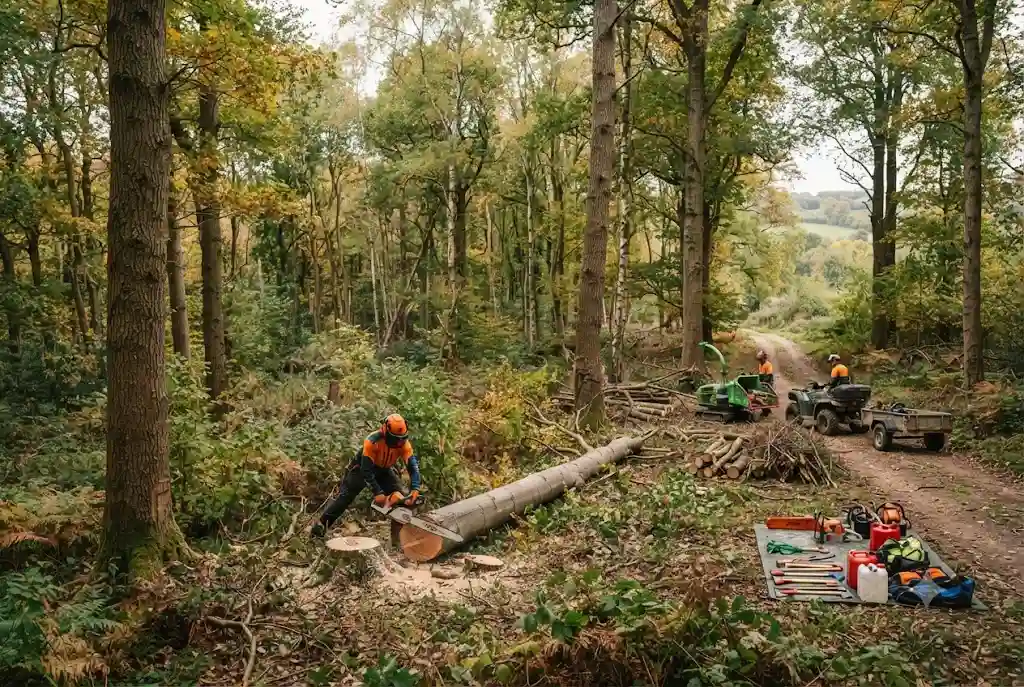
A tree felling licence is an important legal requirement for many types of tree removal in England. If you plan to cut down growing trees, whether on woodland, agricultural land or another type of property, you may need permission from the Forestry Commission before starting work. The rules include specific exemptions and volume limits, so it is important to establish the requirements for your particular project before any trees are felled.
Tree removal can involve more than simply deciding whether a tree needs to come down. Protected trees, planning permissions, environmental designations, wildlife considerations and felling controls can all affect what work is lawful. Understanding the rules in advance can help landowners, developers and contractors avoid unnecessary delays and potential enforcement action.
This guide focuses on the tree felling licence framework in England and explains when a licence may be required, common exemptions, application considerations and how felling rules interact with other tree protection requirements.
What Is a Tree Felling Licence?
A tree felling licence is permission issued by the Forestry Commission to legally fell growing trees in England where a licence is required. The system is intended to regulate tree felling and support sustainable woodland management.
The Forestry Commission’s current guidance states that a licence is normally required to fell growing trees on land in England unless a specific exemption applies. This can apply to individual trees as well as groups of trees. ([GOV.UK](https://www.gov.uk/guidance/when-a-felling-licence-is-needed))
Felling licences are free in England. Depending on the circumstances, a licence can authorise felling for a defined period and may include conditions requiring the felled area to be restocked.
When Is a Tree Felling Licence Required?
When is a tree felling licence required? In England, the general rule is that you need one to fell growing trees unless an exemption applies.
The current Forestry Commission guidance explains that licensing can apply to trees on different types of land and is not limited to large woodlands. Individual trees and groups of trees can fall within the licensing framework.
However, the rules contain important exceptions. These can relate to the size and volume of timber, the location of trees, the purpose of felling and specific circumstances such as danger or development.
Because exemptions have conditions, it is important to check the current Forestry Commission guidance rather than assuming that a particular type of property automatically falls outside the licensing system.
Tree Felling Licence Volume Limits
One of the most important rules concerns the amount of timber being felled during a calendar quarter.
For trees above the relevant diameter thresholds, a felling licence is required when more than 5 cubic metres of timber is felled from the relevant property during a calendar quarter, unless another exemption applies. The four calendar quarters are January to March, April to June, July to September and October to December. ([GOV.UK](https://www.gov.uk/guidance/when-a-felling-licence-is-needed))
The current Forestry Commission guidance also states that up to 2 cubic metres of the 5 cubic metre allowance can be sold during each calendar quarter without requiring a licence. If more than that amount is sold, a licence is required.
This means landowners should keep accurate records of felling and timber sales rather than treating each individual tree removal as a completely separate event.
Diameter Thresholds
The current rules also use diameter thresholds when determining whether the volume provisions apply. For ordinary trees, the relevant over-bark diameter is 8 centimetres or more, measured at 1.3 metres above ground level. For coppice or underwood, the threshold is 15 centimetres or more.
These technical measurements can matter when assessing whether proposed work falls within the licensing rules. If you are unsure how the rules apply to your trees, the Forestry Commission recommends contacting the relevant area office.
When You Do Not Need a Tree Felling Licence
There are circumstances in which tree felling can take place without a Forestry Commission licence.
Common examples can include certain trees growing in gardens, churchyards or designated public open spaces, particular tree-maintenance activities and specific safety situations. There are also exceptions associated with some development work where full planning permission authorises the relevant tree removal.
The exact requirements and evidence for an exemption matter. The current Forestry Commission guidance makes clear that an exemption should not simply be assumed because a tree appears to fall into a particular category. ([GOV.UK](https://www.gov.uk/guidance/when-a-felling-licence-is-needed))
Tree Maintenance
Routine maintenance such as pruning, lopping, topping or pollarding is generally different from felling and does not normally require a Forestry Commission felling licence.
However, this does not mean unrestricted tree work is always permitted. A tree may be protected by a Tree Preservation Order or located within a conservation area, creating separate planning controls.
Our guide to protected trees law explains how those local planning protections can affect proposed tree work.
Dangerous or Damaged Trees
There are circumstances where trees may need to be felled to prevent danger. The Forestry Commission recognises certain safety-related situations as exceptions to the normal licensing requirement.
However, an exemption based on danger should not be used simply because removing a tree is convenient. The circumstances need to satisfy the applicable legal requirements, and other permissions may still be relevant.
Where there is an immediate safety concern, professional assessment can help establish the appropriate response while also considering whether the tree has other legal protections.
Tree Felling Licence and Protected Trees
A tree felling licence and a Tree Preservation Order are not the same thing.
A felling licence is issued through the Forestry Commission and primarily controls tree felling under forestry legislation. A Tree Preservation Order is made by a local planning authority to protect trees or woodland that have particular amenity value.
This distinction is important because satisfying one legal requirement does not necessarily remove another. A tree may need a Forestry Commission felling licence and separate local planning authority consent, depending on the circumstances.
Equally, a tree may fall within an exemption from the felling licence system but still be protected by a TPO or conservation-area controls.
Before work begins, landowners should therefore check both the felling requirements and any local tree protection. GOV.UK guidance specifically notes that other permissions or consents can sometimes be required even when a felling licence is not. ([GOV.UK](https://www.gov.uk/guidance/when-a-felling-licence-is-needed))
Felling Licence UK Rules and Planning Permission
Planning permission can sometimes affect whether a separate felling licence is required.
The current Forestry Commission service identifies development work with full planning permission as one of the circumstances where trees may be removed without a felling licence, provided the planning permission specifies the trees to be removed or demonstrates that their removal is necessary for the development to begin. ([GOV.UK](https://apply-for-a-tree-felling-licence.service.gov.uk/Home/WhenYouDoNotNeedALicence))
However, developers should not interpret planning permission as a universal exemption from every tree-related legal control.
Protected trees, planning conditions, environmental designations and wildlife requirements can still affect what work is permitted. A development site should therefore be assessed for tree constraints at an early stage.
How to Apply for a Tree Felling Licence
If your proposed work requires a licence, the application needs to provide the Forestry Commission with sufficient information to assess the proposed felling.
Applications can be made by someone with an interest in the land, such as a freeholder, leaseholder or tenant where the lease permits the relevant felling. An authorised agent can also apply on behalf of the landowner or other eligible applicant.
The application process can involve details about the trees, proposed felling and restocking arrangements where applicable. The Forestry Commission recommends applying well ahead of the intended felling date.
Current guidance published in July 2026 states that licences can be issued for up to five years as standalone licences, or up to ten years when associated with an approved woodland management plan. ([GOV.UK](https://www.gov.uk/guidance/apply-for-a-felling-licence))
How Long Does a Felling Licence Last?
The duration depends on the type of licence issued.
A standalone felling licence can generally authorise felling for up to five years. Where it is associated with an approved woodland management plan, the licence can cover a period of up to ten years.
Felling licences cannot simply be extended when they expire. If further felling is required after the authorised period, a new application may be necessary.
This makes it important to plan woodland operations realistically and ensure that the proposed work can be completed within the licence period.
Felling Licence Conditions and Restocking
A licence may contain conditions designed to support sustainable woodland management.
One important condition is restocking. The Forestry Commission states that felling licences usually require the felled area to be restocked, either by replanting trees or allowing suitable natural regeneration.
Restocking helps maintain woodland cover and supports the principle that tree removal should not simply result in permanent woodland loss.
There are circumstances where restocking may not be required. For example, certain felling intended to restore open habitat can fall within relevant policy, while thinning operations can have different restocking arrangements. The specific conditions of the licence should always be followed. ([GOV.UK](https://apply-for-a-tree-felling-licence.service.gov.uk/Home/LicenceConditions))
Forestry Felling Licence and Sustainable Woodland Management
A forestry felling licence is part of a wider system intended to support sustainable woodland management rather than simply regulate individual cutting operations.
The Forestry Commission states that all felling should be carried out in accordance with the UK Forestry Standard. Woodland management plans can provide a structured framework for scheduling felling, regeneration and other management activities.
This is particularly valuable for larger woodland areas where felling decisions need to be considered over many years rather than as isolated projects.
A woodland management approach can also help landowners consider biodiversity, landscape character, timber production, access, disease management and future woodland structure together.
Environmental Considerations Before Tree Felling
Obtaining a felling licence does not mean that every other environmental consideration disappears.
The Forestry Commission advises landowners to assess environmental and regulatory constraints before felling. These can include protected areas, wildlife, historic features, landscape considerations and other designations.
Some sites may require additional consent even when the proposed tree removal is exempt from the need for a felling licence. For example, work affecting a Site of Special Scientific Interest may require separate consent.
Wildlife legislation can also affect when work can safely and legally take place. Trees and woodland can provide nesting and roosting habitat, so appropriate ecological considerations should be built into the project before cutting begins.
Tree Removal Regulations and Contractors
Hiring a professional tree contractor does not transfer all legal responsibility away from the landowner.
The Forestry Commission’s guidance states that everyone involved in tree felling has responsibilities to ensure that the appropriate licence, permission or exemption is in place. This can include owners, tenants, agents, timber merchants and contractors. ([GOV.UK](https://www.gov.uk/government/publications/tree-felling-getting-permission/tree-felling-getting-permission))
Before work starts, the parties involved should establish which trees are authorised for removal and what conditions apply.
This is particularly important on larger sites where several contractors or subcontractors may be involved. A clear written scope can help prevent the wrong trees being felled.
What Happens If Trees Are Felled Without a Licence?
Felling trees without a licence when one is required is an offence.
Potential enforcement can affect anyone involved in the unauthorised work, including landowners and contractors. The Forestry Commission can investigate suspected illegal felling and take enforcement action where appropriate.
The consequences can include prosecution and requirements connected with restoring tree or woodland cover. The exact outcome depends on the circumstances and the nature of the offence.
This is why checking the legal position before work begins is considerably safer than trying to resolve a licensing issue after trees have already been removed.
Can a Felling Licence Be Transferred?
Felling licences can remain relevant when land changes ownership.
Current Forestry Commission guidance states that an active felling licence automatically transfers to a new owner when the land is sold. The new owner can use remaining felling permissions but must also comply with any restocking conditions attached to the licence. ([GOV.UK](https://www.gov.uk/guidance/apply-for-a-felling-licence))
This makes it important for buyers and sellers to identify active felling licences during land transactions and understand any outstanding obligations before completion.
Tree Felling Licence and Hedgerow Removal
Tree felling can also form part of a wider hedgerow or boundary project.
If trees are growing within a hedgerow, separate hedgerow rules may apply to removal of the hedge itself. This means a landowner may need to consider both the legal status of the hedgerow and the rules governing individual trees.
Our guide to hedgerow regulations explains the separate framework covering countryside hedgerows, removal notices and agricultural hedgerow management.
Considering these requirements together is particularly important where a development or access project involves removing both vegetation and mature trees along a boundary.
How to Check Whether You Need a Felling Licence
Before arranging tree removal, work through the following checks:
- Identify the trees proposed for removal.
- Confirm that they are growing trees covered by the relevant rules.
- Check the applicable diameter and timber-volume limits.
- Determine whether a specific felling exemption applies.
- Check for Tree Preservation Orders or conservation-area protection.
- Check whether planning permission affects the proposed removal.
- Look for environmental or wildlife constraints.
- Confirm whether other permissions or consents are required.
- Keep appropriate records supporting any claimed exemption.
- Do not begin felling until all required permissions are in place.
If there is uncertainty, the Forestry Commission advises contacting the relevant area office before starting work. ([GOV.UK](https://www.gov.uk/guidance/when-a-felling-licence-is-needed))
Final Thoughts
A tree felling licence is an important part of England’s legal framework for controlling the removal of growing trees. Although exemptions exist, the general rule is that a licence is required unless the proposed felling falls within a recognised exception.
Volume limits, tree diameter, planning permission, land type, tree protection and environmental considerations can all affect the answer. For that reason, tree removal should be assessed as a legal and environmental project rather than simply a practical landscaping task.
Landowners and contractors should establish the requirements before work begins, keep evidence for any exemption they rely upon and follow all licence conditions where a licence is issued.
Understanding the relationship between a tree felling licence, protected trees law and hedgerow regulations provides a stronger foundation for responsible and legally compliant tree management across England.
“`
