

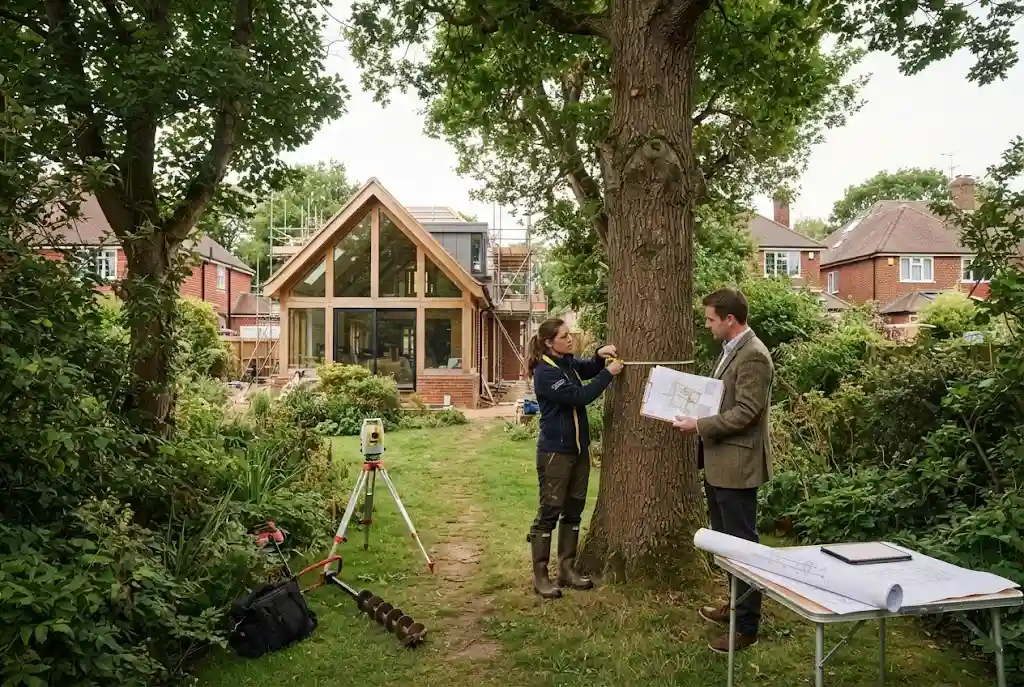
Understanding planning permission for trees is important before carrying out significant tree work or starting a development project that could affect existing trees. A homeowner may own a tree but still face planning controls if it is protected by a Tree Preservation Order (TPO), located within a conservation area or affected by a planning condition. Developers also need to consider trees carefully when preparing planning applications.
Tree-related planning rules can be complicated because different forms of protection operate alongside the wider planning system. In England, local planning authorities can protect trees through TPOs and conservation area controls, while development proposals may also be subject to tree-related planning conditions. Separate rules can apply to certain types of tree felling and woodland.
This guide explains the main issues to consider when dealing with trees and planning permission, including protected trees, planning applications, conservation areas, tree work and development proposals.
Do You Need Planning Permission for Trees?
There is no single answer to whether planning permission is required for tree work. It depends on the circumstances and, importantly, the legal status of the tree.
Planning Portal guidance explains that someone wishing to prune or fell a tree may need planning permission or may need to notify the local planning authority. This depends particularly on whether the tree is protected by a Tree Preservation Order or is located within a conservation area.
A tree that is not protected may not require specific planning consent simply because it is being pruned. However, other restrictions can sometimes apply. For this reason, checking the tree’s status with the relevant local planning authority before starting substantial work is a sensible first step.
Planning Permission for Trees and Tree Preservation Orders
A Tree Preservation Order is one of the most important considerations when assessing planning permission for trees. A TPO can protect an individual tree, a group of trees, an area of trees or woodland where the local planning authority considers protection necessary in the interests of amenity.
Under the relevant rules in England, a TPO generally prohibits cutting down, topping, lopping, uprooting, wilfully damaging or destroying a protected tree without the local planning authority’s written consent, subject to statutory exceptions.
This means that tree ownership does not automatically give a property owner unrestricted freedom to remove or substantially alter a protected tree.
If significant work is proposed to a protected tree, the owner or their agent will normally need to submit the appropriate application to the local planning authority. The application should clearly identify the tree, describe the proposed work and provide the information needed by the authority to assess the request.
What Happens After a TPO Application?
The local planning authority considers the proposed work and the reasons supporting the application. It may grant consent, grant consent subject to conditions or refuse consent.
Conditions can regulate how authorised work is carried out and can sometimes require replacement planting or other measures. If consent is refused, appeal rights may be available in accordance with the applicable procedure.
Because a TPO application concerns a legally protected tree, it is important that the proposed work is described accurately. A vague or incomplete application may make it more difficult for the authority to assess what is actually being requested.
Trees in Conservation Areas
Conservation areas create another important form of tree protection. Certain trees within a conservation area that are not already protected by a TPO can be subject to section 211 controls.
In England, a person intending to carry out certain work to qualifying trees in a conservation area generally needs to notify the local planning authority six weeks before the work begins, unless an exception applies. The purpose of the notice period is to give the authority an opportunity to consider whether the tree should instead be protected by a TPO.
This is different from applying for consent under a TPO. A section 211 notice is a notification of proposed work rather than an application asking the council to approve or refuse the work under a TPO.
If the local authority decides that the tree does not require a TPO, the work may proceed after the relevant notice period, subject to the applicable rules. If the authority makes a TPO, additional controls can then apply.
Trees and Planning Permission for New Development
Trees and planning permission can become particularly important when someone proposes a new building, extension, access road, parking area or other development.
Existing trees can affect how a development is designed and assessed. Their location, size, condition and relationship with proposed buildings may all need to be considered during the planning process.
Planning authorities can use planning conditions to protect existing trees and secure new planting where appropriate. Government guidance states that, when granting planning permission, authorities should use planning conditions for tree preservation and planting where appropriate.
Developers should therefore identify important trees early in the design process rather than waiting until the planning application is almost complete. Early assessment can help reveal constraints and reduce the risk of costly design changes.
Planning Applications and Trees
A planning application may need to address existing trees when proposed development could affect them. This can include trees located directly where construction is proposed as well as trees close enough to be affected by excavation, foundations, access works or changes to the surrounding ground.
The precise information required can vary according to the local planning authority and the nature of the development. Larger or more sensitive proposals may require more detailed arboricultural information.
Where trees are important to the character of a site or surrounding area, their retention may form part of the planning considerations. A developer should not assume that including a tree inside the red-line boundary of an application automatically gives permission for it to be removed.
Government guidance specifically warns that trees included within the red line of a planning application are not automatically authorised for felling.
Can Planning Permission Override a Tree Preservation Order?
The relationship between planning permission and a TPO can be technical. In certain circumstances, tree work that is necessary to implement full planning permission can be exempt from the separate requirement to obtain TPO consent.
Government guidance explains that a TPO does not require separate consent for work that is necessary to implement a full planning permission, subject to the relevant conditions. However, important limitations apply. For example, the position can be different where only outline permission has been granted or where the tree work is not actually necessary to implement the permission.
This is why developers should not assume that receiving planning permission automatically removes every tree-related legal restriction. The precise wording of the planning permission and its conditions needs to be considered alongside the TPO.
Planning Trees: What Should Developers Consider?
When a development site contains mature trees, several questions should be considered before submitting a planning application.
- Which trees are located on or near the proposed development?
- Are any trees protected by a Tree Preservation Order?
- Is the site within a conservation area?
- Could construction affect tree roots or the surrounding soil?
- Will proposed buildings, driveways or services be close to existing trees?
- Are tree surveys or arboricultural reports likely to be required?
- Does the local planning authority have relevant tree policies?
- Would proposed tree removal or pruning require separate consent or notification?
- Are replacement trees or new planting likely to form part of the planning proposal?
Answering these questions early can help integrate tree considerations into the development design rather than treating them as an obstacle at a later stage.
Tree Planning Regulations and Construction Work
Construction can affect trees even when no branches are removed. Excavation, changes in ground levels, soil compaction, vehicle movements and the installation of foundations or services can potentially damage root systems.
For this reason, protecting retained trees during construction can be just as important as deciding which trees should be removed.
Planning conditions may specify measures designed to protect retained trees. If conditions are imposed, they should be read carefully before construction begins. Failing to comply with planning conditions can create separate planning enforcement issues.
Developers should also ensure that contractors understand the tree-related requirements. A planning condition can be undermined in practice if site workers are unaware of protected areas or permitted construction methods.
Planning Consent for Tree Works
Planning consent for tree works can take different forms depending on the circumstances. A TPO application, a section 211 notice or a planning permission may each be relevant, but they should not be treated as interchangeable.
For a protected tree, the normal route is an application for consent to carry out the proposed work. For qualifying trees in a conservation area that are not covered by a TPO, a section 211 notice may be required before work begins.
Planning Portal guidance confirms that applicants can use its tree works application service for work involving trees subject to TPOs or conservation area controls.
Because the applicable procedure depends on the legal status of the tree, checking with the local planning authority is advisable where there is any uncertainty.
What About Dangerous Trees?
Safety concerns can sometimes affect the normal procedure for protected trees. The government guidance on TPOs recognises certain exceptions relating to dangerous trees and branches. However, the scope of an exception can be important, particularly where there is not an immediate risk.
A property owner should not assume that describing a tree as dangerous automatically allows unrestricted removal. The relevant legal exception and the amount of work genuinely necessary need to be considered.
Where a tree presents a serious safety concern, appropriate arboricultural assessment can help establish the nature and urgency of the risk. Our related guide to dangerous tree liability and tree owner responsibility explores the separate responsibilities that can arise when a hazardous tree threatens people or property.
Tree Legislation and Planning Enforcement
Unauthorised tree work can have serious consequences. Government guidance states that carrying out prohibited work to a protected tree can constitute an offence, and local authorities have enforcement powers relating to protected trees.
There can also be replacement tree obligations in certain circumstances where a protected tree has been removed, uprooted or destroyed in contravention of the relevant regulations.
For developers, unauthorised felling may also raise issues under separate forestry legislation where a felling licence is required. Government guidance notes that developers are responsible for ensuring necessary permissions, consents and permits are in place when required.
This makes it particularly important to establish the legal position before work begins rather than trying to resolve a permissions problem after trees have already been removed.
How to Check Whether a Tree Is Protected
If you are planning tree work, one of the first practical steps is to contact the relevant local planning authority and check whether the tree is subject to a TPO or located within a conservation area.
Some councils provide online maps or planning registers that allow residents to search for Tree Preservation Orders and related applications. However, the availability and format of these records varies between authorities.
It is also worth checking planning documents if the property was previously developed. A planning permission may contain conditions relating to existing trees, replacement planting or future tree work.
When Should You Obtain Professional Advice?
Simple tree work may not require extensive legal assistance, particularly where the tree is clearly unprotected and no planning restrictions apply. However, professional advice can become valuable when the situation involves a protected tree, development proposal, enforcement concern or disagreement with a local authority.
An arboricultural professional can help assess the condition and management requirements of a tree. Legal or planning advice can then help address questions concerning permissions, planning controls, ownership rights or potential disputes.
Where several issues overlap, combining arboricultural evidence with planning or legal advice can provide a more complete understanding of the situation.
How Tree Law UK Connects With Planning Rules
Planning controls form an important part of the wider legal framework affecting trees in England. As explained in our guide to tree law UK, tree legislation and ownership rights, owning land containing a tree does not necessarily provide unrestricted freedom to remove or alter it.
Tree protection, neighbour disputes, safety responsibilities and development planning can overlap. Identifying which legal issue applies is therefore often the first step towards finding the correct procedure.
Final Thoughts on Planning Permission for Trees
Planning permission for trees depends on the circumstances. A protected tree may require local authority consent before work is carried out, while trees in conservation areas can be subject to notification requirements. Development proposals can introduce further planning considerations, including tree protection, landscaping and conditions attached to planning permission.
The safest approach is to check the status of trees before pruning, felling or beginning construction work. Where a TPO, conservation area designation or planning condition applies, the correct procedure should be followed rather than relying on assumptions about ownership or permitted development.
For more complicated cases involving development, protected trees, enforcement or disputes, obtaining appropriate arboricultural and planning or legal advice before work starts can help prevent avoidable problems later.
