

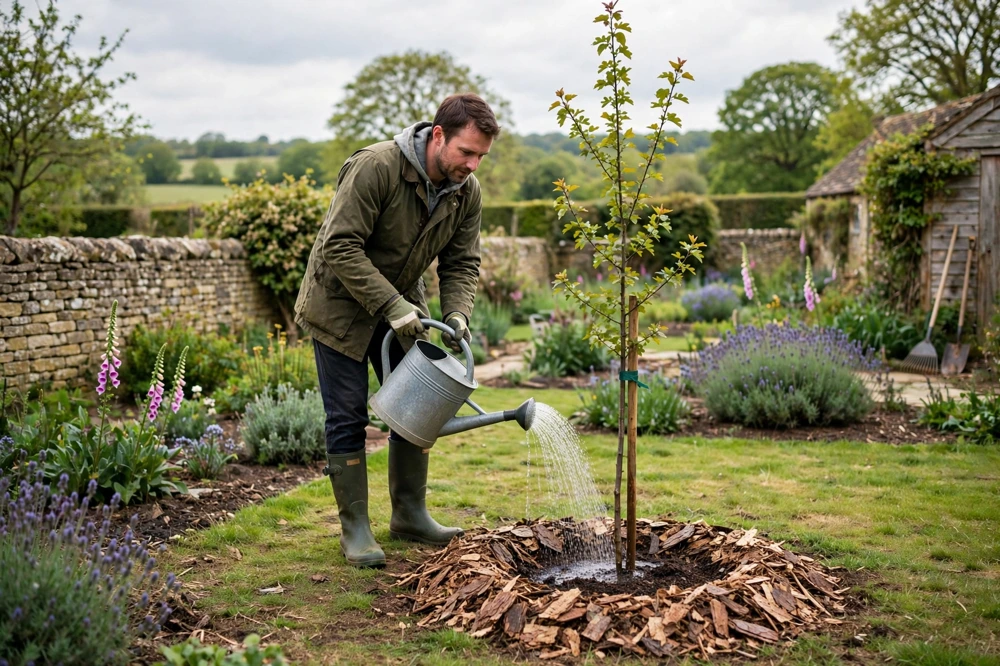
More young trees die from thirst in their first two summers than from almost any other cause, yet watering is the part of aftercare most often done badly. Learning how to water a newly planted tree properly is not complicated, but it is different from watering a lawn or a flower border: a new tree needs deep, infrequent soaking that encourages its roots to grow down into the soil, not a daily sprinkle that keeps them near the surface. This guide explains how much water a young tree needs, how often to give it, and the mistakes that quietly undo an otherwise well-planted tree.
Why Newly Planted Trees Need So Much Water
When a tree is lifted from a nursery, it loses most of its fine root system, the tiny roots that actually absorb water. The rootball you plant may hold only a tenth of the roots the tree had in the ground, yet the canopy goes on losing water through its leaves at the same rate as before. Until new roots grow out into the surrounding soil, which takes roughly one year per inch of stem diameter, the tree lives on a knife edge. That is why the aftercare in our complete tree planting guide treats watering as a two-year commitment rather than a first-week task.
How Much Water Does a Newly Planted Tree Need?
A useful rule of thumb is ten litres of water, roughly two standard watering cans or one large bucket, for every 25mm of stem diameter, applied at each watering. A typical young garden tree with a 30 to 40mm stem therefore needs fifteen to twenty litres in one session, poured slowly into the root zone. The goal is to wet the entire rootball and the soil immediately around it to a depth of at least 30cm. If you are planting in autumn or winter, when our guide to the best time to plant trees in the UK recommends for most species, rainfall does much of the work for you, but a dry spring can still leave a new tree short of water just as it leafs out.
How Often to Water in the First Two Years
In the first growing season, water two to three times a week during dry spells, and weekly even when the weather is merely average. A dry spell means a week or more without significant rain; a single shower rarely delivers enough to reach the roots. In the second year, reduce to a thorough soak once a week in dry weather, and by the third year most trees in the ground can cope alone except in drought. Container-grown trees planted into large pots are the exception: they may need water every day or two in summer for as long as they stay in the pot. Whatever the schedule, check before you water by pushing a finger or a trowel into the soil near the rootball. If it is moist 10cm down, wait; if it is dry, water.
The Best Way to Water a Young Tree
Technique matters as much as quantity. Water slowly, directly onto the rootball and the ring of soil around it, early in the morning or in the evening when less is lost to evaporation. A watering can with a rose, a hose on a gentle trickle, or a purpose-made tree watering bag all work well; a fast jet mostly runs off the surface. Keep the trunk flare dry and avoid splashing soil onto it. A mulch ring of bark or woodchip, 5 to 10cm deep and kept clear of the stem, holds moisture in the soil, suppresses competing weeds and can halve how often you need to water. Mulching and the other foundations of aftercare are covered in our essential tree care tips, and they matter just as much for the pruning decisions described in our guide to when to prune trees in the UK: a water-stressed tree should never be pruned hard.
Watering Through the Seasons
Spring is the danger season that catches people out: leaf burst raises water demand sharply just as rainfall becomes unreliable, so start your watering routine in March or April rather than waiting for summer. In high summer, increase frequency during heatwaves but keep each session deep. Autumn watering is rarely needed in the UK, though a newly planted evergreen going into a dry, windy winter benefits from a good soak, because evergreens keep losing water through their leaves while cold soil slows root uptake. Winter itself needs nothing in the ground, but check container trees in sheltered spots that rain cannot reach.
Common Watering Mistakes
The classic error is little and often: a quick daily splash wets only the top centimetres, encouraging shallow roots that scorch in the first hot week. The opposite error, drowning, is just as real in heavy clay, where a permanently saturated rootball suffocates and rots; yellowing leaves and a sour smell from the soil are the warning signs. Other frequent mistakes include watering the foliage instead of the root zone, relying on lawn irrigation that never reaches the tree, forgetting a tree planted behind a fence or in a rain shadow, and stopping all watering after the first summer because the tree “looks established”. Our guide to tree maintenance throughout the year sets out a simple calendar that keeps watering, mulching and inspection in step with each other.
Signs Your Tree Is Too Dry or Too Wet
A thirsty tree wilts at midday, drops leaves early, produces small or scorched foliage and puts on little growth. An over-watered tree often looks confusingly similar, with yellowing leaves and dieback, which is why checking the soil before watering is the habit that prevents both problems. Some warning signs point to other causes entirely, such as pests, disease or root damage, and our guide to signs your trees need professional attention explains which symptoms should trigger a call to an arborist rather than another can of water.
A Simple Watering Calendar for the First Year
From March to May, check the soil weekly and soak whenever the top 10cm is dry. From June to August, plan on two deep waterings a week in any week without heavy rain, and three during a heatwave. From September, ease back to weekly checks, and from November to February leave the tree to the weather unless it sits in a sheltered rain shadow. Written on a calendar by the back door, this simple rhythm takes the guesswork out of the first year.
Final Thoughts
Watering a newly planted tree well comes down to three habits: soak deeply, check the soil before you top up, and keep going for two full growing seasons. Do that, keep the mulch ring topped up, and the odds shift decisively in your tree’s favour. The ten minutes a week it takes is the cheapest insurance in all of gardening.
