

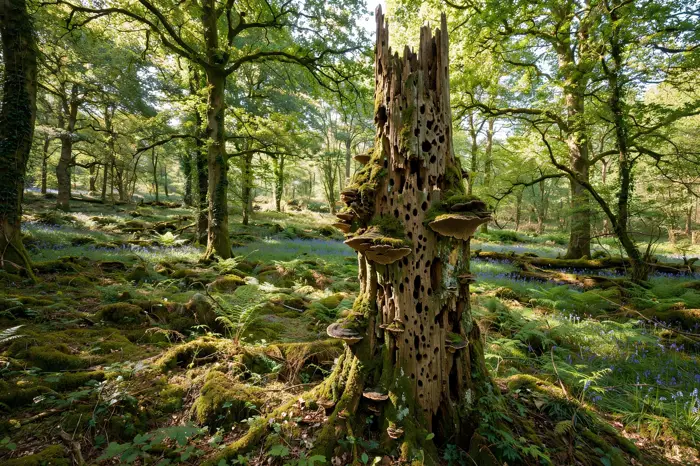
For decades, tidiness was the rule in British woodlands and gardens: fallen branches were burned, dead trunks were felled, and anything rotting was cleared away. Ecologists now know that this tidiness came at a real cost. A deadwood habitat is one of the richest environments in the UK countryside, supporting thousands of species that can live nowhere else, from rare beetles and fungi to the woodpeckers and bats that feed on them. This guide explains why deadwood matters, which wildlife depends on it, and how to keep or create it safely in woods and gardens.
What Counts as Deadwood?
Deadwood is any dead woody material: standing dead trees (sometimes called snags), dead branches still attached to living trees, fallen trunks, rotting logs, stumps and buried roots. Each form hosts different species, and each stage of decay, from hard fresh wood to soft crumbling fibre, suits a different community. A large oak may take fifty years to die and another century to rot away, feeding wildlife at every stage. This slow cycle is one reason the veterans of our ancient woods are so valuable, as our guide to ancient woodland explains: continuity of deadwood over centuries is what allows the rarest species to survive.
The Wildlife That Depends on Deadwood Habitat
Around 2,000 UK invertebrate species, known as saproxylic species, depend on dead or decaying wood for at least part of their lives. They include the stag beetle, whose larvae spend up to seven years feeding in buried dead wood, and hundreds of flies, wasps and beetles found almost nowhere else. Fungi are the engineers of the system, softening wood so other species can use it; a single log may host dozens of fungal species in succession. Woodpeckers excavate nest holes in softened trunks, bats roost behind loose bark and in rot holes, and birds from treecreepers to spotted flycatchers hunt the insects that emerge from decaying timber. Much of this food web quietly underpins the healthier picture described in our article on how healthy trees support wildlife: a woodland’s living and dead trees work as one system.
Deadwood in Woodlands, Parks and Gardens
In managed woodland, the modern approach is to retain a proportion of standing and fallen deadwood wherever it is safe, rather than clearing it by default. Forestry guidance now treats deadwood as a deliberate feature, and many nature reserves create it by ring-barking selected trees. Parks and gardens can follow the same principle at a smaller scale. A log pile in a shady corner, a retained stump, or a section of trunk left standing where it cannot fall on a path all provide genuine habitat. The approach fits naturally alongside planting choices that favour wildlife, such as those in our guide to how native tree species support local ecosystems, because native deadwood hosts far more species than imported timber ever will.
Is Deadwood Safe to Keep?
The reasonable question is risk. A standing dead tree near a house, road or busy path needs professional assessment, because dead wood can fail unpredictably; reducing it to a safe standing monolith, a trunk of three to five metres with no heavy limbs, keeps most of the habitat value while removing most of the risk. Away from targets, dead trees can usually be left alone entirely. One caution: dead wood from a tree killed by certain diseases should be handled on advice, since the pathogens may persist in it. Our article on honey fungus explains how to recognise one of the commonest examples and what to do with infected material. Normal inspection routines, of the kind set out in our guide to why tree conservation is essential, will flag dead trees that are becoming a genuine hazard long before they fail.
How to Add Deadwood to Your Garden
Start with what you have. If a tree or large shrub is pruned or removed, keep some of the wood on site: stack logs in partial shade, partly bury a few upright to mimic standing deadwood, and leave a stump rather than grinding it out if the position allows. Partial burial keeps wood damp and suits stag beetles and many fungi. Avoid treated timber, and do not import logs from diseased trees. Position matters: deadwood in dappled shade stays moist and rots steadily, while wood in full sun dries out and suits a smaller, specialist set of species, so a mix of both is ideal. Within a year or two you will notice fungi in autumn, beetles in summer, and birds working the logs in winter, when deadwood insects are a lifeline for the species in our guide to how UK wildlife survives winter.
When Deadwood Should Be Removed
Deadwood is not untouchable. Remove or reduce it when a dead tree stands over a building, road or well-used path and an assessment finds unacceptable risk; when the wood is infected with a disease that threatens neighbouring trees; or when a fallen trunk blocks drainage, access or a watercourse. Even then, ask whether the wood can be moved a short distance rather than removed from the site altogether: habitat value survives relocation far better than it survives the chipper. A qualified arborist can advise on the balance, and in protected woods or where trees carry preservation orders, consent may be needed before any work at all.
How Much Deadwood Is Enough?
There is no single magic figure, but the principle is simple: some is far better than none, and variety matters more than volume. A woodland that keeps a scattering of standing dead trunks, a few large fallen logs in different stages of decay and plenty of smaller branch wood will support a far wider range of species than one with a single tidy log pile. In a garden, even one substantial log, left in the same shady spot for years rather than moved each spring, becomes a functioning habitat. What wildlife needs most is continuity: deadwood that is allowed to stay put, decay slowly and be replaced as it disappears. Aim to keep it as a permanent feature of the site, not a temporary one awaiting a bonfire.
Final Thoughts
Deadwood is not mess; it is infrastructure for wildlife. Keeping a standing dead trunk where it is safe, stacking logs instead of burning them, and thinking twice before tidying a woodland corner are among the cheapest and most effective conservation actions any landowner can take. The species that depend on a deadwood habitat cannot use anything else, which makes every retained log a small but genuine lifeline.
So next time a tree dies in your wood or garden, pause before reaching for the saw. What looks like an ending is, for a great deal of British wildlife, very nearly the whole point.
