

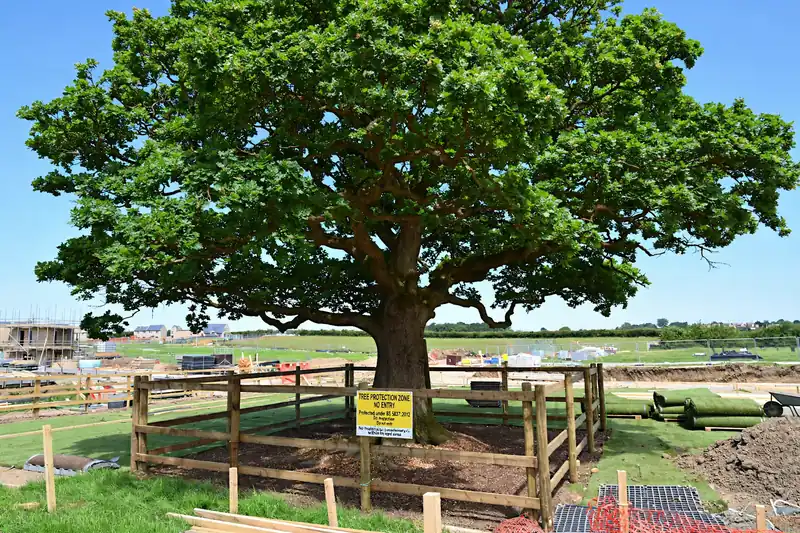
If you are planning building work near a tree — an extension, a driveway, a garden room — you will quickly meet a term that decides what you can and cannot do: the tree root protection area, usually shortened to RPA. Understanding what a tree root protection area is, how it is calculated and how to work around it will save you delays, protect the trees you want to keep, and keep your project on the right side of planning conditions.
This guide explains RPAs in plain language for homeowners, and shows how they fit into the wider system of tree protection in the UK.
What Is a Tree Root Protection Area?
A tree root protection area is the minimum area of soil around a tree that should be left undisturbed if the tree is to stand a good chance of surviving nearby construction. It is defined in British Standard BS5837, the document that governs trees in relation to design, demolition and construction, and it is the area an arboriculturist will mark on your plans before any work begins.
The RPA is not where all the roots are — roots spread much further than most people expect — but it represents the critical zone containing enough of the root system to keep the tree healthy and stable. Digging, compaction, level changes and storage of materials inside this zone are the most common causes of construction-related tree deaths, which often appear two or three years after the builders have left.
How Is an RPA Calculated?
For a single-stemmed tree, the RPA is a circle with a radius of twelve times the trunk diameter, measured at 1.5 metres above ground. A tree with a 40cm trunk therefore has an RPA radius of 4.8 metres — an area of just over 72 square metres. The calculation is capped: for very large trees the radius stops growing at 15 metres.
Multi-stemmed trees use a combined stem diameter, and the shape of the RPA can be adjusted where roots clearly cannot have grown symmetrically — for example where a building or a river already occupies one side. These adjustments should always be justified by an arboriculturist, because planning officers will ask. A BS5837 tree survey is the usual way to record the RPA for every tree on a development site.
What Activities Are Restricted Inside an RPA?
Within a tree root protection area, the default position is: no digging, no level changes, no compaction, no storage, no fires and no concrete mixing. In practice that rules out conventional strip foundations, most service trenches, and parking site vehicles or materials under the canopy. Even repeated foot traffic compacts soil over a season, so the zone is normally fenced before anything else happens on site.
Protective fencing — typically scaffold-framework panels fixed in place — is the standard barrier, and it should go up before demolition or deliveries begin and stay up until the last trade has left. Our guide to protecting mature trees during construction work covers the practical sequence in detail.
Can You Ever Build Inside an RPA?
Sometimes, yes — with engineering that avoids harming roots. Pile-and-beam or cantilevered foundations can bridge over the root zone; surfaces can be built up with no-dig cellular confinement systems that spread load without excavation; and services can be threaded through by hand-digging or air-spade excavation under supervision. Each of these costs more than standard methods, and each needs to be agreed in an Arboricultural Method Statement before work starts.
What you cannot do is quietly shrink the RPA because it is inconvenient. If a retained tree later dies because its RPA was treated as a storage yard, the planning authority can require replacement planting, and where the tree was legally protected the consequences are more serious. Trees covered by preservation orders carry their own rules, explained in our guide to UK tree preservation orders, and the wider framework is set out in our overview of protected trees law.
RPAs in Your Own Garden
Even without a planning application, the RPA idea is a useful rule of thumb for garden projects. Before digging a pond, laying a patio or planting a hedge near a valued tree, picture the circle at twelve times the trunk diameter and keep major excavation outside it. Garden structures on pads or screw piles rather than dug foundations are far kinder to roots, and new planting within the zone should be small, hand-planted and kept watered so it does not compete aggressively.
Routine care matters too. Mulching inside the RPA — a 5–10cm layer of woodchip, kept away from the trunk — protects roots from drought and mower damage, and our professional tree care guide explains how regular inspection keeps mature trees vigorous. If you are planning work near a boundary tree, remember the RPA may extend into a neighbour’s garden, and their tree’s roots enjoy legal protection whether or not the tree itself is covered by an order.
What Happens When Roots Are Damaged Anyway?
Root damage rarely kills a tree on the day it happens. Severed roots reduce the tree’s ability to take up water, torn bark invites decay fungi, and compacted soil slowly suffocates the fine roots that remain — which is why construction-damaged trees often decline over two to five years rather than failing immediately. Stressed trees are also more vulnerable to opportunistic problems such as honey fungus, which spreads through weakened root systems. If work has already happened near a tree you care about, an arboriculturist can still help: remedial mulching, irrigation during dry spells and a monitored inspection cycle give many damaged trees a far better chance than simply hoping for the best.
Getting Advice Before You Start
The cheapest time to think about a tree root protection area is before the architect finalises the drawings. A short arboricultural consultation at design stage can shift a footprint by a metre and save thousands in specialist foundations — or confirm that a poor-quality tree can be removed and replaced, freeing the whole plot. For larger or protected trees, expect the council’s tree officer to be involved, and allow their timescales in your programme.
Handled properly, an RPA is not an obstacle but a design brief: it keeps the trees that make a property feel established, protects their health and stability for decades, and gives your project a clear, defensible method. Measure the trunk, draw the circle, fence it early — and build around it with confidence. If you would like the wider picture on keeping established trees safe during projects, our guide to why tree preservation matters for urban development is a good next read.
