

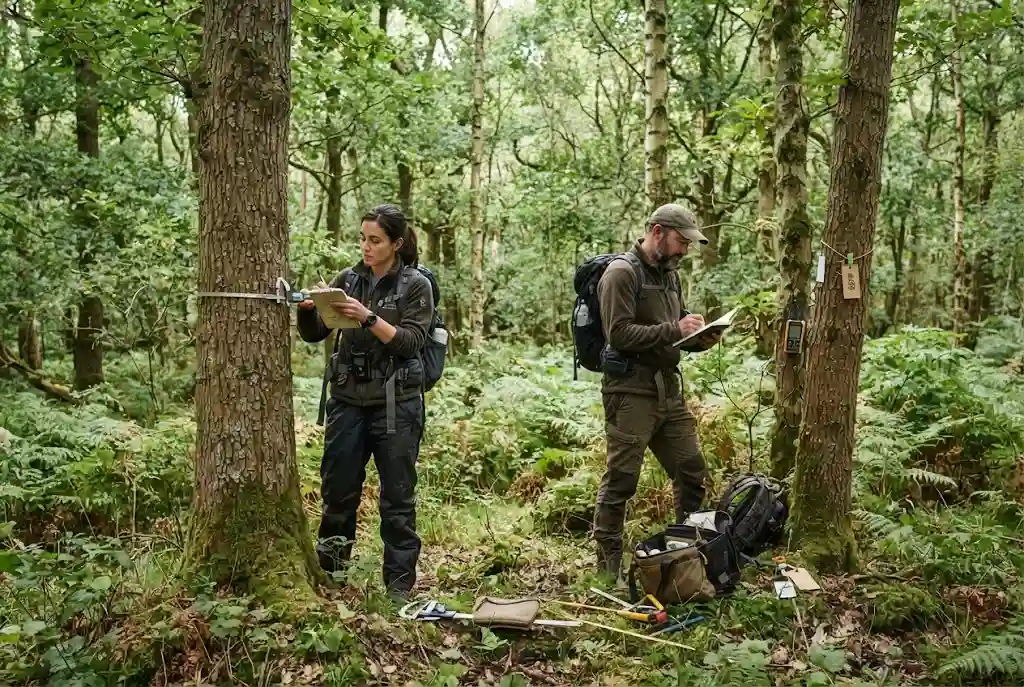
Research in forestry plays an increasingly important role in understanding how forests can remain healthy, productive and resilient in a changing environment. From tree diseases and climate change to biodiversity, timber production and woodland management, scientific research helps forestry professionals make better long-term decisions.
Modern forestry depends on evidence from many disciplines. Forestry science can involve ecology, biology, soil science, climate research, genetics, technology and economics. Together, these fields help explain how forests develop and how management practices can improve their ability to provide environmental, economic and social benefits.
What Is Research in Forestry?
Research in forestry covers the systematic study of forests, trees and the wider systems in which woodlands exist. It can focus on individual tree species, entire forest ecosystems or the relationship between forests and society.
Research can be practical as well as academic. Scientists may investigate how trees respond to drought, while forest managers may use those findings to decide which species are appropriate for future woodland planting. Researchers can also study pests, diseases, biodiversity, timber production, carbon storage and the effects of different management approaches.
The results can influence forestry policy, woodland management plans, conservation strategies and the development of new forestry technologies.
Why Forestry Research Matters
Forests are long-lived ecosystems, which means decisions made today can affect woodland conditions for decades. Research helps forestry professionals understand risks and opportunities before making those decisions.
One of the biggest challenges is uncertainty. Future climate conditions, pests, diseases and environmental pressures cannot always be predicted precisely. Scientific evidence can help managers identify likely risks and develop strategies that improve resilience.
This evidence-based approach supports the principles of the UK Forestry Standard, which provides the framework for sustainable forest management across the UK.
Key Areas of Forestry Research
Forestry research covers a broad range of subjects. Some projects focus on fundamental biological processes, while others are designed to solve practical problems faced by woodland owners and managers.
Tree Health and Diseases
Tree health is a major area of forestry science. Pests and diseases can damage individual trees, reduce woodland productivity and, in serious cases, alter entire forest ecosystems.
Researchers investigate how pathogens spread, which trees are most vulnerable and how management practices can reduce risks. Monitoring and early detection can also help identify emerging threats before they become more difficult to control.
Understanding tree health is particularly important when selecting species for new woodland. Forest managers need to consider not only current site conditions but also potential future pressures.
Climate Change and Forest Resilience
Climate change has become one of the most important subjects in modern woodland research. Rising temperatures, changing rainfall patterns, drought, storms and other extreme weather events can affect tree growth and forest health.
Researchers are studying how different tree species respond to changing conditions and how forest management can improve resilience. This can include investigating species diversity, genetic variation, woodland structure and management systems.
The objective is not necessarily to predict every future condition. Instead, research can help identify management approaches that give forests a better chance of continuing to thrive as environmental conditions change.
Biodiversity and Woodland Ecosystems
Woodlands support complex communities of plants, animals, fungi and microorganisms. Research can help explain how different management approaches affect these communities.
Studies may examine habitats associated with deadwood, woodland edges, canopy structures, ground vegetation or particular tree species. This information can help managers protect important habitats while planning other forestry activities.
Timber Production
Forestry research also supports the production of renewable timber. Scientists and foresters study tree growth, silvicultural systems, species performance and forest productivity.
Improving timber production does not necessarily mean maximising output at the expense of other objectives. Sustainable forestry aims to integrate productive woodland with environmental protection and long-term resilience.
Forestry Science and Climate-Resilient Woodlands
Forestry science can help answer one of the industry’s most important questions: how should forests be managed when future environmental conditions are uncertain?
Research into species suitability is particularly relevant. A tree that performs well under current conditions may face greater stress if temperatures increase or rainfall patterns change. Scientists therefore study species characteristics, site conditions and potential adaptation strategies.
Diversity can also play a role in resilience. Mixed woodlands may respond differently to environmental pressures than forests dominated by a single species, although the most appropriate structure depends on site conditions and management objectives.
These considerations are increasingly important when planning new woodland. Forestry professionals need to think about what a forest could look like many decades after planting rather than focusing only on its initial establishment.
Woodland Research and Tree Improvement
Woodland research can include work on tree genetics and improvement. Researchers may investigate genetic characteristics that influence growth, disease resistance, drought tolerance or adaptation to particular environments.
Tree improvement is a long-term process because forestry operates on much longer timescales than many agricultural or commercial systems. Research therefore needs to consider how planting material will perform over many years.
Genetic research can contribute to more informed decisions about future forests, but it needs to be considered alongside biodiversity, ecological suitability and the broader objectives of woodland management.
Forestry Innovation and Technology
Forestry innovation is changing how forests are monitored, managed and understood. Digital technology can help professionals collect information across large areas and identify changes that might otherwise be difficult to detect.
Remote Sensing and Mapping
Remote sensing technologies can provide information about forest structure, vegetation and landscape conditions. Combined with geographic information systems, these tools can help forest managers analyse woodland at different scales.
Digital mapping can also support planning for forest roads, harvesting operations, habitat management and woodland creation.
Forest Monitoring
Technology can improve monitoring by allowing information to be collected more efficiently. Sensors, imagery and other data sources can help researchers identify patterns in tree growth, environmental conditions and forest health.
However, technology does not replace professional judgement. Data still needs to be interpreted within the context of local conditions and practical forestry knowledge.
Research in Forestry and Sustainable Management
Research supports sustainable forestry by providing evidence that can improve management decisions. Forest managers may use research findings when considering species selection, silviculture, harvesting, biodiversity and climate resilience.
This relationship between research and practice is important because forests are constantly changing. Management techniques that were suitable under one set of conditions may need to be adapted as new evidence becomes available.
For anyone interested in how research translates into large-scale woodland management, our guide to Forestry England forests, services and projects provides useful context about the management of England’s public forest estate.
The Role of Forest Research
Forest Research is the principal organisation responsible for forestry and tree-related research in Great Britain. It is an agency of the Forestry Commission and provides scientific and technical knowledge to support forestry policy and practice.
Its work covers areas including tree health, climate change, biodiversity, woodland creation, forest management and the benefits provided by trees and woodlands.
The organisation’s research contributes to the evidence base used by policymakers, forestry professionals and land managers. This illustrates how scientific research can move from laboratories and field studies into practical forestry decisions.
Forestry Research and the Future of Woodland Creation
New woodland creation is likely to remain an important part of the UK’s environmental and forestry agenda. Research can help determine where trees are most suitable, which species may perform well and how new forests should be designed.
Good woodland creation involves more than planting as many trees as possible. Site selection, biodiversity, soil, water, landscape, climate resilience and long-term management all need to be considered.
Research can help identify the relationships between these factors. For example, studies of soils and hydrology can inform planting decisions, while ecological research can help determine how new woodland affects existing habitats.
Research in Forestry and Timber Production
The UK’s forestry sector also depends on research into timber quality, productivity and efficient forest management. Understanding how trees grow under different conditions can help improve long-term production planning.
Researchers can study growth rates, species performance, harvesting systems and the effects of different silvicultural approaches. The results can help businesses and forest managers make more informed decisions about future timber supply.
Responsible timber production is part of sustainable forestry when woodland is managed and regenerated appropriately. Research therefore has a role in ensuring that productive forests remain resilient while supporting wider environmental objectives.
Forestry Research Jobs and Skills
Forest research jobs can suit people interested in combining scientific investigation with environmental and land-management challenges. Roles can exist across research organisations, universities, government agencies, consultancy businesses and specialist forestry companies.
Research careers can involve laboratory work, field studies, data analysis, ecological surveys, modelling or scientific communication. The required qualifications vary according to the role.
A strong background in subjects such as biology, ecology, environmental science, forestry, geography or data analysis can be relevant to different areas of forestry research.
Practical Forestry Experience
Academic knowledge is valuable, but practical forestry experience can also help researchers understand how their findings may be applied in real woodland settings.
People entering the wider forestry profession can explore structured routes such as Forestry Commission apprenticeships. Practical training can provide useful insight into the operational challenges that research is often intended to address.
How Research Supports Forestry Professionals
Forestry professionals need reliable information when making long-term decisions. Research can provide evidence about species suitability, tree health, climate risks, biodiversity and management techniques.
Professional development therefore involves keeping up with new findings as well as understanding established forestry principles. This is particularly important in areas where knowledge is developing rapidly, such as climate adaptation and emerging tree health threats.
Professional forestry organisations and membership bodies can also help practitioners stay connected with developments in the industry. Our future guide to forestry membership and professional organisations will examine this part of the sector in greater detail.
Challenges Facing Forestry Research
Forestry research can be challenging because forests change slowly and environmental conditions vary considerably between locations. Some experiments may need to be monitored for many years before meaningful conclusions can be drawn.
Researchers also need to account for interactions between different factors. Climate, soil, species, pests, diseases, wildlife and management practices can all influence forest outcomes.
This makes collaboration particularly valuable. Forestry science can benefit from cooperation between universities, government research organisations, forest managers, environmental specialists and industry practitioners.
Why Forestry Innovation Will Continue to Matter
The forestry sector is entering a period in which traditional knowledge and new technology need to work together. Established silvicultural principles remain important, but new tools can improve the speed and scale at which forests are monitored and analysed.
Artificial intelligence, remote sensing, digital mapping and improved environmental monitoring may create new opportunities for forestry professionals. At the same time, technology needs to be tested carefully so that decisions remain grounded in reliable evidence.
Innovation is most valuable when it solves genuine forestry problems. Whether that means detecting tree disease earlier, improving woodland planning or understanding climate risks, successful innovation should ultimately support better forest outcomes.
Conclusion
Research in forestry provides the scientific foundation needed to understand and manage forests in a changing world. It contributes to knowledge about tree health, climate resilience, biodiversity, timber production, woodland creation and the use of new technologies.
The relationship between forestry research and practical management is especially important because forests operate on long timescales. Decisions made today can influence woodland health, productivity and environmental value for decades.
As the UK forestry sector responds to climate change, pests, biodiversity priorities and technological developments, continued investment in forestry science and innovation will remain essential. Strong research, combined with practical expertise and sustainable management, can help ensure that the UK’s woodlands remain resilient and valuable for future generations.
