

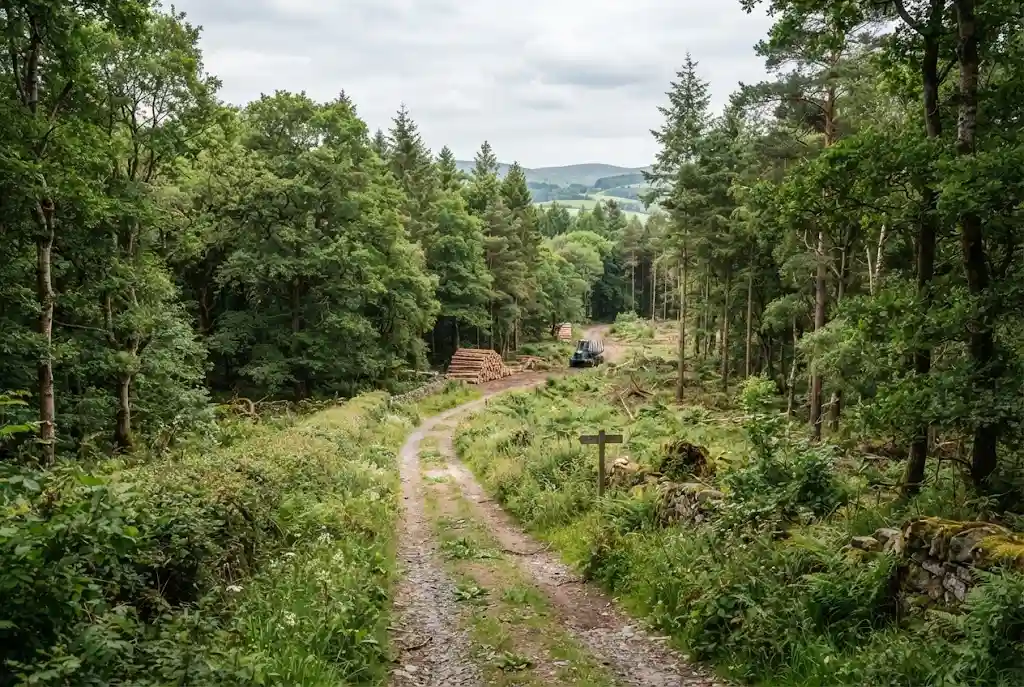
The UK Forestry Standard is the technical standard that provides the foundation for sustainable forest management across the United Kingdom. It applies to all woodland, regardless of ownership or who manages it, and provides requirements and guidance covering environmental, economic and social aspects of forestry.
For landowners, forest managers, practitioners and others working in the sector, understanding the UK Forestry Standard is essential. It helps guide decisions about woodland creation, management, timber production, biodiversity, climate resilience, soil, water, landscape and public interests.
What Is the UK Forestry Standard?
The UK Forestry Standard, commonly abbreviated to UKFS, sets out the approach of the four UK governments to sustainable forest management. It provides a common framework for forestry across England, Scotland, Wales and Northern Ireland while allowing for country-specific guidance where appropriate.
The current fifth edition was published in October 2023 and came fully into effect in England on 1 October 2024. In England, forestry grant and regulatory applications received from that date are assessed against the fifth edition, subject to transitional arrangements for applications and approvals already in progress.
The standard is not simply a checklist for planting trees. Instead, it establishes a framework for balancing the different functions that forests can provide over the long term. This includes timber and other forest products, biodiversity, recreation, landscape, communities, soil and water protection and climate resilience.
Why the UK Forestry Standard Matters
The UK has a diverse forestry landscape, ranging from commercial plantations and productive forests to ancient woodland, conservation sites and mixed-use landscapes. A single approach would not be suitable for every site.
The UK Forestry Standard provides a consistent foundation while recognising that the right balance of objectives depends on local circumstances. Forest owners and managers need to consider the characteristics of their woodland, its surrounding environment and the outcomes they want to achieve.
This approach is particularly important as forests face changing pressures. Climate change, pests, diseases, biodiversity loss and extreme weather can all affect woodland health. The fifth edition strengthens the emphasis on resilience and the need for forests to continue delivering multiple benefits in a changing environment.
Key Principles of Sustainable Forestry
Sustainable forestry is based on managing forests in a way that maintains their ability to provide benefits in the present and future. The UK Forestry Standard brings several important considerations together rather than treating them as separate issues.
Biodiversity
Woodlands can provide valuable habitats for plants, insects, birds and other wildlife. Forestry management therefore needs to consider existing habitats, species diversity and opportunities to improve ecological conditions.
Creating a mixture of suitable tree species and maintaining appropriate habitat features can contribute to woodland resilience and biodiversity. Management decisions should also consider protected species and important ecological features associated with the site.
Climate Change
Climate change is increasingly central to forestry planning. Trees and woodlands can capture and store carbon, but forests themselves are affected by changing temperatures, rainfall patterns, storms, drought and other environmental pressures.
The fifth edition of the UK Forestry Standard places greater emphasis on building resilience to climate change, pests and diseases. This means that forest managers need to consider whether current woodland structures and species choices are likely to remain suitable in future conditions.
Soil and Water
Healthy soil is fundamental to productive and resilient woodland. Forestry operations therefore need to consider soil condition, erosion risks and the potential effects of machinery and access infrastructure.
Water protection is also an important part of forestry management. Planning roads, tracks, drainage and harvesting operations carefully can help reduce impacts on watercourses and surrounding environments.
Landscape and Historic Environment
Forests form part of wider landscapes and can contain or sit alongside historic features. Sustainable forestry planning therefore considers visual impact, landscape character and heritage interests alongside production and environmental objectives.
This broader perspective is one reason why forest management plans need to look beyond individual trees. Woodland decisions can influence the character, ecology and use of an entire landscape.
UK Forestry Standard and Forestry Production
Forestry production remains an important part of the UK’s woodland economy. Timber is a renewable material, and responsibly managed forests can provide a continuing supply of home-grown wood while supporting employment and rural economies.
The UK Forestry Standard does not mean that productive forestry and environmental objectives must be separated. Instead, sustainable management aims to balance timber production with biodiversity, landscape, soil, water, climate and social considerations.
The government’s sustainable forestry cycle describes a process in which diverse tree species are planted, woodland is managed for future resilience, timber is harvested responsibly and new growth is established. Responsible harvesting can therefore form part of a longer management cycle rather than representing the end of a forest’s productive life.
For readers interested in the organisation responsible for England’s public forests, our article on Forestry England forests, services and projects provides useful background on how sustainable woodland management works at a large scale.
How Sustainable Forestry Management Works
Sustainable forestry management starts with clear objectives. A woodland owner or manager needs to understand what the site is intended to provide and then develop a management approach that can deliver those objectives without compromising the woodland’s long-term health.
A woodland management plan can help organise this process. Government guidance describes such plans as a structured way to plan and communicate woodland objectives and proposed work while demonstrating how the woodland will be managed and monitored sustainably.
Planning may cover tree species, silvicultural systems, harvesting, regeneration, access, biodiversity, landscape, recreation and environmental protection. The specific approach will depend on the woodland’s characteristics and its management objectives.
Why Long-Term Planning Matters
Forestry operates on timescales that are much longer than most business or land-management projects. Trees can take many years or decades to mature, meaning decisions made during planting and early management can influence future woodland conditions for generations.
Long-term planning also gives managers an opportunity to respond to changing conditions. Monitoring tree health, reviewing risks and adapting management practices can help forests remain productive and resilient.
Eco Forestry and the UK Forestry Standard
The phrase eco forestry is often used when discussing approaches that place strong emphasis on ecological processes and forest health. While the terminology can vary, the underlying idea of managing woodland responsibly aligns with several principles within the UK Forestry Standard.
The standard recognises that sustainable forest management has environmental, economic and social dimensions. A forest can provide timber while also supporting wildlife, recreation, landscape quality and local economic activity.
This balanced approach is particularly important when considering woodland creation. New planting needs to take account of factors such as biodiversity, soil, water, landscape, climate and the suitability of tree species for the site.
Changes in the Fifth Edition of the UK Forestry Standard
The fifth edition reflects changes in legislation, scientific knowledge and forestry practice since the previous edition. It also responds to growing concerns about climate change, pests and diseases affecting UK woodlands.
Among the areas strengthened in the latest edition are guidance relating to species diversity, climate resilience, deer impacts, pests, flood risks and waste management. The standard also includes updated good practice requirements intended to improve the quality and resilience of woodland management.
The changes matter because forestry conditions are not static. Species that may have been suitable in one set of environmental conditions can face different levels of stress as climate patterns change. Likewise, new or expanding pests and diseases can create risks that need to be incorporated into forest planning.
UK Forestry Standard and Responsible Timber Harvesting
Timber harvesting can be an important tool in sustainable forestry when it is properly planned and carried out. Harvesting decisions need to take account of woodland objectives, site conditions, environmental impacts and regeneration.
Different silvicultural approaches can be used depending on the forest and its objectives. Continuous cover forestry, for example, can maintain a permanent canopy while allowing selected trees to be harvested. Other forests may use different rotation and regeneration systems.
The UK Forestry Standard provides guidance for responsible forestry operations, including considerations around access, timber stacking, extraction routes and environmental protection. Careful operational planning can improve safety and efficiency while reducing unnecessary impacts on the forest environment.
UK Forestry Standard and the Forestry Sector UK
The wider forestry sector UK includes landowners, forest managers, contractors, timber businesses, researchers, professional advisers, regulators and organisations involved in conservation and woodland recreation.
The UK Forestry Standard gives these different parts of the sector a shared framework for sustainable forest management. However, implementation and regulatory arrangements vary between the four nations, with the relevant forestry bodies responsible for applying and monitoring the standard in their respective countries.
This makes the UKFS particularly useful for understanding the relationship between forestry policy and practical management. It provides a common foundation while recognising differences in national regulation and local circumstances.
UK Forestry Standard and Forestry Research
Good forestry management depends on reliable evidence. Research can improve understanding of tree health, species suitability, climate impacts, biodiversity and woodland management techniques.
The UK Forestry Standard is supported by technical and practice guidance from Forest Research. This connection between research and practical forestry helps ensure that management recommendations can evolve as scientific knowledge and environmental conditions change.
Readers interested in the evidence behind modern woodland management can explore our wider coverage of research in forestry, including forestry science, woodland research and innovation.
Why the UK Forestry Standard Is Important for the Future
The UK’s forests face a combination of opportunities and pressures. Demand for renewable timber, the need for new woodland, climate change, biodiversity priorities and public interest in access to nature all influence how forests are managed.
The UK Forestry Standard provides a framework for balancing these demands. It encourages forest managers to look at woodland as a long-term system rather than focusing on a single output.
That perspective is especially valuable as the forestry industry develops. Future management decisions will need to consider resilience, species diversity, responsible timber production, environmental protection and the needs of communities.
Professional expertise will remain central to this process. Training and qualifications can help develop the practical and technical skills needed across the sector, while forestry apprenticeships and training pathways can provide routes into forestry careers.
What the UK Forestry Standard Means for Woodland Owners
For woodland owners, the UK Forestry Standard provides an important reference point when planning management activities. It can help owners understand the principles that should underpin responsible woodland creation and management.
Owners considering woodland creation, felling, replanting or other significant operations should use current official guidance and seek appropriate professional advice where necessary. Forestry proposals may also require specific permissions, assessments or grant-related documentation depending on the circumstances.
Using the standard as part of early planning can help identify environmental, operational and regulatory considerations before work begins. This can make woodland management more structured and support better long-term outcomes.
Conclusion
The UK Forestry Standard provides the foundation for sustainable forest management across the United Kingdom. Its purpose is to help balance environmental, economic and social objectives while maintaining healthy and resilient woodlands for the future.
For the modern forestry industry, this means looking beyond timber production alone. Biodiversity, climate resilience, soil, water, landscape, public access and communities all have a place within responsible forestry management.
As the UK forestry sector responds to climate change, pests, changing markets and growing demand for sustainable resources, the principles within the UK Forestry Standard will remain central to professional woodland management. Understanding those principles is therefore valuable for woodland owners, forestry professionals, businesses and anyone following developments across the UK’s forestry industry.
